

ダウンロード
場所
DIJ Tokyo (access)
Co-organizer
supported by German Chamber of Commerce and Industry in Japan

登録情報
 Follow us on Bluesky.
DIJ Mailing Lists
Please subscribe below to stay informed about our research activities, events & publications:
Big in Japan? Recruitment and training strategies of German companies in Japan
2026年3月2日 / 18.00 – 20.00 (JST)
DIJ Roundtable with Matthias Pilz, University of Cologne, Germany
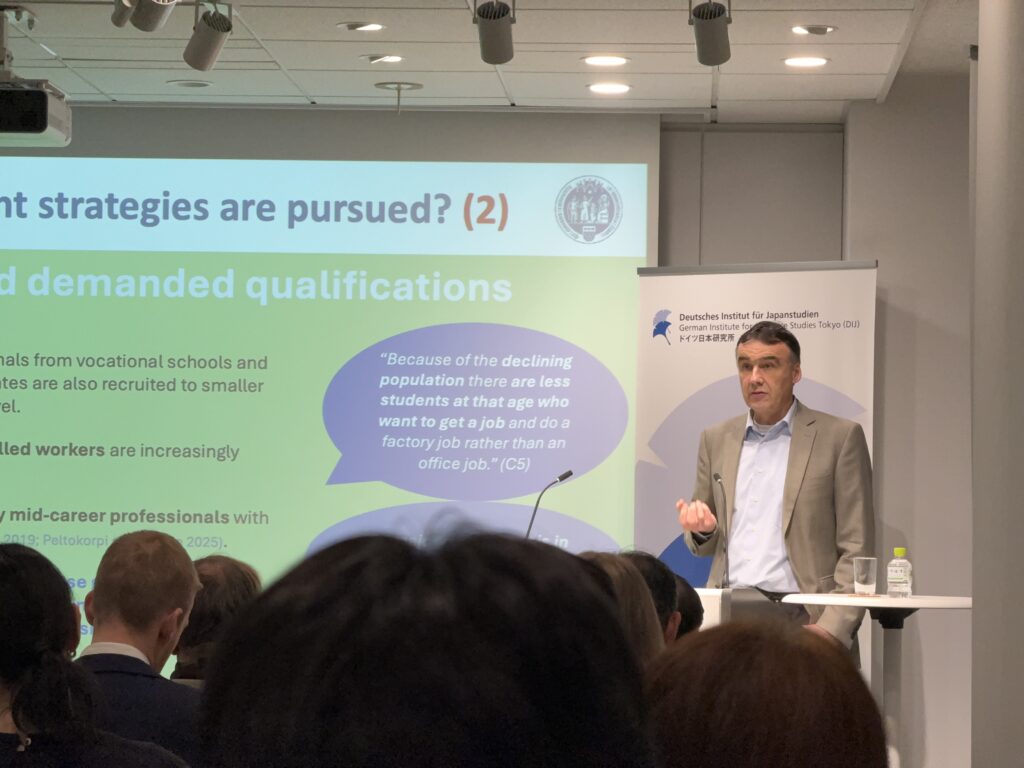
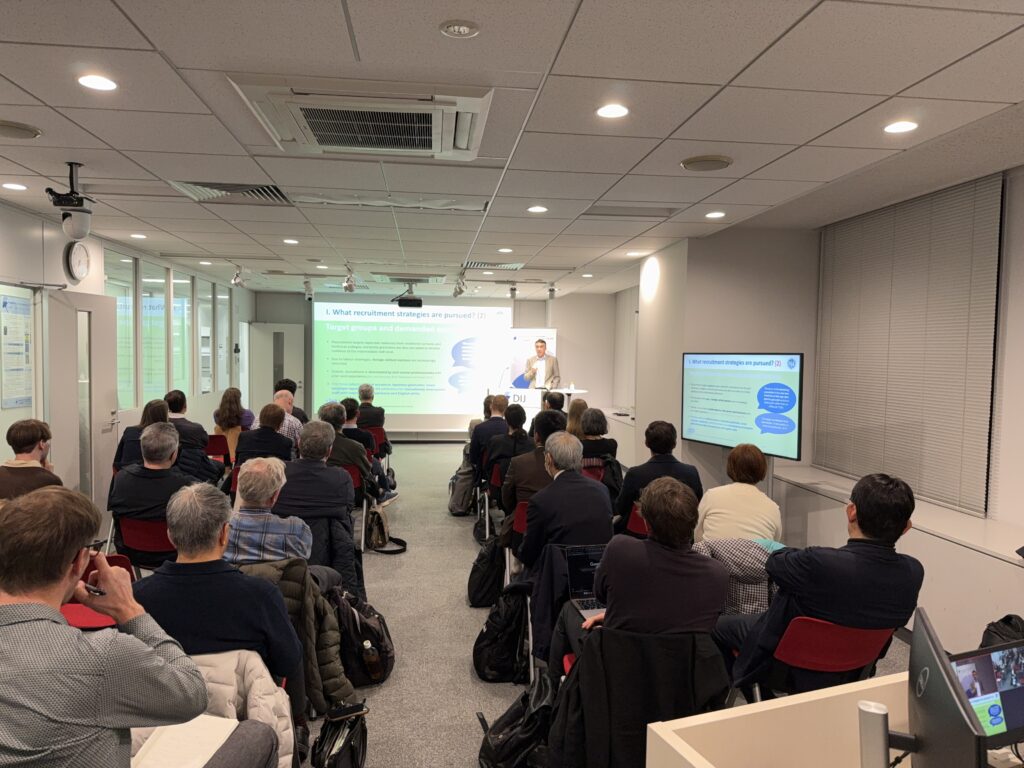
A video of the event is available on the DIJ’s Youtube channel here

Japan is a highly attractive, but difficult market for multinational companies. Their presence is by far the lowest among the OECD when measured by the stock of foreign direct investment relative to GDP. One of the biggest hurdles is the recruitment of qualified personnel. What strategies do foreign companies in Japan pursue to address the human resource challenge? To what extent do their strategies incorporate practices applied in their home market?
We addressed these questions in our interviews with 25 experts from the field of human resource management in ten German companies, along with four external experts. Germany is an interesting case because of its dual apprenticeship system at home and the widely debated idea to transfer it to other countries. The key findings of our study show that German companies in Japan are increasingly hiring older applicants with professional experience. While onboarding is common for all new employees, the dominant form of training for the small number of career starters is on-the-job training. Few if any elements of training modes from Germany are adopted.
Our findings are not only of practical relevance. They are also interesting from a theoretical perspective. The strategy pursued by German companies cannot be classified under the standard categories distinguished in the international resource management literature. German companies do neither emulate strategies of larger Japanese companies, nor do they implement their home country’s or a global or regional strategy. Instead, they pursue what may be called “independent localisation”.
Programme
18:00 Welcome
Franz Waldenberger
18:10 Recruitment and training strategies of German companies in Japan
Matthias Pilz
18:40 Panel discussion
Panelists: Shigeki Egami, Carolina Kawakubo, Matthias Pilz
Moderator: Franz Waldenberger
19:10 Q&A
19:30 Networking reception
20:00 End
Shigeki Egami is an experienced HR leader serving as Group CHRO at NOK Corporation. After graduating from the University of Tokyo’s Faculty of Economics, he started his career at Mitsubishi Motors. Later, he moved to Mitsubishi Fuso Truck and Bus Corporation, which became a subsidiary of Daimler AG from Germany. During this major change, Egami helped guide the company through a dramatic transformation, balancing global standards with local traditions and driving HR and organizational reforms. He continued his leadership in HR at SATO Holdings Corporation as Executive Officer CHRO and Plant Director, building global HR foundation and management competency models. At Bridgestone Corporation, Egami led HR transformation and introduced new ways to match talent with business needs. Since joining NOK in 2024, he has used his wide experience to help both employees and the company succeed together, shaping the future of NOK Group with his strategic insight.
Dr. Carolina Kawakubo is the President & Representative Director of NRW.GLOBAL BUSINESS JAPAN K.K., bringing extensive executive experience to the Japanese market. With a PhD in Business Management, she specializes in bridging cultural gaps and driving organizational transformation. Previously, serving as Vice President of the German Chamber of Commerce in Japan (AHK), she chaired the Diversity Round Table, advising companies on inclusive HR policies and female leadership structures. Her background includes key management roles at Henkel and Medskin Solutions, where she led strategic positioning and restructuring projects. Fluent in Japanese, German, and English, she combines corporate governance with practical local management expertise.
Prof. Dr. Matthias Pilz is Full Professor of Business Education and International Vocational Education and Training Research at the University of Cologne and Director of the German Research Center for Comparative Vocational Education and Training (G.R.E.A.T.). Prior to becoming an academic, he worked as a teacher at a Business College in Hannover and was an advisor for European Union education projects at the district government of Hannover. He is Editor in Chief of the International Journal of Training and Development. His research interests are in international comparative research in VET, transitions from education to employment, and teaching and learning. After spending several weeks as a guest with a Japanese family in 1990 and completing an internship at Panasonic Germany during his studies, Japan has been the focus of his research activities for many years.