イベント&アクティビティ
Symposium ‘Global Views of Japanese Parliamentarism’
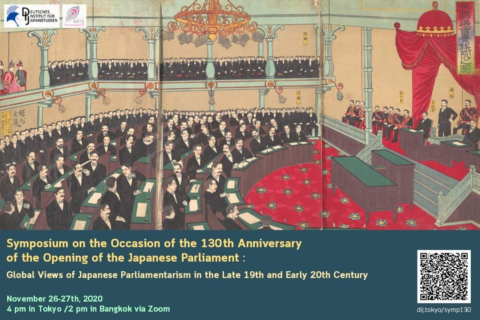 Online Symposium (26-27 November 2020)
On November 29, 1890, the parliament of the Empire of Japan, the Imperial Diet, met for the first time marking the beginning of parliamentary government not only in Japan but also in Asia. While the recognition of Japan as a role model for successful ‘modernization’ of a non-Western society in the wake of the Russo-Japanese War has received much scholarly attention, the transnational appeal of this successful establishment of representative governance in Japan has not yet received much interest. Together with the Faculty of Arts, Chulalongkorn University, Bangkok, the DIJ will take the occasion of this year’s 130th anniversary of the opening of the Imperial Japanese Diet as an opportunity to hold a symposium to discuss the global appeal of this first functioning constitutional government in Asia and beyond. For the programme and registration information see our event page.
DIJ researchers at VSJF Sections’ Meetings
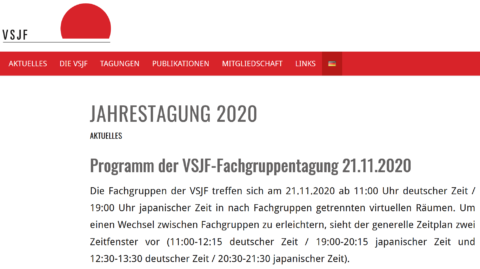
Several DIJ researchers and alums will participate in this year’s sections’ meetings of the German Association for Social Science Research on Japan (VSJF). The sections’ meetings replace the annual conference which has been postponed to 2021 due to the Corona pandemic. Research fellow Nora Kottmann and DIJ alum Carola Hommerich are organizers of the Sociology Section (with Celia Spoden). The History Section is convened by VSJF president Anke Scherer and research fellow Torsten Weber. The Technology Section is convened by DIJ alum Cosima Wagner and research fellow Susanne Brucksch who will also give a paper (“Trend report: Digital health developments in Japan during the pandemic”) in that section. Former DIJ research fellow Harald Conrad organizes the Economy Section. The sections meet online on Saturday, 21 November, from 19.00-20.15 and 20.30-21.30 (JST). During the VSJF members’ meeting, the Contemporary Japan Best Paper Award 2020 will be presented by CJ’s Managing Editor Isaac Gagné. For the programme of all sections’ meetings see the VSJF website.
Quo Vadis, Central Banks? Monetary Policy in the COVID-19 Crisis and Beyond
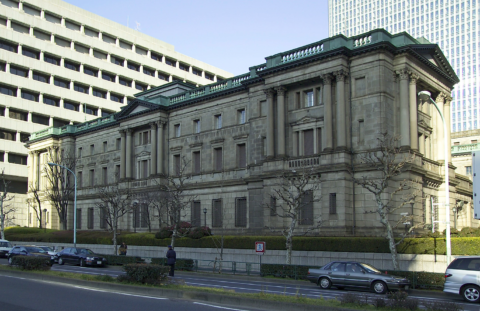 DIJ DWIH Web-Forum
Central bank laws in the US, Japan, and Europe consider price stability as the prime goal of monetary policy. However, since the Global Financial Crisis and even more so during the present COVID-19 crisis, we have observed the implementation of unconventional monetary policy measures accompanied by an unprecedented concerted action between monetary and fiscal authorities. Are these changes only temporary or do they indicate a fundamental change in the role of central banks, their relationship with governments and the constitution of monetary policy? How does the “new normal” affect the independence of central banks? The discussions in this Web-Forum will explore monetary policy in the COVID-19 crisis and its implications for current and future central banking. Details
Speakers:
Kiyohiko G. Nishimura, former Bank of Japan Deputy Governor (2008-2013)
Katrin Assenmacher, Head of the Monetary Policy Strategy Division, ECB
Moderated by Kazuo Momma, Executive Economist, Mizuho Research Institute
Agenda-Cutting in Media News Coverage of Covid-19: A Case Study from Japan
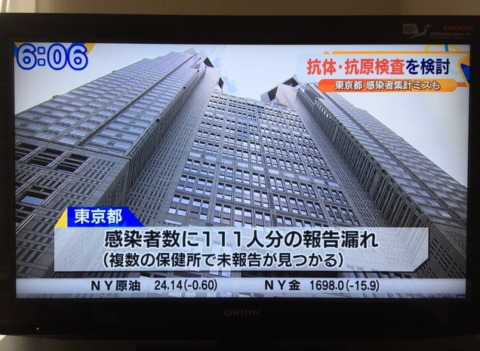
In liberal democracies, there is the expectation that the role of mass media is to provide swift and accurate information to the public – especially in times of crisis such as the ongoing Covid-19 pandemic. Risk communication is particularly challenging for journalists as they have to balance the circulation of precise information on dangers and the avoidance of fear-mongering. This presentation by Yosuke Buchmeier addresses the question of how the Covid-19 crisis has been covered in the Japanese media, primarily focusing on television news coverage of the public broadcaster NHK. This research project is based on the theoretical concept of ‘agenda-cutting’, which describes the phenomenon when a relevant societal issue is deliberately de-emphasized, entirely omitted or removed from a news agenda. Details
Speaker:
Yosuke Buchmeier, LMU Munich/DIJ Tokyo
書籍共同展示 没後50年 三島由紀夫
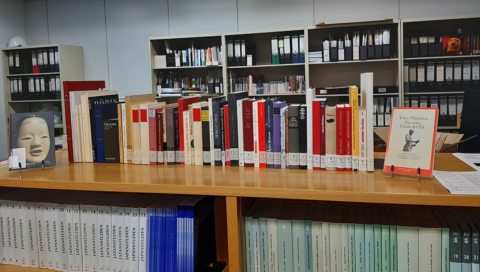 2020年は小説家・劇作家、三島由紀夫の没後50年に当たります。これを記念して、
FULLY BOOKED Boys for Sale – film screening and discussion at OAG House
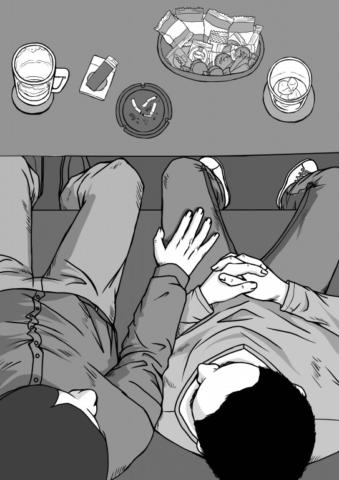
Lecture Series ‘Gender and Sexuality in East Asia’ (4/5)
In Tokyo’s Shinjuku 2-chome district there are bars that specialize in urisen, young guys who have sex with men. Featuring candid interviews and interspersed with animation detailing the awkward, sweet, and sometimes horrific situations these young sex workers experience, the boys for sale boldly tell their stories of life in the Tokyo underground. This documentary is an illuminating look into a rarely seen world that tantalizingly shows the humanity of sex work. The film screening will be followed by a discussion with the film’s producer Ian Thomas Ash and a protagonist from the film.
Please note that this event takes place at the OAG House Tokyo. Details
Economic Policy Responses to the Covid-19 Crisis in the Euro Area and Japan
 DIJ DWIH Web-Forum
Governments and central banks all over the world have taken historically bold fiscal and monetary policy measures to fight the dramatic, yet still not fathomable economic impact of the Covid-19 crisis. While the announcements have certainly calmed sentiments of market participants, many important questions remain as to how the proposed measures are to be implemented effectively given their gigantic scope and the lack of precedence. Actions need to be taken in a timely manner, as the impact of lockdowns, social distancing and travel restrictions is being felt immediately, and they need to be targeted accurately, because the economic impact varies extremely across industries and households. The speakers in our web-forum will address these concerns by taking Japan and the Euro area, especially Germany as examples. Details
Speakers:
Masaaki Shirakawa, former Bank of Japan Governor (2008-2013)
Volker Wieland, member of the German Council of Economic Experts
Moderated by Yuri Okina, Chairperson of The Japan Research Institute
DIJ research presentations at SASE Virtual Conference

DIJ research fellows Susanne Brucksch and Markus Heckel will participate in the 32nd Annual Meeting of the Society for the Advancement of Socio-Economics (SASE). This year’s meeting will be held online from July 18-21.
Susanne will participate as a discussant in the Roundtable “Economy, Society, Polity: Global and National Health(care) Lessons from the Covid-19 Pandemic”. She will also present her paper “Innovation Activities through Medtech Partnerships in Japan?” which highlights current efforts to increase medtech partnerships, cluster policies and matching-hubs to cross disciplinary and organizational boundaries and to encourage innovation activities in the field of medical devices in Japan.
Markus will present two papers: “Deflation – Lessons from the Japanese Experience”, co-authored with DIJ director Franz Waldenberger, applies the quantity theory of money and international arbitrage conditions. It suggests that expansionary monetary policies are very limited in fighting deflation in Japan. Markus’ paper “Central Bank Communication under Unconventional Monetary Policy: The Bank of Japan during Times of Crisis” analyzes the monetary policy and central bank communication of the Bank of Japan during 2003-2019 with a focus on the global financial crises and the Fukushima nuclear disaster. Results show that the complexity of monetary policy can be reduced to forms of “general” monetary policy with quantitative easing and short-term liquidity emergency measures used in crisis times.


 Follow us on Bluesky
Call for Submissions

Contemporary Japan
current issue Vol. 38, No.2
Contemporary Japan is open year-round for rolling submissions, with accepted publications published immediately online. Please see the instructions for submission here.
DIJ Monograph Series
Our monograph series is  Open Access after a one-year embargo period. Downloads are available on our
→ monographs pages.
道案内
ドイツ-日本研究所
〒102-0094 東京都千代田区
紀尾井町7-1 上智紀尾井坂ビル 2F
道案内
+81 (0)3 3222-5077
+81 (0)3 3222-5420
dijtokyo@dijtokyo.org