イベント&アクティビティ
Gerald D. Feldman Travel Grants for multi-country research projects
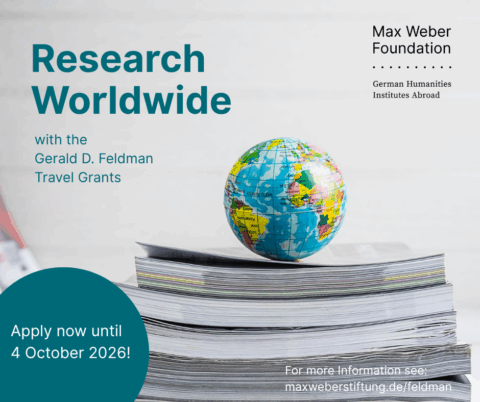 Are you an early career researcher looking for funding for research stays abroad of up to three months? If your countries of interest match, why not consider applying for a Gerald D. Feldman Travel Grant for researchers in the humanities and social sciences? The Max Weber Foundation (MWS) offers travel grants that allow you to conduct your own research project in two or three of the countries where MWS institutes and branches are located or at the Richard Koebner Minerva Center for German History in Israel. We particularly encourage applicants whose research includes Japan. Application deadline: 4 October 2026. Please see the full call, list of possible host countries, and application guidelines here
DIJ-Soziologin Barbara Holthus in ZDF-Dokumentation „Weltstädte: Tokyo“

In der neuen Folge Tokyo der ZDF-Reihe „Weltstädte“ spricht DIJ-Soziologin Barbara Holthus über Einsamkeit junger Menschen in der japanischen Hauptstadt und erklärt, dass niedrige Gehälter, lange Arbeitsstunden und die eigene, kleine Wohnung zum Einsamkeitsgefühl beitrügen: „Die jungen Leute haben sehr wenig Geld und dann leben sie in ganz kleinen Wohnungen und haben wenig menschliche Beziehungen, wenn sie denn mal nach der langen Arbeit nach Hause kommen.“ Gleichzeitig boomten Tiercafés und der Haustiermarkt. Wie Barbara Holthus erklärt, böten Tiercafés dabei nicht nur Möglichkeiten zum Konsum und zur Unterhaltung, sondern könnten auch das Bedürfnis nach körperlicher Nähe erfüllen: “ein bisschen Austausch mit etwas Lebendem”. Haustiere würden von vielen als gleichwertige Familienmitglieder und Ersatz für menschliche Beziehungen verstanden. Die ganze Folge „Tokyo“ ist in der ZDF-Mediathek verfügbar.
Barbara Holthus quoted in AP and DLF media reports
 For a report published by Associated Press, DIJ sociologist Barbara Holthus explained how socialization, collectivism, and the concept of meiwaku, or not wanting to pose an inconvenience to others, contribute to the phenomenon of Japanese soccer fans cleaning up after sports games. “If you grew up with a certain way of how things are being done, you apply that to even cleaning up a stadium afterwards.” Barbara was also interviewed by German radio station Deutschlandfunk Kultur for a feature on Japanese women’s fights against stereotypes (in German). Commenting on changes and continuities in Japanese society regarding gender equality and equal opportunities, she explained that “men in Japan still tend to marry below their social class”. The radio feature also quotes insights on traditional gender roles and recent political developments in Japan from DIJ alumnus Vincent B. Lesch.
Unser Forschungsteam sucht Verstärkung
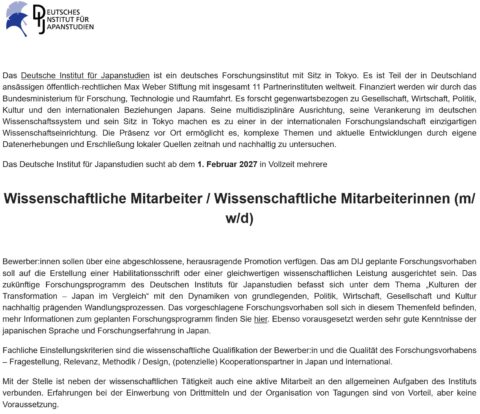 Zum 1. Februar 2027 sucht das DIJ mehrere wissenschaftliche Mitarbeiter / wissenschaftliche Mitarbeiterinnen (w/m/d) mit einer abgeschlossenen, herausragenden Promotion, sehr guten Kenntnissen der japanischen Sprache und Forschungserfahrung in Japan. Das am DIJ geplante Forschungsvorhaben soll auf die Erstellung einer Habilitationsschrift oder einer gleichwertigen wissenschaftlichen Leistung ausgerichtet sein und sich in das zukünftige Forschungsprogramm einfügen, das sich unter dem Thema „Kulturen der Transformation – Japan im Vergleich“ mit den Dynamiken von grundlegenden, Politik, Wirtschaft, Gesellschaft und Kultur nachhaltig prägenden Wandlungsprozessen befasst. Die Stellen sind auf drei Jahre befristet; eine Verlängerung ist möglich. Bewerbungsfrist ist der 9. August 2026. Die Ausschreibung und Details finden Sie hier.
Sebastian Polak-Rottmann zitiert zum Problem leerstehender Häuser
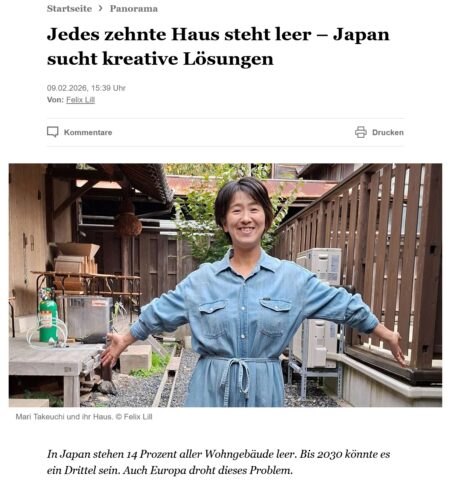
In Japan stehen 14 Prozent aller Wohngebäude leer. Bis 2030 könnte es sogar ein Drittel sein, und auch Europa droht dieses Problem. DIJ-Anthropologe Sebastian Polak-Rottmann erklärt in der Frankfurter Rundschau, warum Japan besonders stark betroffen ist und wie Menschen im ländlichen und städtischen Japan mit dem “akiya mondai” umgehen: „Der wesentliche Punkt ist, dass diese Häuser in der Regel mit der Zeit verfallen. Sie sind ein Symptom von Wanderungsbewegungen, auch von einer gewissen Unattraktivität des ländlichen Raums für viele Leute.“ Seine Expertise zu Auswirkungen des demographischen Wandels auf zwischenmenschliche Verbindungen vor allem im ländlichen Japan wurde auch zitiert in Artikeln in der Augsburger Allgemeinen und den Salzburger Nachrichten.
David Malitz joins roundtable discussion with Thai Foreign Minister
 On December 19th, DIJ Principal Researcher David M. Malitz was invited to join a roundtable discussion with Thai Foreign Minister Sihasak Phuangketkeow and Japanese academics at the Royal Thai Embassy in Tokyo. As the head of the research cluster Japan in Transregional Perspective, David conducts research on Japan-Southeast Asia relations. The discussion covered regional developments, Japan-Thailand relations, and potential future cooperation between the two countries. Thailand is a key economic partner of Japan, hosting approximately 6,000 Japanese companies and over 70,000 Japanese nationals. In November 2022, bilateral relations were elevated to the status of a Comprehensive Strategic Partnership. The year 2027 will mark the 140th anniversary of the establishment of diplomatic relations between Japan and Thailand.
DIJ Expertise on Japanese Economy and Society in German Media

For German media Deutsche Welle (DW) and Deutschlandfunk (DLF), Franz Waldenberger and Sebastian Polak-Rottmann have contributed their expertise in the fields of Japan’s economy and society, respectively. In a DW online article on Japan’s monetary policy, Franz Waldenberger explained that while the Japanese government was highly indebted, the economy as a whole was “rich”. Japan’s share of net foreign assets as percentage of GDP was “among the highest in the world”, he said. “I call it ‘rich country, poor government'”. In a German-language DLF radio feature on the problem of Japan’s abandoned houses (akiya mondai), Sebastian Polak-Rottmann commented on abandoned houses are “a symptom of demographic change and of migration” that could be observed both in rural and in urban areas. Since empty houses in rural areas often had strong family ties for their owners, many did not want to sell them, he explained.
Harald Kümmerle interviewed about Japanese digital strategy
-480x435.jpg)
“Japan’s digital policy is consensus-driven, differing from both Western and Chinese approaches”, says DIJ researcher Harald Kümmerle in a recent interview with Nikkei X-Tech, an online news portal of Japanese newspaper Nikkei Shinbun. Building on a widely recognised classification of global digital governance into three ideal types – market-driven (US), state-driven (China), and rights-driven (EU) – Kümmerle proposes Japan’s consensus-driven model as a distinct fourth type. This model, he argues, is characterized by soft regulation and administrative guidance rather than formal rule-making. This provides both opportunities and challenges. As Harald notes in the interview, “If Japan can expand its circle of partners among Indo-Pacific nations in the field of economic security, it may be able to mediate between the EU and the US.” The article (in Japanese) is available here.



 Follow us on Bluesky
Call for Submissions

Contemporary Japan
current issue Vol. 38, No.2
Contemporary Japan is open year-round for rolling submissions, with accepted publications published immediately online. Please see the instructions for submission here.
DIJ Monograph Series
Our monograph series is  Open Access after a one-year embargo period. Downloads are available on our
→ monographs pages.
道案内
ドイツ-日本研究所
〒102-0094 東京都千代田区
紀尾井町7-1 上智紀尾井坂ビル 2F
道案内
+81 (0)3 3222-5077
+81 (0)3 3222-5420
dijtokyo@dijtokyo.org