イベント&アクティビティ
Verena Blechinger-Talcott Panelist bei MWS-Stiftungskonferenz “250 Jahre Unabhängigkeitserklärung”
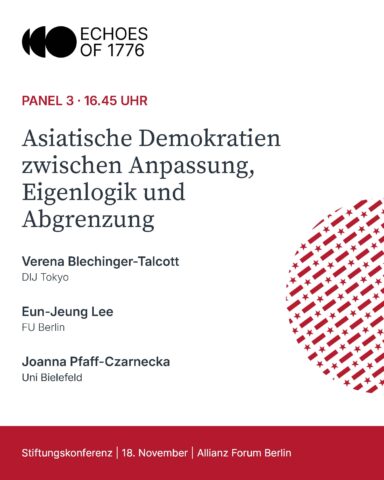 DIJ-Direktorin Verena Blechinger-Talcott nimmt als Sprecherin im Panel “Asiatische Demokratien zwischen Anpassung, Eigenlogik und Abgrenzung” an der Stiftungskonferenz der Max Weber Stiftung teil. Zusammen mit Eun-Jeung Lee (FU Berlin) und Joanna Pfaff-Czarnecka (Universität Bielefeld) wirft sie einen Blick auf demokratische Gesellschaften in Asien, unter anderem Japan und Südkorea, und diskutiert den Einfluss der USA auf das Demokratieverständnis dieser Länder. Das Panel ist Teil der diesjährigen Stiftungskonferenz “Zwischen Vorbild und Herausforderung: Die US-amerikanische Demokratie seit 1776”, die sich mit globalen Perspektiven auf 250 Jahre Unabhängigkeitserklärung der USA befasst. Die Konferenz findet am 18. November im Allianz Forum Berlin statt.
Japan-Stipendien für Promovierende
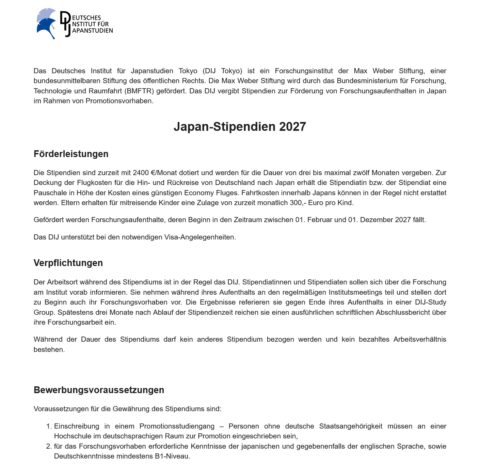 Auch dieses Jahr vergibt das DIJ wieder attraktive Stipendien zur Förderung von Forschungsaufenthalten in Japan im Rahmen von Promotionsvorhaben. Die Stipendien sind mit zurzeit 2400 Euro/Monat dotiert und werden für die Dauer von drei bis maximal zwölf Monaten vergeben. Gefördert werden Forschungsaufenthalte, deren Beginn in den Zeitraum zwischen 1. Februar und 1. Dezember 2026 fällt. Über die Voraussetzungen sowie das Bewerbungsverfahren informiert unsere Ausschreibung und die Stipendienordnung. Bewerbungsschluss für diese Ausschreibung ist der 20. November 2026.
DIJ Newsletter Autumn 2026
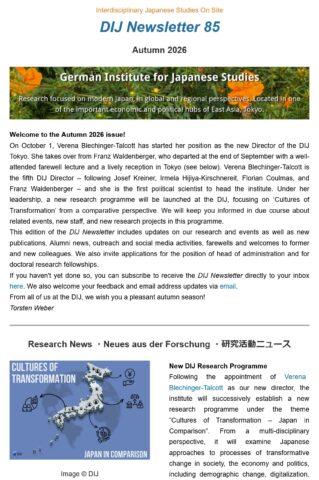
The autumn issue of our DIJ Newsletter is now available online! We hope you enjoy this latest edition, which provides insights into our research, new publications, outreach activities, job and fellowship opportunities. We also introduce new team members and bid farewell to colleagues who have left the DIJ. The DIJ Newsletter is published four times a year and features updates on our research, publications, events, outreach activities and team. If you haven’t done so yet, you can subscribe to receive our Newsletters directly to your inbox. The full issues and subscription form are available here.
Open Access article on Mega-Event Narratives of the Expo and the Olympics in Japan
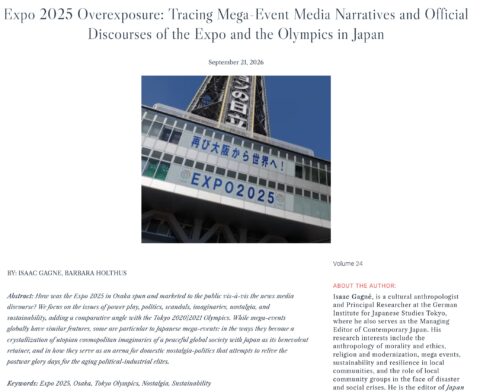 Rebirth of the Shōwa Dreams or a zombie of the past? The new open access publication “Expo 2025 Overexposure: Tracing Mega-Event Media Narratives and Official Discourses of the Expo and the Olympics in Japan” (Asia-Pacific Journal , Vol. 24 , 2026) by DIJ researchers Isaac Gagné and Barbara Holthus studies how the Expo 2025 in Osaka was marketed to the public vis-à-vis the news media discourse. Focusing on power play, politics, scandals, imaginaries, nostalgia, and sustainability, the article adds a comparative angle with the Tokyo 2020/2021 Olympics. “Tokyo 2020/2021 and Expo 2025, as with the Tokyo 1964 Olympics and the Osaka 1970 Expo before them, have been a stage for the many stakeholders involved to play out their political dreams and domestic and international desires. The cycle of mega-events in 21st-century Japan can thus be conceived of as a phoenix-like imaginary, a rebirth of the Shōwa Dreams—but they are also in peril of becoming a zombie of the past”, the authors argue.
Deutschsprachiges Kaffeekränzchen „Philosophie-Jause“
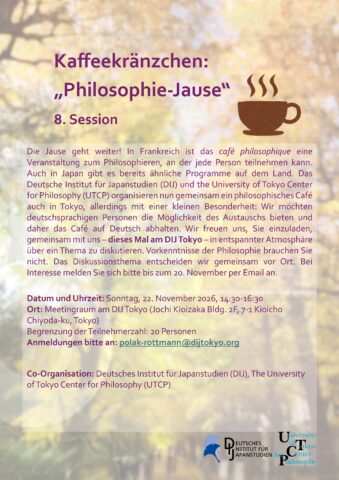 Die Jause geht weiter! In Frankreich ist das café philosophique eine Veranstaltung zum Philosophieren, an der jede Person teilnehmen kann. Auch in Japan gibt es bereits ähnliche Programme auf dem Land. The University of Tokyo Center for Philosophy (UTCP) und das Deutsche Institut für Japanstudien (DIJ) organisieren gemeinsam ein philosophisches Café auch in Tokyo, allerdings mit einer kleinen Besonderheit: Wir möchten deutschsprachigen Personen die Möglichkeit des Austauschs bieten und daher das Café auf Deutsch abhalten. Das Organisationsteam (Yukiko Kuwayama, UTCP und Sebastian Polak-Rottmann, DIJ) freut sich, Sie am 22. November ins DIJ Tokyo einzuladen, um gemeinsam in entspannter Atmosphäre über ein Thema zu diskutieren. Fachliche Vorkenntnisse benötigen Sie nicht. Bei Interesse melden Sie sich bitte bis zum 20. November an. Weitere Informationen hier
Verena Blechinger-Talcott starts position as new DIJ director
 Verena Blechinger-Talcott has taken over the position as director of the DIJ Tokyo on October 1, 2026. A specialist in Japanese Studies and Political Science, she is Professor of Japanese Politics and Economics at Free University of Berlin (on leave), where she served as Vice-President from 2018 to 2026. She has long been associated with the DIJ Tokyo: from 1997 to 2002, she conducted research at the institute as a research fellow, headed the Social Sciences Department there and also served as Deputy Director. Her research focuses on the politics of Japan and East Asia from a comparative perspective, as well as on Japanese foreign policy. Under the theme ‘Cultures of Transformation – Japan in Comparative Perspective’, the new DIJ research programme guided by Verena Blechinger-Talcott will examine the dynamics of fundamental processes of change that have a lasting impact on politics, the economy, society, and culture. We warmly welcome her back at the DIJ!
Hybrid Study Group on Ideological Receptions of the Anime Series Attack on Titan

In November 2021, Republican US Representative Paul Gosar shared an edited video clip taken from the globally popular anime series Shingeki no Kyojin – Attack on Titan (2013–2023) to attack political opponents and to criticize immigration. This is just one example of how anime is increasingly used in non-Japanese polarized political discourse. Drawing on fieldwork as well as materials from both Japanese industry and the fan community, the presentation focuses on the specific environment of the Japanese anime industry and the reception by Japanese audiences that builds on practices such as derivative works and non-narrative consumption. The aim is to elucidate the role that distinctive features of the Japanese contents industry play in both the national and international reception of anime as a potentially political form of media. Details and registration here
Hybrid Study Group on Japan’s Youth Climate Movement
Youth climate activism is globally significant but varies across cultures. European studies highlight public protest and digital mobilization, whereas Japan shows subtler engagement, possibly rooted in cultural attitudes toward hierarchy, conformity, and harmony that encourage “quiet activism”. In our project “Mapping Japan’s Youth Climate Movement: Actors, Roles, and Strategies”, we want to identify the main youth climate movements and youth-led organizations in Japan, examining their goals, organization, mobilization and communication strategies, and relationships within the wider movement. Beyond official self-descriptions, we are interested in everyday realities such as leadership, informal structures, and decision-making, and in how these groups try to influence public debate and climate policy. The project is in the middle of fieldwork. Our speaker will present its concept, first learnings from the field, and preliminary findings from two focus groups with youth-led climate organizations. Details and registration here


 Follow us on Bluesky
Call for Submissions

Contemporary Japan
current issue Vol. 38, No.2
Contemporary Japan is open year-round for rolling submissions, with accepted publications published immediately online. Please see the instructions for submission here.
DIJ Monograph Series
Our monograph series is  Open Access after a one-year embargo period. Downloads are available on our
→ monographs pages.
道案内
ドイツ-日本研究所
〒102-0094 東京都千代田区
紀尾井町7-1 上智紀尾井坂ビル 2F
道案内
+81 (0)3 3222-5077
+81 (0)3 3222-5420
dijtokyo@dijtokyo.org