

Details
2026 Follow us on Bluesky
DIJ Mailing List
Please subscribe below to stay informed about our research activities, events & publications:
[mo_verify_email]
DIJ Newsletter 84, Summer 2026
Articles
Catchword kokushobi
The Japanese summer heat is notorious for reaching unbearable levels with increasing frequency. In 2025, temperatures at 30 different monitoring stations across the country reached highs of at least 40 degrees Celsius on a total of nine days. This made last year’s summer the hottest since records began in 1898. Furthermore, the city of Isesaki in Gunma Prefecture set a new national heat record of 41.8 degrees. This surpassed the previous record temperature of 41.1 degrees, recorded in Saitama and Shizuoka prefectures in 2018 and 2020 respectively.
However, temperatures such as these pose significant health risks. Older people, in particular, are more likely to suffer heat-related deaths, for example from heatstroke. According to the Japanese Ministry of Health, Labour and Welfare, there were over 2,100 deaths from heatstroke in 2024 – in line with the upward trend of previous years. To highlight the seriousness of the situation, days on which the 40-degree mark is exceeded will in future be given a special designation: ‘kokushobi’, which could be translated as ‘cruelly hot day’ or ‘brutally hot day’.
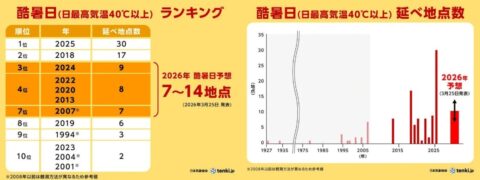
Statistics of days of at least 40 degrees Celsius until 2025 and prediction for 2026 © tenki.jp
This term was chosen on the basis of an online survey conducted by the Japan Meteorological Agency (JMA), in which nearly half a million people took part. Between 27 February and 29 March 2026, respondents were able to choose one of the 13 suggested terms or submit their own proposal for a name. Among these were some humorous suggestions such as ‘holiday’ (kyūjitsu), ‘sauna day’, or ‘soaking wet with sweat day’ (ase bisho bisho). Around 40 per cent of participants ultimately opted for the term ‘kokushobi’, which has already been in unofficial use by the Japan Weather Association (JWA) since 2022. Not least because of its relative familiarity, this term is considered a particularly suitable choice.
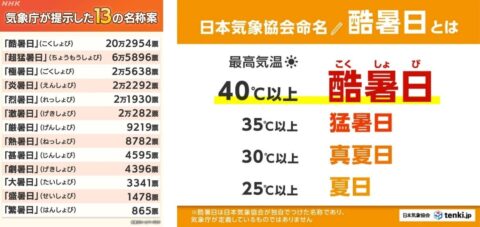
Results of poll on name for plus 40 degrees Celsius day (left); overview of names for hot summer days (right) © NHK / tenki.jp
With the introduction of ‘kokushobi’, the three existing technical terms – which are based on the highest recorded temperatures – have, for the first time since 2007, been expanded to include the next higher temperature category. Previously, days on which the outdoor temperature reached 25 degrees Celsius were referred to as ‘natsubi’ (‘summer day’). From 30 degrees onwards, a day is considered a ‘manatsubi’ (‘high summer day’), and a ‘mōshobi’ (‘heat day’) once temperatures exceed 35 degrees. The fact that a new term is now needed to warn of even greater heat stress is evidence of the pressure brought about by climate change to drive linguistic evolution.
To prevent health risks, the public is urged to check the proper functioning of their air-conditioning systems in good time and to engage in regular physical exercise to help acclimatise. In addition, a so-called ‘special heatstroke warning’ was introduced at the end of April 2026; when this is triggered, affected regions are effectively obliged to provide public cooling centres.