Open access article co-authored by Harald Kümmerle studies use of digital technologies by Germany and Japan
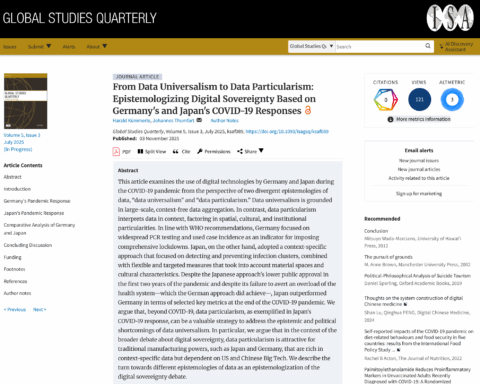 How have Germany and Japan used digital technologies during the COVID-19 pandemic? From the perspective of two divergent epistemologies of data, the open access article “From Data Universalism to Data Particularism: Epistemologizing Digital Sovereignty Based on Germany’s and Japan’s COVID-19 Responses” (Global Studies Quarterly, Vol. 5, Issue 3) by DIJ’s Harald Kümmerle and (Brussels) compares both countries’ use of data and their responses to the pandemic. Observing that Japan outperformed Germany in terms of selected key metrics at the end of the COVID-19 pandemic, the article argues that data particularism, as exemplified in Japan’s COVID-19 response, can be a valuable strategy to address the epistemic and political shortcomings of data universalism. In particular, the authors argue that in the context of the broader debate about digital sovereignty, data particularism is attractive for traditional manufacturing powers, such as Japan and Germany, that are rich in context-specific data but dependent on US and Chinese Big Tech.