イベント&アクティビティ
DIJ Roundtable
Labour Market Liberalisation after the Lehman Crisis: Comparing France, Germany and Japan
10 years after the collapse of the investment firm Lehman Brothers, a shift in discourses on structural labour market reforms is becoming ever more visible. Whereas before the crash many experts and policymakers had argued that market-oriented reforms were necessary to improve labour market and economic performance, the social costs of liberalisation now seem to attract much more attention.
Yet the jury is still out on whether this discursive shift has prompted a similar change in policy. While policies emphasising social equality appear to have gained in popularity (e.g. minimum wages, equal treatment for non-standard workers), structural reforms echoing liberalisation are also still on the agenda (e.g. French reforms of labour contract law).
This event aims to shed light on this mixed picture of continuity and change by bringing together three renowned scholars from France, Germany, and Japan for a roundtable discussion. They will discuss whether and to what extent the Lehman crisis (a.k.a. the global financial crisis) has indeed led to a lasting reorientation of labour market policy and politics.
Speakers:
Bruno Amable, University of Geneva
Paul Marx, University of Duisburg-Essen
Mari Miura, Sophia University in Tokyo
DIJ Newsletter 58 published
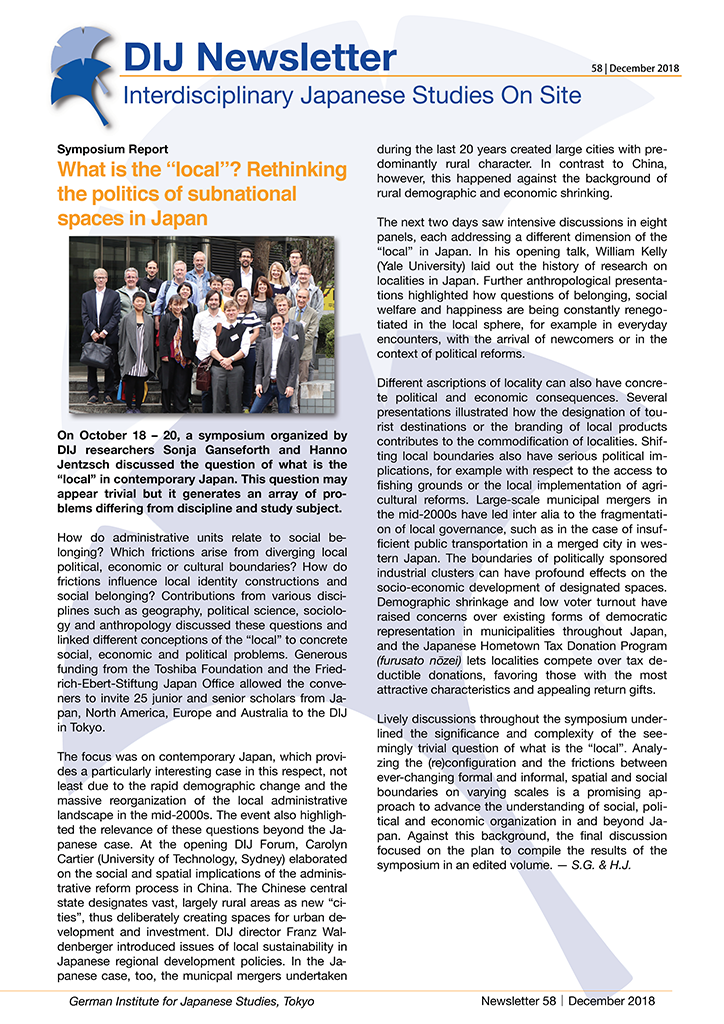 Symposium Report: What is the “local”? Rethinking the politics of subnational spaces in Japan
On October 18 – 20, a symposium organized by DIJ researchers Sonja Ganseforth and Hanno Jentzsch discussed the question of what is the “local” in contemporary Japan. This question may appear trivial but it generates an array of problems differing from discipline and study subject.
DIJ’s Flagship Journal: Contemporary Japan
Contemporary Japan, the flagship journal of the DIJ, publishes peer-reviewed original research articles and book reviews on Japan from all disciplines in the humanities and social sciences twice per year.
DIJ NIRA Workshop: Big Data – the new competitive paradigm. How well is Japan prepared?
Big data are at the heart of the digital revolution. In the digitalized and connected world data have become abundant. Rapidly developing tools to process, integrate and analyze large volumes of diverse datasets in ever faster and intelligent ways open up enormous potentials for research, private enterprises and public policy.
Festive event in Hotel New Otani: 30 Years of the DIJ
Together with 170 guests, including high ranking representatives from academia, industry and government, DIJ celebrated its 30 year anniversary on 31 October.
Latest Statistics: Less overtime: Is Abe´s “work-style reform” working?
Historically, changes in overtime respond to changes in economic growth rates. However, since 2016 the two diverge, with overtime almost continuously falling despite continuing GDP growth.
Join the DIJ as Post-Doctoral Research Fellow
 We are seeking applicants to fill a project position planned to start on 1 March 2019 for a Post-Doctoral Research Fellow.
The position will form part of the project “Streams of Knowledge: Processes of Entanglement and Disentanglement in the Pacific Area.” This is a joint project carried out in cooperation with the German Historical Institutes in Moscow and Washington, their branch offices in Vladivostok and Berkeley, and the MWS Research Group at the National University of Singapore.
Monumenta Nipponica 80th Anniversary Symposium: Roundtable
Deputy Director Barbara Holthus introduces the DIJ at the Monumenta Nipponica 80th Anniversary Symposium:
The event’s full video playlist is available on YouTube.
“Inner city life, inner city pressure”. Thinking local urban spaces through senses and discourses
The lingering scent of food served in small restaurants, the clattering sounds of commuter trains running along the tracks accompanied by a slight shaking of the uneven road — these and many more sensations are transmitted via the medium of public urban space. The (un-)determined shared spaces enable and channel movements and serve as a canvas on which the everyday urban life is painted. Even though this might sound idyllic, the local public sphere is not limited to harmony and sympathy but is also open to conflict, disturbance and unintended contact.
This presentation aims to shed light on the perception and construction of urban spaces and on how these social processes are enacted in Japan. The following questions stand at the center: How does public space as a medium frame perceptions and communication? And how do perceptions and communication construct public space in return?
Speaker:
Florian Purkarthofer, University of Vienna
DIJ monograph 62 released:
Parental well-being. Satisfaction with work, family life, and family policy in Germany and Japan
 “Pursuing happiness is not only idealistic, it is the world’s best and perhaps only hope to avoid global catastrophe” (Global Happiness Policy Report 2018). With that, the report argues for happiness as overarching policy goal. This volume argues that parental well-being is well qualified to assume a central role for governments of industrially advanced nations that are in need of coping with the challenges of low fertility and societal aging.
More than 4000 mothers and fathers of young children in Germany and Japan have been surveyed in regard to their well-being and satisfaction with many aspects related to their work and family lives. The volume brings together 13 scholars to analyze this unique dataset. The chapters fall into three main parts: (1) parenting and childcare, (2) self, social relatedness, and social structures, and (3) family policy well-being. A particular focus lies on the well-being of mothers in contrast to fathers. The volume uses a multidimensional concept of parental well-being, with each chapter highlighting one dimension, ranging from health, education, employment, and family policy satisfaction to partnership, social network, and childcare satisfaction. National differences are in several aspects superseded by gender, class, and personality types.
「ドイツ日本研究所」×「電通国際交流室」セミナー@アカデミーヒルズ
ジャパン・ウォッチャーが目撃した『平成ニッポン30年』
ドイツ日本研究所は創立30周年を記念して、電通ビジネス・ディベロップメント&アクティベーション局国際交流室とコラボレーションしたトークセッション「ジャパン・ウォッチャーが目撃した『平成ニッポン30年』」を開催する。
平成の価値観、コミュニケーション、キャリア形成、生産性、働き方、自然災害との向き合い方などについての考察を、会場の参加者と共にセッションしていく。
登壇者:
フランツ・ヴァルデンベルガー
ドイツ日本研究所 所長
上條 典夫
株式会社電通 執行役員
森下 公江
株式会社電通 電通イノベーションイニシアチブ イノベーションインテリジェンス部長
Work Style Reform, Gender Time Gap, Work-Life Balance, and Gender Equality in Japan and Germany
In cooperation with the Japanese-German Center Berlin (JDZB) and the Friedrich Ebert Foundation (FES) the DIJ hosted an one-day workshop about work style reform, gender time gap, work-life balance and gender equality regarding Japan and Germany.
Speakers:
Michiko Mae, University of Düsseldorf
Ute Klammer, University of Duisburg-Essen
Yumiko Murao, Associate Professor of Sociology at Toyo University
Elke Holst, German Institute for Economic Research
Kumiko Nemoto, Kyoto University
Fanz Waldenberger, German Institute for Japanese Studies
Machiko Osawa, Japan Women’s University
Ralf Kleindiek, The Boston Consulting Group


 Follow us on Bluesky
Call for Submissions

Contemporary Japan
current issue Vol. 38, No.2
Contemporary Japan is open year-round for rolling submissions, with accepted publications published immediately online. Please see the instructions for submission here.
DIJ Monograph Series
Our monograph series is  Open Access after a one-year embargo period. Downloads are available on our
→ monographs pages.
道案内
ドイツ-日本研究所
〒102-0094 東京都千代田区
紀尾井町7-1 上智紀尾井坂ビル 2F
道案内
+81 (0)3 3222-5077
+81 (0)3 3222-5420
dijtokyo@dijtokyo.org