イベント&アクティビティ
エネルギー転換 (Energiewende) ― ドイツと日本のエネルギー転換の未来

ドイツ語で“Energiewende”と呼ばれる「エネルギー転換」とは、電力・熱・交通部門での化石燃料や原子力の使用からの脱却と、エネルギー効率を改善しながら自然エネルギーへの移行を図る政策・実践を示しています。
この共催イベントでは、ドイツと日本のエネルギー転換の可能性と挑戦について議論されます。ドイツのシンクタンク、アゴラ・エナギーヴェンデからはディミトリ・ペシア氏、日本の自然エネルギー財団からは大林ミカ氏が登壇します。自然エネルギー財団とアゴラ・エナギーヴェンデは、3月頭に共同レポート『ドイツのエネルギー転換 10 の Q&A -日本への教訓』を公開したばかりです。
本イベントでは、まず、レポートの共同執筆者であるディミトリ・ペシア氏が、ドイツのエネルギー転換の最新事情についてお話します。つづいて、大林ミカ氏が、日本のエネルギー政策に関する話題提供を行います。そして最後に、質疑応答の時間を設けています。なお、イベント後は、軽食をご用意しています。
Are the elderly a cost factor for society or its safety net? A comparison of family regimes and National Transfer Accounts data in Germany and Japan
Various works have argued that ageing societies’ increasing dependency ratios provoke generational conflict over scarce financial resources. In post-industrial economies, younger cohorts face disadvantages in the labour market and regarding the generosity of the welfare state compared to previous generations. However, there has also been the tendency to alleviate these imbalances through informal inter-generational family transfers. Comparing Japan and Germany – two of the fastest aging societies worldwide – this presentation investigates whether and to what extent the family can serve as a bulwark against potential generational conflict.
With regard to demographic and household-financial dynamics and policy responses, the presentation will compare differences in the capacity of families to serve as an inter-generational safety net.
Who pays for whom? Intergenerational Transfers in Japan and Germany
Population ageing tends to increase the share of financially dependent members in a given society, which is why it is often assumed to be a trigger for generational conflict. The data on this question paint an ambivalent picture. On the one hand, in many post-industrial economies, today’s younger birth cohorts are put at a disadvantage in the labour market and also in terms of public sector spending compared to older cohorts. On the other hand, there is a tendency of private transfers inside the family to flow downwards – from old to young. It appears that a potential generational conflict in the public domain (welfare state, labour market) is at least partly balanced in the family domain. To what extent this is the case will be analysed by using data from National Transfer Accounts, an internationally harmonized macro-level database of financial intergenerational transfers.
Speakers:
Naohiro Ogawa is a population economist who specializes in studying the effects of demographic change on economic growth and social security systems.
Gerhard Naegele has been a professor of gerontology at the Technical University of Dortmund, Institute of Gerontology since 1992.
政府債務-ドイツはなぜ財政健全化を重視するのか?

ベルンハルト・シュルテ=ドリュッゲルテ
ドイツ連邦議会議員
フランツ・ヴァルデンベルガー
ドイツ日本研究所
ドイツと日本の財政政策には大きな隔たりがあります。ドイツは財政健全化を重視しています。同国にはマーストリヒト条約の安定成長協定で定められた債務上限が課せられている上に、憲法には均衡財政を想定した「債務ブレーキ」条項が規定されています。
一方、日本は今や債務残高の対GDP比でOECDの最上位に位置していますが、財政健全化の政策優先度はそれほど高くありません。
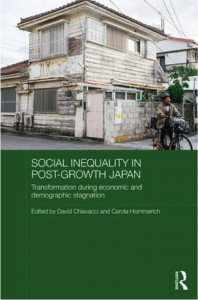
Book Launch: Social Inequality in Post-Growth Japan Transformation during Economic and Demographic Stagnation
Speakers:
David Chiavacci
Mercator Professor in Social Science of Japan, University of Zurich
Carola Hommerich
Associate Professor of Sociology, Hokkaido University
Sawako Shirahase
Professor of Sociology, The University of Tokyo
In recent decades Japan has changed from a strongly growing, economically successful country regarded as prime example of social equality and inclusion to a country with a stagnating economy, a shrinking population and a very high proportion of elderly people. New forms of inequality have been emerging and deepening, and a new perception of Japan as “gap society” (kakusa shakai) has become commonly acknowledged.
The book provides a comprehensive overview of inequality in contemporary Japan. It examines inequality in labor and employment, welfare and family, education and social mobility, in the urban-rural divide, and with regard to immigration, ethnic minorities and gender.
The Ideologue and Activist Ōkawa Shūmei (1886-1957)

Ōkawa Shūmei is generally known for his involvement in the Japanese right-wing movement that led to his arrest after the “Incident of May 15” in 1932. Ōkawas activities after his release from prison in 1937 until his indictment as a war criminal in 1946 have not been explored widely.
Ōkawa was a prolific writer who covered diverse topics, including religion, Asianism, the Indian independence movement, colonial history, Japanese history and the “Japanese spirit”. This talk will summarize Ōkawas life, his thinking and his actions against the background of his times. In this context it will also explore the Japanese ideological concept of the “national essence” (kokutai), the tensions between collectivism and statism (kokka shugi) vs. individualism, and political utopianism in the Japanese far right before 1945.
“Japan in der Ära Abe. Eine politikwissenschaftliche Analyse” – DIJ Monographie 60 erschienen!

Wie kaum ein japanischer Premierminister vor ihm scheint der seit 2012 wieder amtierende Shinzō Abe die Politik seines Landes grundlegend zu verändern. Als Spross einer Politikerdynastie eigentlich ein typischer Vertreter des politischen Establishments, verspricht er in allen zentralen Politikfeldern – von der Außen- und Sicherheitspolitik, über die Wirtschafts- und Arbeitsmarktpolitik, bis hin zur Energiepolitik –, alte Gewissheiten und Strukturen in Frage zu stellen. Dazu kommt, dass es Abe gelungen ist, im notorisch instabilen Regierungssystem Japans eine ungewöhnlich populäre und scheinbar fest im Sattel sitzende Regierung zu formen. Doch gleichzeitig regt sich Widerstand vor allem bei der japanischen Jugend, die mit Großdemonstrationen und neuen Formen des Protests auf sich aufmerksam macht.
Die in diesem Band versammelten Beiträge beleuchten diese und weitere Trends der Ära Abe.
Fully reserve backed money – a solution to Japan’s fiscal and monetary challenges
The paper argues that Japan’s legislators should use this window of opportunity to introduce 100% de jure reserve requirements for transfer deposits.
Such a move would not only take advantage of the benefits propagated by supporters of a reserve-backed regime. The implied BoJ’s balance sheet expansion would allow the Bank to further purchase JGBs. As the expansion would be permanent, the regime shift would not only stabilize the government’s fiscal condition, the BoJ, too, would no longer have to worry about exiting its policy of quantitative easing. Both the government and the central bank could focus on their primary policy goals.


 Follow us on Bluesky
Call for Submissions
Contemporary Japan
current issue Vol. 38, No.2
Contemporary Japan is open year-round for rolling submissions, with accepted publications published immediately online. Please see the instructions for submission here.
DIJ Monograph Series
Our monograph series is  Open Access after a one-year embargo period. Downloads are available on our
→ monographs pages.
道案内
ドイツ-日本研究所
〒102-0094 東京都千代田区
紀尾井町7-1 上智紀尾井坂ビル 2F
道案内
+81 (0)3 3222-5077
+81 (0)3 3222-5420
dijtokyo@dijtokyo.org