
Details
2011, ISSN 1568-4474, € 129,00, Brill, 548 p. [Order]Authors
Lützeler, Ralph
Coulmas, Florian
Coulmas, Florian
Reviews
Imploding Populations in Japan and Germany
Population and Development Review. Issue Population and Development Review Population and Development Review Volume 37, Issue 4, December 2011
pp. 797–798
onlinelibrary.wiley.com/doi/10.1111/j.1728-4457.2011.00463.x/abstract
pp. 797–798
onlinelibrary.wiley.com/doi/10.1111/j.1728-4457.2011.00463.x/abstract
Imploding Populations in Japan and Germany
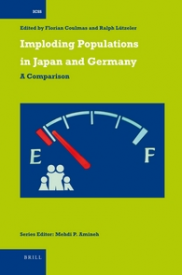
This book provides a comprehensive overview of the impact of low birth-rates and population decline on Japan and Germany. Experts from both countries examine a broad range of issues, from demographic change, social ageing, family policies, family formation, work-life balance, domestic and international migration to business perspectives and labour market issues. Focussed on Japan and Germany, two highly developed countries with extremely low fertility, the chapters of this volume also refer to several other countries for comparison. In the absence of war, famine and pandemics, rapid population decline is a new phenomenon. Japan and Germany are struggling with this reality, but many other countries will follow their example.
Content
Part I Societies of Population Decline
Part II Fertility Decline and Policy Implications
Part III Challenges and Chances of Ageing
Part IV Regional Aspects of Ageing and Depopulation
Ishikawa, Yoshitaka
Recent In-Migration to Peripheral Regions of Japan in the Context of Incipient National Population Decline
pp. 421-442
Recent In-Migration to Peripheral Regions of Japan in the Context of Incipient National Population Decline
pp. 421-442
Elis, Volker
Rural Depopulation and Economic Shrinkage in Japan: What Can Affected Municipalities Do About It?
pp. 443-460
Rural Depopulation and Economic Shrinkage in Japan: What Can Affected Municipalities Do About It?
pp. 443-460
Beetz, Stephan
Demographic, Economic and Institutional Shrinkage – from the Perspective of Rural Areas in Germany
pp. 461-472
Demographic, Economic and Institutional Shrinkage – from the Perspective of Rural Areas in Germany
pp. 461-472
Lützeler, Ralph
Left Behind in the Global City: Spaces and Places of Ageing and Shrinking in the Tokyo Metropolitan Area
pp. 473-491
Left Behind in the Global City: Spaces and Places of Ageing and Shrinking in the Tokyo Metropolitan Area
pp. 473-491
Kono, Shigemi
Confronting the Demographic Trilemma of Low Fertility, Ageing and Depopulation
pp. 35-53
Confronting the Demographic Trilemma of Low Fertility, Ageing and Depopulation
pp. 35-53
Klingholz, Reiner
Europe’s Demographic Future
pp. 55-62
Europe’s Demographic Future
pp. 55-62
Streeck, Wolfgang
Flexible Employment, Flexible Families, and the Socialization of Reproduction
pp. 63-95
Flexible Employment, Flexible Families, and the Socialization of Reproduction
pp. 63-95
Takahashi, Shigesato
Economic Globalization and Changes in Family Formation as the Cause of Very Low Fertility in Japan
pp. 97-113
Economic Globalization and Changes in Family Formation as the Cause of Very Low Fertility in Japan
pp. 97-113
Shirahase, Sawako
Income Inequality in a Rapidly Ageing Society, Japan: Focusing on Transformations in the Structure of Households with Elderly
pp. 115-139
Income Inequality in a Rapidly Ageing Society, Japan: Focusing on Transformations in the Structure of Households with Elderly
pp. 115-139
Backes, Gertrud M.
Ageing Societies: Present Challenges and Models for the Future
pp. 141-148
Ageing Societies: Present Challenges and Models for the Future
pp. 141-148
Atoh, Makoto
Japanese Family Policies in Comparative Perspective
pp. 151-173
Japanese Family Policies in Comparative Perspective
pp. 151-173
Seeleib-Kaiser, Martin; Toivonen, Tuukka
Promoting Gender Equality, Birthrates, or Human Capital? Germany, Japan and Family Policy Discourse
pp. 175-201
Promoting Gender Equality, Birthrates, or Human Capital? Germany, Japan and Family Policy Discourse
pp. 175-201
Klein, Axel
Actors of Social Policy Making in Japan: A Look at the Individual Level
pp. 229-245
Actors of Social Policy Making in Japan: A Look at the Individual Level
pp. 229-245
Strohmeier, Klaus Peter
Growing Up in a Shrinking City: The Impact of Residential Segregation on the Qualitative Reproduction of Urban Society
pp. 247-266
Growing Up in a Shrinking City: The Impact of Residential Segregation on the Qualitative Reproduction of Urban Society
pp. 247-266
Kohlbacher, Florian
Business Implications of Demographic Change in Japan: Chances and Challenges for Human Resource and Marketing Management
pp. 269-294
Business Implications of Demographic Change in Japan: Chances and Challenges for Human Resource and Marketing Management
pp. 269-294
Hipp, Christiane; Verworn, Christiane
Silver Employment in Germany: Trends and Consequences for the Management of an Ageing Workforce
pp. 295-307
Silver Employment in Germany: Trends and Consequences for the Management of an Ageing Workforce
pp. 295-307
Godzik, Maren
New Housing Options for the Elderly in Japan: The Example of Tokyo’s Edogawa Ward
pp. 309-322
New Housing Options for the Elderly in Japan: The Example of Tokyo’s Edogawa Ward
pp. 309-322
Vogt, Gabriele
The Political Economy of Health-Care Migration: A Japanese Perspective
pp. 323-346
The Political Economy of Health-Care Migration: A Japanese Perspective
pp. 323-346
Friebe, Jens
Care for the Elderly and Demographic Change: Ageing and Migrant Nurses in the German State of North Rhine-Westphalia
pp. 347-360
Care for the Elderly and Demographic Change: Ageing and Migrant Nurses in the German State of North Rhine-Westphalia
pp. 347-360
Backhaus, Peter
The Power of Address: Age and Gender in Japanese Eldercare Communication
pp. 361-372
The Power of Address: Age and Gender in Japanese Eldercare Communication
pp. 361-372
Ando, Junko
Japan’s Adult Guardianship System: Statutory guardianship and civil guardians
pp. 373-381
Japan’s Adult Guardianship System: Statutory guardianship and civil guardians
pp. 373-381
Arai, Makoto
Japan’s Adult Guardianship Law: Current Status and Issues
pp. 383-396
Japan’s Adult Guardianship Law: Current Status and Issues
pp. 383-396
Kemper, Franz-Josef
Demographic Change and Challenges from a Regional Perspective: The Case of Germany
pp. 399-420
Demographic Change and Challenges from a Regional Perspective: The Case of Germany
pp. 399-420
Lützeler, Ralph; Coulmas, Florian
Population Implosion: Coping with the Unknown
pp. 1-32
Population Implosion: Coping with the Unknown
pp. 1-32