Events and Activities
DIJ KAS Roundtable
US-Japan Relations under Donald Trump and Shinzo Abe
US-Japan relations form a core element in Asian regional security and a central pillar of the international trade regime. The quality of the relationship has always been shaped by the personalities representing the two countries. Shinzo Abe, Japan’s now longest-serving prime minister, has been keen to establish good personal ties with Donald Trump, whose “America First” policy implied a major shift in the US approach to regional and global issues. This roundtable will discuss the changes that US-Japan relations underwent since the beginning of Trump’s presidency and analyze the regional and global implications.
Keynote:
Glen S. Fukushima, Center of American Progress
Comments:
Koichi Nakano, Sophia University
Tilman Schmit-Neuerburg, German Federal Foreign Office
Assimilation Policies and Ainu Identity
Questioning Japan’s Recognition of the Ainu People as Indigenous
In April 2020, the Japanese government will open the “Symbolic Space for Ethnic Harmony” in Shiraoi (Hokkaido). The “Symbolic Space” will consist of a National Ainu Museum, a National Ethnic Harmony Park, where Ainu culture can be practiced, and a central depot for Ainu remains. The government is expecting one million visitors per year. According to the official reading, Ainu indigenous rights will be implemented here incrementally, supported by the New Ainu Law, which was adopted in April 2019. Against this backdrop, the talk asks whether the recognition of the Ainu is in accordance with an international understanding of the term “indigenous”.
The lecture addresses the process of colonization (after 1590) and will give a summary of the treatment of the Ainu in Japanese legal history. Policies of assimilation already began a century prior to the modern Meiji state as is evidenced by the Bakufu guidelines for officials in Hokkaido (1799). The “Hokkaido Former Aborigines Protection Act” of 1899 had the objective of forcing the Ainu into a farming existence, and schooling and welfare policies were additional measures. This law was repealed only a century later, in 1997, with the recognition of the Ainu as a group with a distinct culture and history. In 2007, Japan supported the “United Nations Declaration on the Rights of Indigenous Peoples”, and the “New Ainu Law” of April 2019 now addresses the Ainu as “indigenous” for the first time in Japanese legislation. Following this outline, the contribution analyzes the question whether Japan is actually fulfilling its commitments to UNDRIP. Relevant criteria are land, fishing/hunting, and language rights as well as the repatriation of stolen human remains to Ainu communities, among others.
Speaker:
Uwe Makino, Chuo University (Tokyo)
Improving Japan’s Disability Employment
From Separate to Inclusive Workplaces
Japan’s “Act on Employment Promotion of Persons with Disabilities” has been revised in 2013 and 2019. The 2013 amendment prohibited discrimination on the grounds of disability and obliged employers to provide reasonable accommodation to employees with disabilities, and was supposed to be a paradigm shift in Japan’s disability employment policy, which until then had relied on the disability employment quota system. As the law originally intended to improve employment opportunities in the general labor market, the quota and related systems contributed to quantitative improvements. However, it also established the “special but separate” treatment for persons with disabilities (PWD). In order to answer the puzzle why different or separate treatments remained in place in the employment of PWD even after the 2013 amendment, I have analyzed statistical data, administrative guidelines, and the debate preceding the recent 2019 amendment.
Speaker:
Reiko Yoshida, The University of Tokyo
The new Japanese Fishery Policies between Revitalization and Capitalization
Coastal fisheries in Japan have been in decline since the early 1990s. Situated mostly in rural areas, fishing communities suffer from depopulation, aging and a lack of successors. Moreover, stagnating production levels, falling prices, decreasing demand and rising costs have led to income insecurities, further deterring young people to enter the industry. Policymakers and fishermen alike have been struggling to find solutions for this complex mix of challenges.
The dissertation projects analyzes how fishery policies have changed since the implementation of the 2001 Fisheries Basic Act. The Basic Act stipulated the revitalization of small scale coastal fisheries with a focus on communities as one of its the main goals, followed by several programs channeling subsidies into fishing to achieve this. Since 2014, however, we can observe a policy shift with several distinct features. The responsibility of developing measures for revitalization is increasingly put into the hands of the fishermen and local authorities, with a strong emphasis on economic factors. The 2018 reform of the Fishery Law further emphasizes this trend, aiming to usher in more capital-based fisheries. Moreover, management of stocks will increasingly be based on Total Allowable Catch (TAC) systems, a move away from the traditional community based management. This has left many small-scale-fishermen worried about their future in coastal fisheries.
Speaker:
Susanne Auerbach, Freie Universität Berlin
User-driven Innovation in Health- & Elderly Care in Japan
Japan is enthusiastic about developing and applying innovative technology in the context of health- and elderly care. Research and development in care robotics, sensor technology (mimamori sensā), or ICT applications are widely promoted by the government. Despite these manifold efforts and activities, many devices fall short of meeting the needs expressed by users. Therefore, this DIJ Forum raises the question, what is necessary to fulfil user’s needs in healthcare? What needs to be done to improve user acceptance and usability of technology regarding innovation in health- and elderly care? Our two speakers are best suited to discuss these questions from a cross-disciplinary perspective.
Speakers:
Sarah Cosentino, Waseda University
Nobu Ishiguro, Osaka University
DIJ Newsletter 60 published
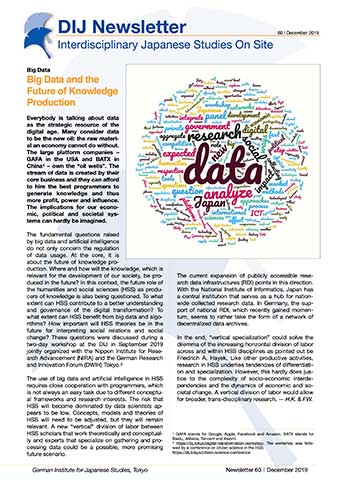 Report: Big Data and the Future of Knowledge Production
Everybody is talking about data as the strategic resource of the digital age. Many consider data to be the new oil: the raw material an economy cannot do without. The fundamental questions raised by big data and artificial intelligence do not only concern the regulation of data usage. At the core, it is about the future of knowledge production. Where and how will the knowledge, which is relevant for the development of our society, be produced in the future?
Studying Japan
In July 2019, an interdisciplinary group of 27 Japan scholars from Europe, Australia, the USA, Japan, and Singapore gathered in Berlin and discussed methodological opportunities and challenges in social science research on Japan against the backdrop of transnational entanglements, new technological developments, and new ethical challenges.
The insights of the international conference will be worked into the methods handbook Studying Japan which Nora Kottmann and Cornelia Reiher are currently editing.
New Cultural Studies Project
The project “Theater and Society in the Japanese Regions” analyzes how pressing issues of Japanese society are represented and negotiated in regional theater productions, based on recent concepts of theater and performance as a space for social debate. What topics and issues are addressed and how are they realized? What can the arts do to help coping with social issues? And what about their role for the revitalization of regional areas?
DIJ Roundtable
The Future of Society – German and Japanese Perspectives
Institutions are the foundations of our society. They help to coordinate individual actions and they are also needed to integrate various social, economic and political subsystems. But institutions cannot not be fully understood by their functional contribution alone. There is also an important normative part. It is too often forgotten, that institutions have normative foundations. In the face of current challenges like the digital transformation, the avance of AI, climate change and new geopolitical power relations, the normative qualities of our social institutions are being challenged with far reaching consequences for social cohesion.
Professor Udo Di Fabio, former judge of the German Federal Constitutional Court, has recently published two books on the foundations of modern society, combining historical, legal and sociological perspectives. He will present his main arguments in a keynote adress. His ideas will by commented on by Japanese and German scholars before the general discussion is opened to the floor.
Image(-Text) correlations in the works of Natsume Sōseki
Even though the first publications of Natsume Sōseki’s (1867–1916) works were illustrated and had visual elements, the research on Sōseki focuses mostly just on the text. Nevertheless, Sōseki’s entire oeuvre shows from the beginning to the end a deep but shifting image-text relation that has to be introduced and placed into the historical context, taking the artists (Natori Shunsen, Noda Kyūho, Asai Chū, Hashiguchi Goyō, Nakamura Fusetsu, and Tsuda Seifū), publication type (newspaper, book, pocketbook) and genre into consideration. This approach can thereby identify a network of artists and intellectuals, as well as places and visual ideas.
My presentation aims to give an overview of the material and the illustrations, while also analyzing particular image and text examples, thereby giving Sōseki also a visual standing in the discourse about Modernity and the Fin de Siècle.
Speaker:
Kevin Schumacher, University of Munich / DIJ


 Follow us on Bluesky
Call for Submissions

Contemporary Japan
current issue Vol. 38, No. 1
Contemporary Japan is open year-round for rolling submissions, with accepted publications published immediately online. Please see the instructions for submission here.
DIJ Monograph Series
Our monograph series is  Open Access after a one-year embargo period. Downloads are available on our
→ monographs pages.
Access
DIJ Tokyo
Jochi Kioizaka Bldg. 2F
7-1 Kioicho Chiyoda-ku, Tokyo
102-0094 Japan
Where to find us
+81 (0)3 3222-5077
+81 (0)3 3222-5420
dijtokyo@dijtokyo.org

DIJ-ARI Asian Infrastructures Research Partnership