イベント&アクティビティ
DIJ Newsletter Autumn 2026
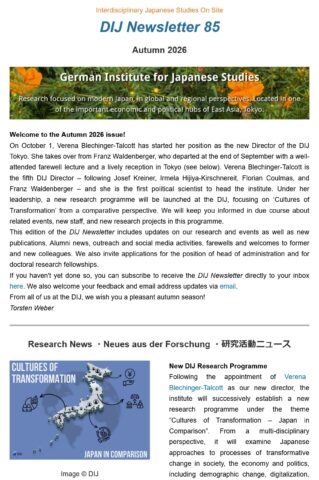
The autumn issue of our DIJ Newsletter is now available online! We hope you enjoy this latest edition, which provides insights into our research, new publications, outreach activities, job and fellowship opportunities. We also introduce new team members and bid farewell to colleagues who have left the DIJ. The DIJ Newsletter is published four times a year and features updates on our research, publications, events, outreach activities and team. If you haven’t done so yet, you can subscribe to receive our Newsletters directly to your inbox. The full issues and subscription form are available here.
Onsite Study Group on High-Skilled and Elite Chinese Immigrants in Tokyo
By the end of 2025, the number of Chinese nationals residing in Japan increased to 930,396, accounting for 22.55% of all foreign nationals. Notably, Tokyo hosts one-third of this population, many of whom hold skilled and elite residence status. This research premises on the conceptualization of immigration decision-making as a process shaped by past and ongoing lived experiences in countries of origin and destination, alongside comparisons with the “West” and its imaginaries. It situates Chinese mobility against a backdrop of geopolitical, economic, and sociocultural volatility, marked by evolving US–China tensions, authoritarian resurgence, and shifting immigration politics. Drawing on participant observation and in-depth semi-structured interviews, this presentation shares preliminary findings on the decision-making processes and rationales of Chinese business people and professionals. It highlights the population’s heterogeneity while examining the uncertainties, dilemmas, and precarity they navigate. Details and registration here
Stellenausschreibung Verwaltungsleitung DIJ Tokyo
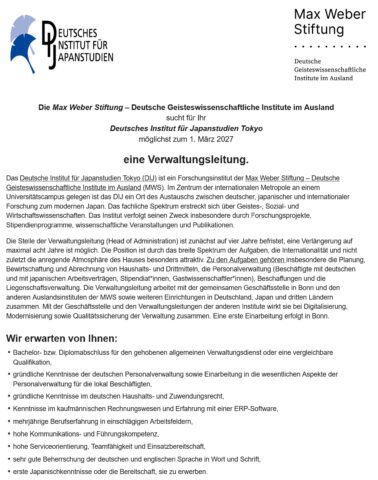 Wir suchen zum 1. März 2027 eine neue Verwaltungsleitung (Head of Administration). Die Stelle ist auf vier Jahre befristet, eine Verlängerung auf maximal acht Jahre ist möglich. Die Position ist durch das breite Spektrum der Aufgaben und die Internationalität besonders attraktiv. Zu den Aufgaben gehören insbesondere die Planung, Bewirtschaftung und Abrechnung von Haushalts- und Drittmitteln, die Personalverwaltung, Beschaffungen und die Liegenschaftsverwaltung. Wir erwarten von Ihnen u.a. mehrjährige Berufserfahrung in einschlägigen Arbeitsfeldern, hohe Kommunikations- und Führungskompetenz, einen Bachelor- bzw. Diplomabschluss für den gehobenen allgemeinen Verwaltungsdienst oder eine vergleichbare Qualifikation, Kenntnisse der deutschen Personalverwaltung sowie Einarbeitung in die Personalverwaltung für die lokal Beschäftigten, Kenntnisse im deutschen Haushalts- und Zuwendungsrecht und im kaufmännischen Rechnungswesen, hohe Serviceorientierung, Teamfähigkeit und Einsatzbereitschaft, sehr gute Beherrschung der deutschen und englischen Sprache, erste Japanischkenntnisse oder die Bereitschaft, sie zu erwerben. Die vollständige Ausschreibung finden Sie hier. Wir freuen uns auf Ihre Bewerbung bis zum 1. November 2026 über unser Bewerbungsportal.
Japan-Stipendien für Promovierende
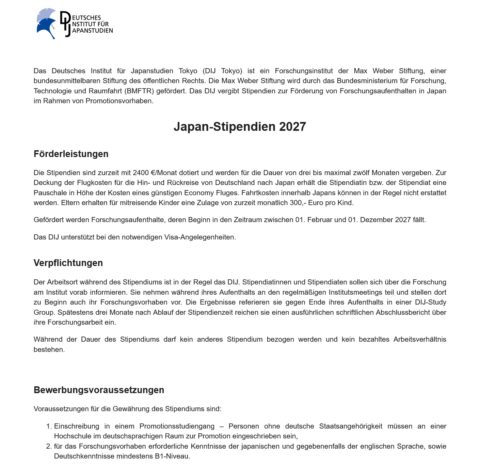 Auch dieses Jahr vergibt das DIJ wieder attraktive Stipendien zur Förderung von Forschungsaufenthalten in Japan im Rahmen von Promotionsvorhaben. Die Stipendien sind mit zurzeit 2400 Euro/Monat dotiert und werden für die Dauer von drei bis maximal zwölf Monaten vergeben. Gefördert werden Forschungsaufenthalte, deren Beginn in den Zeitraum zwischen 1. Februar und 1. Dezember 2026 fällt. Über die Voraussetzungen sowie das Bewerbungsverfahren informiert unsere Ausschreibung und die Stipendienordnung. Bewerbungsschluss für diese Ausschreibung ist der 20. November 2026.
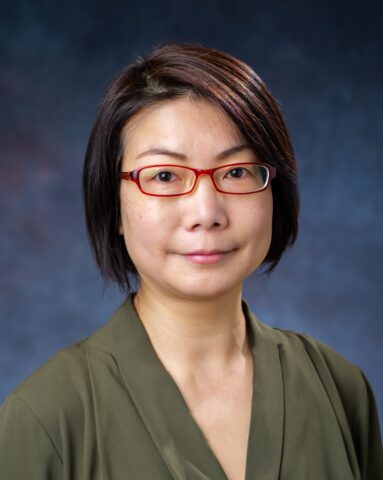
Verena Blechinger-Talcott starts position as new DIJ director
 Verena Blechinger-Talcott has taken over the position as director of the DIJ Tokyo on October 1, 2026. A specialist in Japanese Studies and Political Science, she is Professor of Japanese Politics and Economics at Free University of Berlin (on leave), where she served as Vice-President from 2018 to 2026. She has long been associated with the DIJ Tokyo: from 1997 to 2002, she conducted research at the institute as a research fellow, headed the Social Sciences Department there and also served as Deputy Director. Her research focuses on the politics of Japan and East Asia from a comparative perspective, as well as on Japanese foreign policy. Under the theme ‘Cultures of Transformation – Japan in Comparative Perspective’, the new DIJ research programme guided by Verena Blechinger-Talcott will examine the dynamics of fundamental processes of change that have a lasting impact on politics, the economy, society, and culture. We warmly welcome her back at the DIJ!
DIJ-Soziologin Barbara Holthus in ZDF-Dokumentation „Weltstädte: Tokyo“

In der neuen Folge Tokyo der ZDF-Reihe „Weltstädte“ spricht DIJ-Soziologin Barbara Holthus über Einsamkeit junger Menschen in der japanischen Hauptstadt und erklärt, dass niedrige Gehälter, lange Arbeitsstunden und die eigene, kleine Wohnung zum Einsamkeitsgefühl beitrügen: „Die jungen Leute haben sehr wenig Geld und dann leben sie in ganz kleinen Wohnungen und haben wenig menschliche Beziehungen, wenn sie denn mal nach der langen Arbeit nach Hause kommen.“ Gleichzeitig boomten Tiercafés und der Haustiermarkt. Wie Barbara Holthus erklärt, böten Tiercafés dabei nicht nur Möglichkeiten zum Konsum und zur Unterhaltung, sondern könnten auch das Bedürfnis nach körperlicher Nähe erfüllen: “ein bisschen Austausch mit etwas Lebendem”. Haustiere würden von vielen als gleichwertige Familienmitglieder und Ersatz für menschliche Beziehungen verstanden. Die ganze Folge „Tokyo“ ist in der ZDF-Mediathek verfügbar.
International Symposium on Entangled Trajectories of Modernization in East Asia
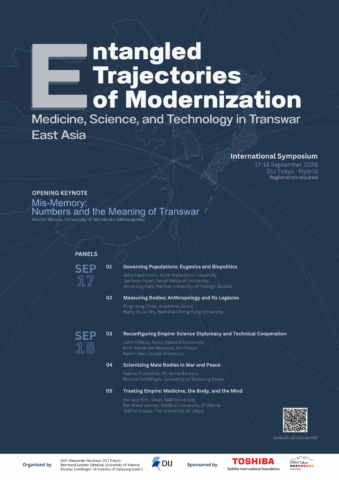 This two-day symposium explores the critical transition from the 1930s to the 1960s, a period marked by colonization, war, and postwar reconstruction in East Asia. Focusing on Japan, Korea and Taiwan, the event highlights the intertwined development of medicine, science, and technology across imperial legacies, Cold War geopolitics, and rapid modernization. Bringing together 14 historians of science, technology, and medicine, the conference seeks to uncover how shared histories and divergent paths shaped state-building, institutional reform, and knowledge production in these nations. Through comparative and transnational perspectives, the symposium invites new insights into the collaborative and contested processes that defined, and still define, the region’s future. The symposium takes place on September 17 and 18 online and on-site at the DIJ. It is organized by DIJ’s Dolf-Alexander Neuhaus, Bernhard Leitner (Medical University of Vienna), and Nicolas Schillinger (University of Duisburg-Essen). Details and registration here
DIJ researchers at EAJS Conference in Poznań
 Four DIJ researchers and more than 20 DIJ alumni will present their latest research at this year’s tri-annual conference of the European Association for Japanese Studies (EAJS) in Poland. Paper presenters include Isaac Gagné (“‘Pragmagic’ in urban East Asia: Tracing pragmatic practices and rituals of magical control in Tokyo and Hong Kong”; co-authored with Dominik Bartmanski), Nicole M. Mueller (“Working the Metaverse: Conceptual Frameworks, Corporate Policy, and Literary Interventions”), Dolf-Alexander Neuhaus (“Industrial education for Koreans under Japanese colonial rule and its postwar legacies, 1910s – 1960s”), and Torsten Weber (“Re-visiting the war in postwar Japan: Takeuchi Yoshimi’s ‘Asia’ versus Japan’s ‘West’”). The conference takes place at Adam Mickiewicz University in Poznań from August 27-30, 2026.



 Follow us on Bluesky
Call for Submissions

Contemporary Japan
current issue Vol. 38, No.2
Contemporary Japan is open year-round for rolling submissions, with accepted publications published immediately online. Please see the instructions for submission here.
DIJ Monograph Series
Our monograph series is  Open Access after a one-year embargo period. Downloads are available on our
→ monographs pages.
道案内
ドイツ-日本研究所
〒102-0094 東京都千代田区
紀尾井町7-1 上智紀尾井坂ビル 2F
道案内
+81 (0)3 3222-5077
+81 (0)3 3222-5420
dijtokyo@dijtokyo.org