イベント&アクティビティ
The Development of (Social) Robots for Health Care Scenarios: Hopes, Concerns and Limits
The development of (social) robots reflects engineers’ understanding of societal arenas as well as the social actors primarily responsible for structuring and shaping these arenas. On these grounds, the design of (social) robots is contingent upon the role model of the persons performing the task the robot is supposed to take over or help with through cooperation. It is, therefore, of paramount importance to reflect these understandings and where necessary to replace stereotypes with more sophisticated views.
To contribute in this respect, the workshop will address key factors regarding the development of (social) robots with the purpose to be integrated in health care scenarios: (a) What are the benefits that could be expected particularly within the scope of societies endangered by a strong demographic shift (e.g. Japan and Germany)? (b) What are the common concerns that are raised by the persons working in the field and the target user, and how should academic researcher as well as employees of R&D departments reflect and take these concerns into consideration? (c) Should there be limits regarding the use of robots in specific scenarios and/or persons respectively patients? Finally, how could criteria to determine these limits look like and are they (always) transcultural?
Picture: CC BY 2.0 | Flickr/RoboCup2013
Local Anti-Nuclear Movements in Japan. The Diverging Cases of Maki and Rokkasho
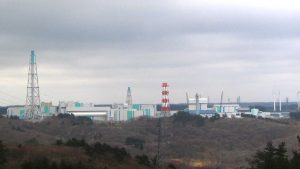
In Japan, local mayors and city councils decide on whether a nuclear facility shall be constructed in their community or not. Therefore, policy analysis on the nation state level alone cannot explain why some nuclear facilities were built, while the construction was stopped (or prevented) elsewhere. This research project analyzes and compares the cases of two local communities: the town of Maki, now a part of Niigata city, where the construction of a nuclear power plant was prevented by a citizen referendum; and Rokkasho, a small town in Aomori prefecture, which hosts one of the largest nuclear centers comprised of several nuclear facilities.
In the analysis, resource mobilization theory, the framing approach and the theory of political opportunity structure are combined in the triangular model of social movement analysis (Hasegawa Koichi 2011). Expert interviews, mostly with former activists in Maki and Aomori, complement the data gathered by literature analysis.
Picture: CC BY-SA 3.0 | wikimedia/Nife
Gender Representations in East Asian Television Advertisements: Hong Kong, Japan, and South Korea
Gender representations in television advertisements have been a subject of academic research for many years. However, comparatively few studies have looked into television advertisements’ gender representations in societies with a Confucian legacy, particularly from a comparative perspective. This study compares the representation of men and women in 1,694 television advertisements from Hong Kong, Japan, and South Korea. It uncovers stereotypical gender representations related to age, clothing/nudity, work, authority, and beauty. Overall, gender representations were highly stereotypical in all three cultures, which may be due to a shared common cultural background based on Confucianism. In terms of the degree of gender stereotyping, Hong Kong was more gender-egalitarian than Japan and South Korea; this finding is consistent with results from some international gender indices indicating that Hong Kong is more gender egalitarian than Japan and South Korea. Finally, this talk discusses the possible effects of stereotypical gender representations on audiences.
Womenomics – Remedy or Illusion?
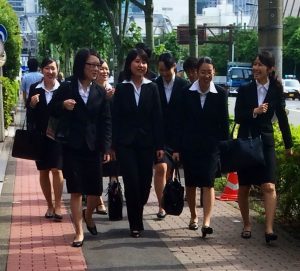
„Womenomics”, one of the policies by Prime Minister Abe Shinzo introduced in 2014 to reinvigorate Japan’s economy has come as a surprise not only to his government and politicians but also to the Japanese society. Gender and gender issues have long been a seemingly untouchable topic in Japan’s political discourse.
This talk presents the main characteristics of this concept, its aims and goals. It looks at the motivations and expectations on the side of policy-makers, of employers and of those most concerned: women and their families.
Picture: CC BY 2.0 | flickr/Steven-L-Johnson
“The Slow Way Home: Civic Engagement and Walkability in Japanese Neighbourhoods”
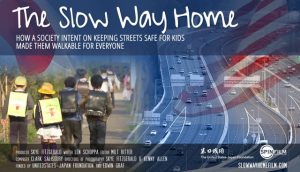
The documentary film “Slow Way Home” explores this divergence, examining how American families have largely given up on keeping streets and public spaces safe enough for children, while Japanese communities have mobilized to keep their streets safe and walkable, not only for children but for everyone in society. Following a screening of the film, Prof. Schoppa will offer remarks on the forces that keep parents and local residents in Japan civically engaged in working to preserve the safety of streets for local school children, when similar dynamics do not seem to operate in the United States.
Revolution and Empire: the Northern Expedition in the Japanese Press, 1926-28
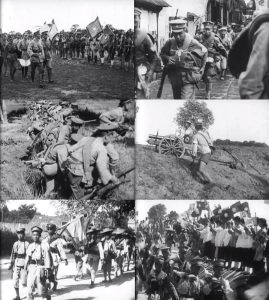
With the Northern Expedition (1926-28), the Nationalist Party (GMD) emerged in China as the leading force for reunification of the country. The foreign powers had thus to face a new government in Nanjing that claimed back for China the sovereign rights it had lost with the ‘unequal treaties’ in the late Qing period. To Japan, in particular, the establishment of the Nationalist regime posed a threat to its ‘special interests’ in Northeast China.
Historians have studied extensively the political process that in 1931 led to the Japanese invasion of Manchuria, taking into account both domestic conditions and the wider international context. Public opinion in Japan, however, has remained rather on the sidelines of research.
Picture: CC BY-SA 3.0 | Source
地方のポリシーメーカーの挑戦としての人口動態の変化 – 日本とドイツの地方自治体の戦略と解決策

出生率の低下、高齢者、とりわけ要介護者の増加、そして人口減少などを特徴とする人口動態の変化は、特に地方自治体を直撃する。またここから、様々な課題が複雑に絡み合っていることもはっきりする。
重層的かつ多様な問題に対応できるのは、全体論的で、現地の状況に合わせた解決のアプローチのみである。本会議では、人口動態が突きつける課題について、日独の地方自治体を例に検討し、国レベル、地方レベルにおける、具体的な解決戦略を想定し、議論する。
Seoul’s Namsan under Japanese Influence – Japanese Ritual Life and Assimilation Policy in Korea, 1890-1945
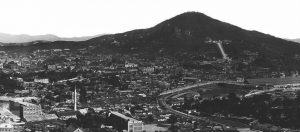
Namsan is a small mountain in central Seoul. It was used for propaganda both by the Japanese who settled there in the 1890s and by Koreans until the democratization of South Korea in the 1980s. However, as Namsan nowadays has become a famous leisure attraction for tourists as well as locals, the fact that it has a troubled and politically charged history is mostly forgotten.
This talk outlines the changes on Namsan around the period of Japanese rule. During that time, Shintō shrines and Buddhist temples were continuously built on and around Namsan, turning it into the center of Japanese ritual life. At the same time, by removing traditional Korean ritual sites, Koreans were estranged from their own spiritual traditions. From 1925, when the Japanese Government and the Government-General of Chōsen decided to build Chōsen Jingū on Namsan, the issue of Koreans visiting Namsan and taking part in Japanese ritual life became even more politicized. As a result, Namsan was slowly turned into a space of assimilation of Koreans into Japanese – a development that reached its pinnacle when Koreans were forced to pray at shrines during the wartime years.


 Follow us on Bluesky
Call for Submissions

Contemporary Japan
current issue Vol. 38, No.2
Contemporary Japan is open year-round for rolling submissions, with accepted publications published immediately online. Please see the instructions for submission here.
DIJ Monograph Series
Our monograph series is  Open Access after a one-year embargo period. Downloads are available on our
→ monographs pages.
道案内
ドイツ-日本研究所
〒102-0094 東京都千代田区
紀尾井町7-1 上智紀尾井坂ビル 2F
道案内
+81 (0)3 3222-5077
+81 (0)3 3222-5420
dijtokyo@dijtokyo.org