イベント&アクティビティ
DIJ Newsletter 58 published
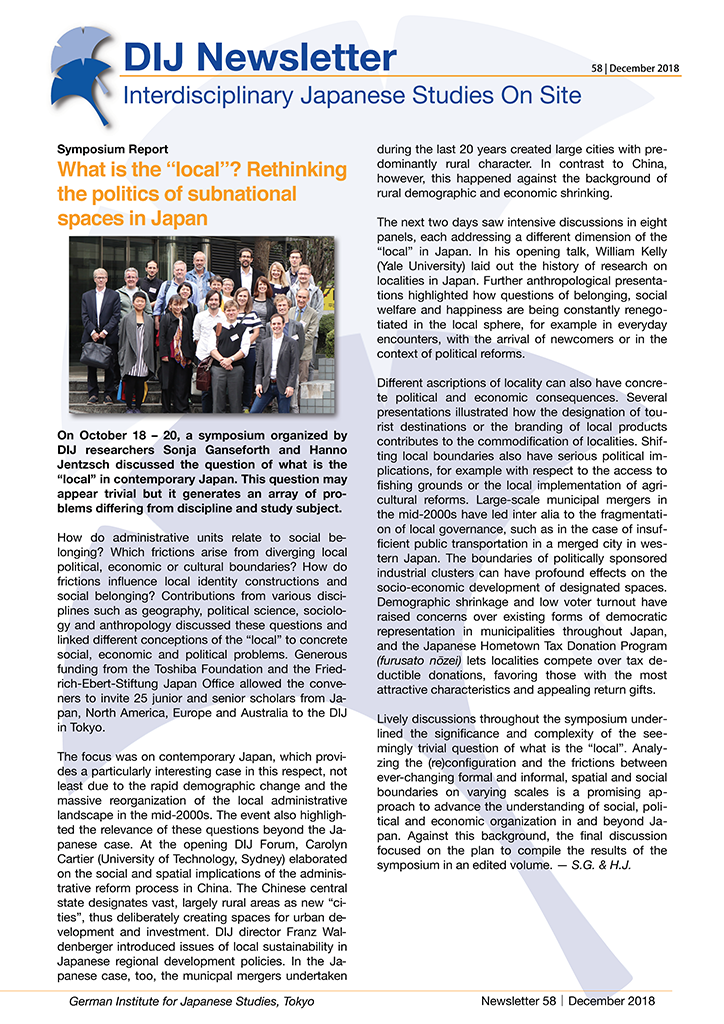 Symposium Report: What is the “local”? Rethinking the politics of subnational spaces in Japan
On October 18 – 20, a symposium organized by DIJ researchers Sonja Ganseforth and Hanno Jentzsch discussed the question of what is the “local” in contemporary Japan. This question may appear trivial but it generates an array of problems differing from discipline and study subject.
DIJ’s Flagship Journal: Contemporary Japan
Contemporary Japan, the flagship journal of the DIJ, publishes peer-reviewed original research articles and book reviews on Japan from all disciplines in the humanities and social sciences twice per year.
DIJ NIRA Workshop: Big Data – the new competitive paradigm. How well is Japan prepared?
Big data are at the heart of the digital revolution. In the digitalized and connected world data have become abundant. Rapidly developing tools to process, integrate and analyze large volumes of diverse datasets in ever faster and intelligent ways open up enormous potentials for research, private enterprises and public policy.
Festive event in Hotel New Otani: 30 Years of the DIJ
Together with 170 guests, including high ranking representatives from academia, industry and government, DIJ celebrated its 30 year anniversary on 31 October.
Latest Statistics: Less overtime: Is Abe´s “work-style reform” working?
Historically, changes in overtime respond to changes in economic growth rates. However, since 2016 the two diverge, with overtime almost continuously falling despite continuing GDP growth.
DIJ monograph 62 released:
Parental well-being. Satisfaction with work, family life, and family policy in Germany and Japan
 “Pursuing happiness is not only idealistic, it is the world’s best and perhaps only hope to avoid global catastrophe” (Global Happiness Policy Report 2018). With that, the report argues for happiness as overarching policy goal. This volume argues that parental well-being is well qualified to assume a central role for governments of industrially advanced nations that are in need of coping with the challenges of low fertility and societal aging.
More than 4000 mothers and fathers of young children in Germany and Japan have been surveyed in regard to their well-being and satisfaction with many aspects related to their work and family lives. The volume brings together 13 scholars to analyze this unique dataset. The chapters fall into three main parts: (1) parenting and childcare, (2) self, social relatedness, and social structures, and (3) family policy well-being. A particular focus lies on the well-being of mothers in contrast to fathers. The volume uses a multidimensional concept of parental well-being, with each chapter highlighting one dimension, ranging from health, education, employment, and family policy satisfaction to partnership, social network, and childcare satisfaction. National differences are in several aspects superseded by gender, class, and personality types.
Bouncing Back After Failure: Perceived and Actual Similarity as a Coping Resource in Multinational Work Teams
Multinational work environments challenge the coping capabilities of employees with additional culture-related stressors above and beyond those usually found at the workplace. This paper examines the differential effects of perceived team leader / member similarity, their actual national similarity, and the mutual overlap in personal values on the coping potential of team members in a multinational work team setting, with a special focus on the Japanese context. An analysis of the data provided by 365 dyads of multinational team leaders and members in mixed Japanese/non-Japanese work teams revealed that the coping abilities of team members who shared the leader’s country of origin (surface level national similarity) were not significantly higher than those of team members who came from a different country. Conversely, the actual overlap in personal values endorsed by a team’s leader and each individual team member emerged as a robust predictor for that team member’s coping potential, both directly and indirectly through generalized similarity perceptions. This highlights that in order to understand why some multinational work teams work out in the long run and others do not, an overly strong focus on surface characteristics of their composition (e.g., national or ethnic diversity) may not be an optimal approach. In many cases, the actual determinants may be the perceived and experienced match or mismatch between the deep-level psychological characteristics (e.g., shared personal values) of team members and their leaders.
The Politics of Balancing Flexibility and Equality: A Comparison of Recent Equal Pay Reforms in Germany and Japan
In Germany and Japan, like in most OECD countries, the equal pay for equal work principle and other regulations related to equal treatment have been strengthened recently through reforms. These have been justified and promoted as measures to address gender wage gaps as well as discriminatory practices regarding non-standard workers. Yet, observers remain sceptical as to whether these reforms will be effective. Previous research has argued that Germany and Japan as “socially conservative welfare states” (Gottfried and O’Reilly 2002) face particular institutional and value-related obstacles for achieving equal treatment in practice. This paper argues that, while these factors remain important, gaps between policy output and persisting inequalities are increasingly the result of a strategically motivated politics of balancing. Policymakers in both countries use existing institutions such as collective bargaining and labour-management consultations to balance conflicting policy goals, i.e. improving equal treatment and maintaining employment flexibility, which crucially relies on differentiated treatment of workers by, for example, distinguishing between standard and non-standard workers. By resorting to strategies of balancing policymakers hope to console both objectives while mitigating the political risks of controversial structural reform.
DIJ Newsletter 57 is out now!
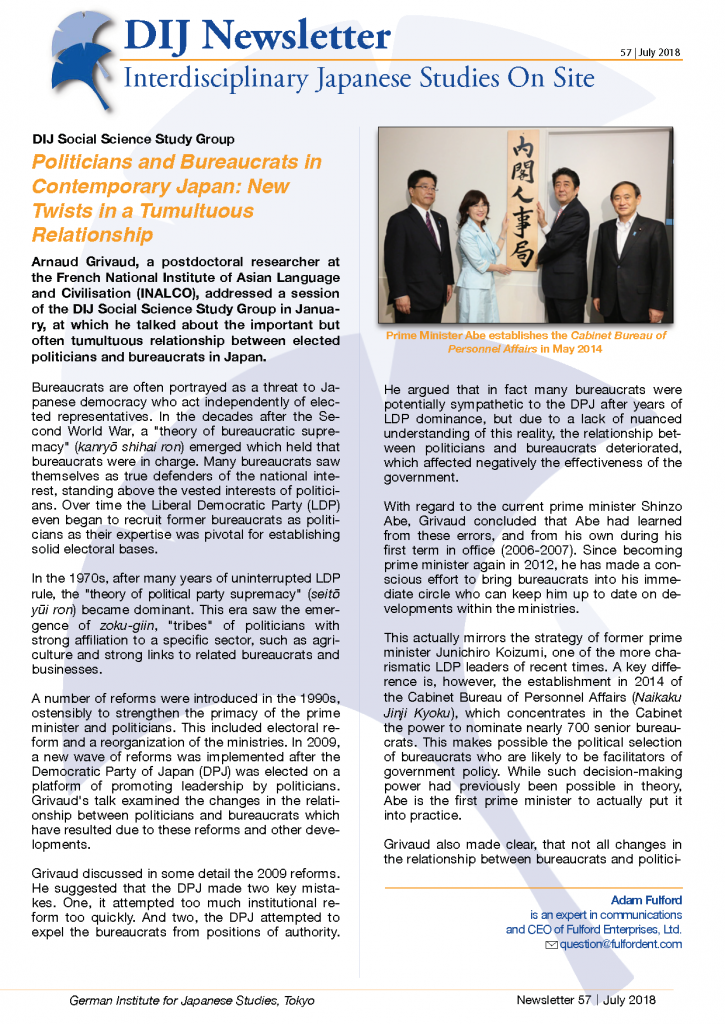 DIJ Newsletter 57 is out now! This issue features the following topics:
DIJ Social Science Study Group: Politicians and Bureaucrats in Contemporary Japan: New Twists in a Tumultuous Relationship
Arnaud Grivaud, a postdoctoral researcher at the French National Institute of Asian Language and Civilisation (INALCO), addressed a session of the DIJ Social Science Study Group in January, at which he talked about the important but often tumultuous relationship between elected politicians and bureaucrats in Japan.
China, Japan, and the Contest for ‘Asia’
China’s recent rediscovery of the Silk Road reaffirms the country’s claim to being acknowledged once again in its role as the ‘Central Kingdom’. Its ambition is global but at its core is China’s position in Asia.
(Re)Locating the Tsukiji Central Wholesale Market
Located in the heart of Tokyo, the Tsukiji Wholesale Market is the world’s largest seafood market with annual sales of 428 billion yen in 2017. It is most famous for its tuna auctions setting the world market prices, but in addition to seafood, there is also trade in vegetables, fruit, eggs, chicken and processed foods. The market was founded in the Edo period and stands in its present location since 1935. After decades of political contestation, it is now scheduled to relocate to a modern construction in Toyosu in October.
Inbound Tourism – Japan’s new growth market
Since 2012, Japan has been experiencing a veritable tourist boom. More than 28 million residents from abroad visited the country in 2017, four times as many as in 2011.
DIJ-Monographie 61 erschienen!
“Networks and Mobilization Processes: The Case of the Japanese Anti-Nuclear Movement after Fukushima”
Environmental disasters or other large-scale disruptive events often trigger the emergence of social movements demanding social and/or political change. This study investigates mobilization processes at the meso level of the Japanese anti-nuclear movement after the nuclear disaster at the Fukushima Daiichi nuclear power plant caused by the Great East Japan Earthquake and subsequent tsunami waves on March 11, 2011. To capture such meso level movement dynamics – which so far have played only a minor role in research on social movement mobilization – the study presents an analytical model based on premises from political process theory, network theory, and relational sociology. This model is then applied to the case of the Japanese anti-nuclear movement after Fukushima by looking at the relational dynamics of two coalitional movement networks engaged in advocacy-related activities in Tōkyō.
DIJ Newsletter 56 is out now!
This issue features the following topics:
International conference at the DIJ: Work-Related Diversity
On November 30th and December 1st 2017, the DIJ hosted the conference “From Flexible Rigidities to Embracing Diversity? – Work-Related Diversity and Its Implications for Japan and Beyond”
Local Anti-Nuclear Movements in Japan
The construction of a nuclear power plant is always a fiercely contested issue, especially for the affected local communities.
Japan’s rural areas – challenges and policies
Many municipalities outside of Japan’s larger agglomeration are exposed to severe demographic change.
Do labour market inequalities erode support for democracy?
In October 2017, a workshop examined links between labour market inequalities and politics in France, Germany and Japan.
Non-Japanese employees in Japan
Since the global financial crisis the number of Non-Japanese employees working in Japan is rising again.
The DIJ Newsletter is available in German and English, for download and in print.
“Rural Japan Revisited” – Contemporary Japan Virtual Special Issue

This virtual special issue is dedicated to contemporary studies exploring a Japan beyond the country’s metropolitan areas. Over the past decades, rural Japan nearly vanished from the Western research agenda, as urban Japan had come to dominate the attention of most social scientists studying contemporary Japan. Particularly the cityscape of Tokyo, the epitome of the Asian mega-city, has shaped the popular cultural imagination of Japan from abroad to an extent that the countryside, if seen at all, acquires all qualities of a museum or cultural repository of the past. Yet it should not be forgotten that millions of Japanese continue to live in quite different social spaces, such as hamlets, villages, or rural towns in mountainous and coastal areas. Even though urbanization, consumption and media usage have left their imprint on everyday life, social values and behavior rules in even the most remote part of the country, there is ample reason to take the urban-rural divide as a meaningful line of distinction between the two structurally different and inherently distinct spheres of city and countryside.
This virtual special issue has been compiled as a reminder of the significance that life and living in regional Japan is having for an adequate understanding of contemporary Japan, the changing faces of the “rural imaginary” (Schnell 2005) and the plurality of lifeways in late-modern society.


 Follow us on Bluesky
Call for Submissions

Contemporary Japan
current issue Vol. 38, No.2
Contemporary Japan is open year-round for rolling submissions, with accepted publications published immediately online. Please see the instructions for submission here.
DIJ Monograph Series
Our monograph series is  Open Access after a one-year embargo period. Downloads are available on our
→ monographs pages.
道案内
ドイツ-日本研究所
〒102-0094 東京都千代田区
紀尾井町7-1 上智紀尾井坂ビル 2F
道案内
+81 (0)3 3222-5077
+81 (0)3 3222-5420
dijtokyo@dijtokyo.org