Events and Activities
Management Careers, Internal Control and Corporate Governance. Where Japan and Germany Differ

Career concerns of managers function as an important control mechanism in the context of corporate governance. They bear important motivating and disciplining effects. In Japan, where – in the absence of a well-functioning external market – management careers have been generally restricted to in-house promotions, career concerns also result in efforts by middle management to exert control over and influence top management decisions as they impact their career perspectives.
Takaaki Eguchi’s paper explains the background and implications of such internal control mechanisms in Japan and points to their limitations in recent years given the increasing need for a stronger top management function. Reviewing relevant empirical research, Franz Waldenberger shows that managerial careers in Germany have long been embedded in an external market.
DIJ Newsletter No. 55 is out now!
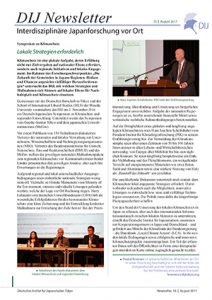
The current issue features a comprehensive report about the German-Japanese Symposium on climate change mitigation and regional development („Deutsch-Japanisches Symposium zu Klimaschutz und regionaler Entwicklung“) which was hosted in cooperation with the Embassy of Germany in Tokyo and the School of International Liberal Studies (SILS) at Waseda University.
In addition to that we also report on some of DIJ’s other events from the recent past, present our latest publications and introduce one of our new employees.
As always, the DIJ Newsletter is available as PDF file and in print.
“Japan in der Ära Abe. Eine politikwissenschaftliche Analyse” – DIJ Monographie 60 erschienen!

Wie kaum ein japanischer Premierminister vor ihm scheint der seit 2012 wieder amtierende Shinzō Abe die Politik seines Landes grundlegend zu verändern. Als Spross einer Politikerdynastie eigentlich ein typischer Vertreter des politischen Establishments, verspricht er in allen zentralen Politikfeldern – von der Außen- und Sicherheitspolitik, über die Wirtschafts- und Arbeitsmarktpolitik, bis hin zur Energiepolitik –, alte Gewissheiten und Strukturen in Frage zu stellen. Dazu kommt, dass es Abe gelungen ist, im notorisch instabilen Regierungssystem Japans eine ungewöhnlich populäre und scheinbar fest im Sattel sitzende Regierung zu formen. Doch gleichzeitig regt sich Widerstand vor allem bei der japanischen Jugend, die mit Großdemonstrationen und neuen Formen des Protests auf sich aufmerksam macht.
Die in diesem Band versammelten Beiträge beleuchten diese und weitere Trends der Ära Abe.
Fully reserve backed money – a solution to Japan’s fiscal and monetary challenges
The paper argues that Japan’s legislators should use this window of opportunity to introduce 100% de jure reserve requirements for transfer deposits.
Such a move would not only take advantage of the benefits propagated by supporters of a reserve-backed regime. The implied BoJ’s balance sheet expansion would allow the Bank to further purchase JGBs. As the expansion would be permanent, the regime shift would not only stabilize the government’s fiscal condition, the BoJ, too, would no longer have to worry about exiting its policy of quantitative easing. Both the government and the central bank could focus on their primary policy goals.
Contemporary Japan 28, No. 2
Contemporary Japan is an international peer-reviewed journal edited by the German Institute for Japanese Studies Tokyo (DIJ) and published biannually by de Gruyter, Berlin and New York.
Contemporary Japan publishes in-depth, original work from all disciplines as they relate to present-day Japan or its recent historical development.
High-tech Start-up Ecosystems in East Asian Agglomerations: Are They Different From the West?
 Start-up ecosystems within regional agglomerations have been intensively studied in Western countries, but much less in East Asia. Therefore, little is known about the specific features of East Asian start-up ecosystems.
We study the high-tech start-up ecosystems within four leading East Asian agglomerations: Tokyo, Seoul, Suzhou and Chongqing.
DIJ Newsletter 53, April 2016
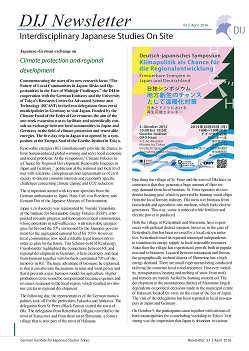 The Newsletter, which since June 1997 appears two times a year in German and English, contains information about DIJ research projects, events and publications.
Bulletin 36, 2016
Das im Frühjahr 2016 erschienene Bulletin informiert ausführlich über die Aktivitäten des Deutschen Instituts für Japanstudien im vergangenen Jahr (2015).
Diese auf deutsch herausgegebene Publikation kann direkt beim DIJ in Tokyo bezogen werden.



 Follow us on Bluesky
Call for Submissions

Contemporary Japan
current issue Vol. 38, No. 1
Contemporary Japan is open year-round for rolling submissions, with accepted publications published immediately online. Please see the instructions for submission here.
DIJ Monograph Series
Our monograph series is  Open Access after a one-year embargo period. Downloads are available on our
→ monographs pages.
Access
DIJ Tokyo
Jochi Kioizaka Bldg. 2F
7-1 Kioicho Chiyoda-ku, Tokyo
102-0094 Japan
Where to find us
+81 (0)3 3222-5077
+81 (0)3 3222-5420
dijtokyo@dijtokyo.org

DIJ-ARI Asian Infrastructures Research Partnership