Events and Activities
David M. Malitz analyses Japan’s diplomatic reaction to the war in the Middle East
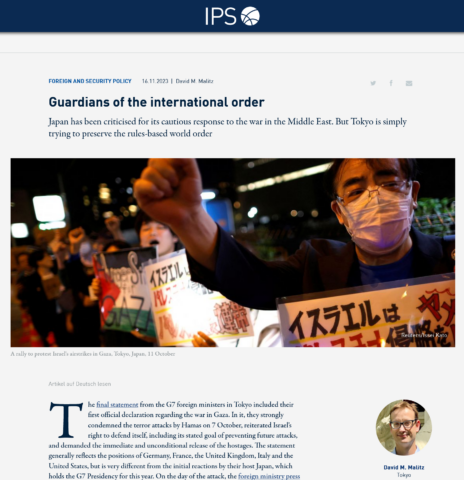
The online journal International Politics and Society (IPS) has published an article by DIJ researcher David M. Malitz analysing Japan’s diplomatic reaction to the war in the Middle East. In “Guardians of the international order”, David explains that some of the criticism Japan has received for its cautious response to the war is undeserved. As he writes, it would “be wrong to play up or misinterpret why Japan did not sign the ‘Joint Statement on Israel’ with Germany, the United Kingdom, France, Italy and the United States on 9 October. Japan could not back the phrase ‘our countries will support Israel in its efforts to defend itself’ because its law prohibits exporting weapons.” Notwithstanding, high-ranking Japanese diplomats condemned the ‘terror attacks’ by Hamas and ‘expressed solidarity with the Israeli people’. “Japan has again demonstrated that it shares the same values and that its main concern is maintaining the rules-based international order”, David concludes. The article is also available in German here.
Torsten Weber bespricht Nationalmuseum für Japanische Geschichte

DIJ Historiker Torsten Weber hat für die neueste Ausgabe der Geschichtszeitschrift Werkstatt Geschichte (Vol. 31, No. 88) die Dauerausstellung des Nationalmuseums für Japanische Geschichte in Sakura (Chiba) besprochen. In “Vielfalt als Nationalgeschichte. Das japanische Rekihaku Museum” erklärt er die Entstehungsgeschichte des Museums, sein pädagogisches Konzept und die wichtigsten Exponate der sechs Abteilungen. Das Museum, das 2023 sein 40-jähriges Bestehen feiert, zeichne sich vor allem durch seinen Fokus auf Alltagsgeschichte, innerjapanische Diversität des historischen Erlebens sowie transnationale Verbindungen japanischer Geschichte in Ostasien aus. Außerdem reflektiere die Dauerausstellung zur Geschichte Japans von der Prähistorie bis zur Gegenwart den aktuellen Forschungsstand und adressiere auch offene Forschungsfragen. Darüber hinaus biete sie durch Film, Musik, zahlreiche “Science Lab”-Stationen und eine Tempelschule zum Mitlernen Einblicke in die Arbeit der Kuratoren sowie abwechslungsreiche pädagogische Elemente. Der Ausstellung gelinge es, stereotype Simplifizierungen zu vermeiden und präsentiere “die Geschichte Japans fast komplett ohne einen expliziten Fokus auf die Nation”.
Co-authored book chapter by Nora Kottmann examines Japanese singles and solo-life

The average age of first marriage in Japan has steadily increased over the last century, as has the likelihood of never marrying, for both women and men. In conjunction with the decline in average length of marriage, these trends indicate that Japanese people are spending more of their lives singles, in the sense of being legally unmarried. Against this background, the chapter “Japanese Singles and Solo-Life”, co-authored by Laura Dales and former DIJ researcher Nora Kottmann discusses the implications of singlehood and the ways that being single and solo activities (sorokatsu) have been framed and re-framed in the wake of the 2020 COVID-19 pandemic. The authors explore the possibilities for belonging, as well as marginality, in singlehood at a time when intimate and relational practices are shaped by the proscription of the ‘3 Cs’ (closed spaces, crowds, and close-contact situations). The chapter was published in Singular Selves: An Introduction to Singles Studies (Routledge India 2024), edited by Ketaki Chowkhani and Craig Wynne.
New book by Harald Kümmerle on Mathematics as science in Japan
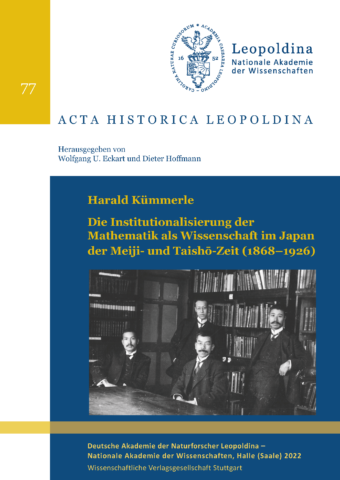 The new open access book Die Institutionalisierung der Mathematik als Wissenschaft im Japan der Meiji- und Taishō-Zeit (1868–1926) by DIJ researcher Harald Kümmerle examines the rapid institutionalization of mathematics as a scientific discipline in Meiji and Taishō-era Japan. This development was based on a rich pre-existing tradition of knowledge and is analysed with a focus on the foundations, the course, and the characteristics of knowledge circulation. To this end, Harald’s study examines the organisational formation, standardisation, professionalisation, and disciplinary formation of mathematics in Japan. The book is published in the Acta historica Leopoldina series (vol. 77) by Wissenschaftliche Verlagsgesellschaft Stuttgart. It is based on Harald’s PhD dissertation which was awarded the Johannes Zilkens Dissertation Award in 2020.
New issue of Contemporary Japan with ‘Gender, Family and Work’ special section
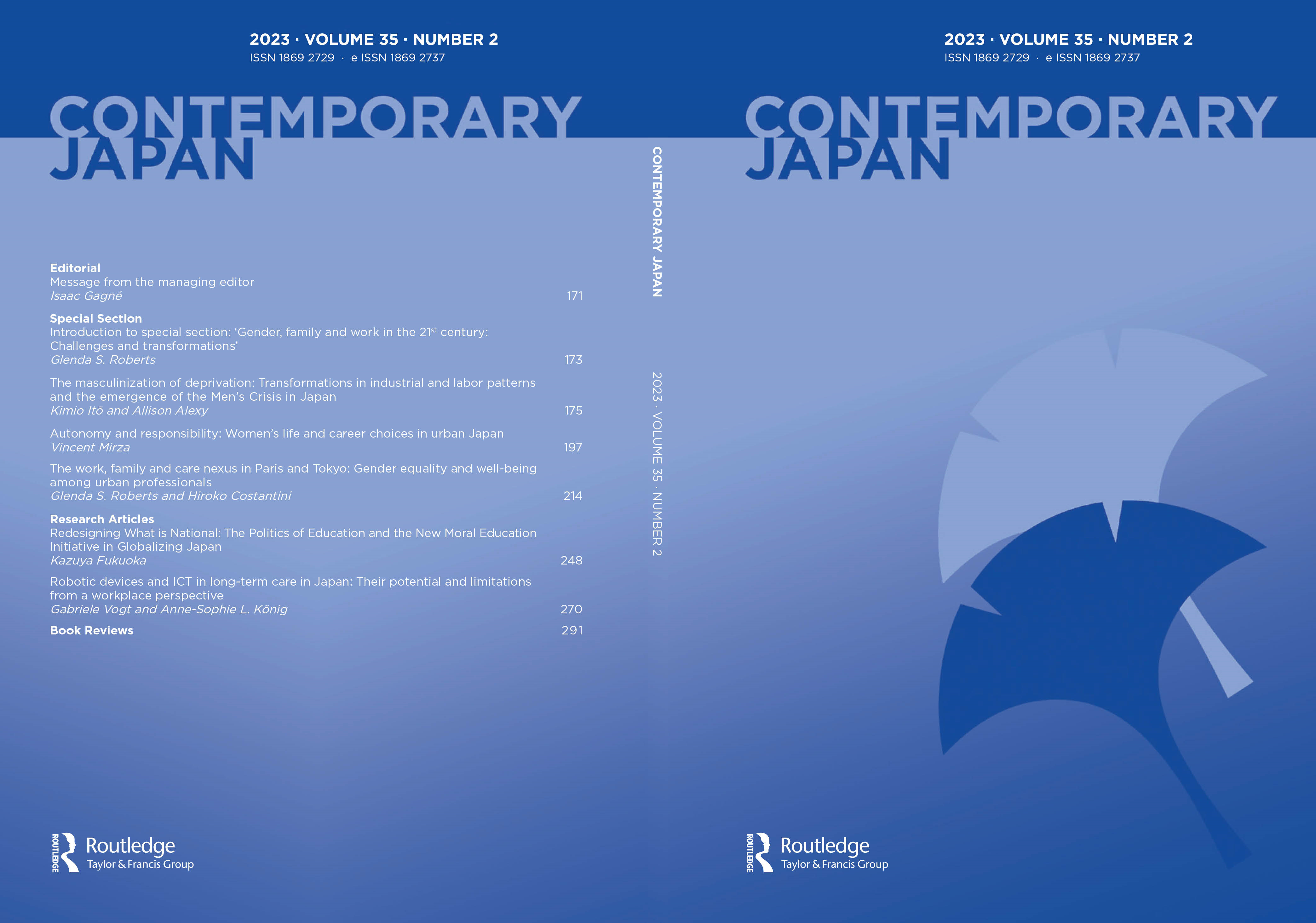 We have just published a new issue of Contemporary Japan (vol. 35, no. 2), containing a special section on “Gender, Family and Work in the 21st Century: Challenges and Transformations”, guest edited by Glenda S. Roberts. The special section includes articles on the masculinization of deprivation by Kimio Itō & Allison Alexy, on women’s life and career choices in urban Japan by Vincent Mirza, and on gender equality and well-being among urban professionals in Paris and Tokyo by Glenda S. Roberts & Hiroko Costantini. This issue also contains two research articles on the politics of education by Kazuya Fukuoka and on robotic devices and ICT in long-term care by Gabriele Vogt and Anne-Sophie L. König. Rounding out the issue, our book review section covers three English language publications on urban migrants in rural Japan, on education and social justice, and on censorship in Japan. Please see the full issue here
DIJ Newsletter Autumn 2023
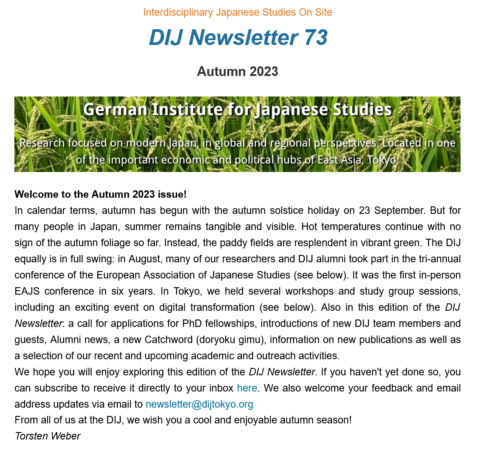
The autumn issue of our DIJ Newsletter includes introductions of new DIJ team members and guests, Alumni news, a new Catchword (doryoku gimu), a call for applications for PhD fellowships, information on new publications as well as a selection of our recent and upcoming academic and outreach activities. We hope you will enjoy exploring this new edition of the DIJ Newsletter. If you haven’t done so yet, you can subscribe to receive our Newsletters directly to your inbox. The full issues and subscription form are available here.
Open access journal article by David Malitz examines Thai nationalisms
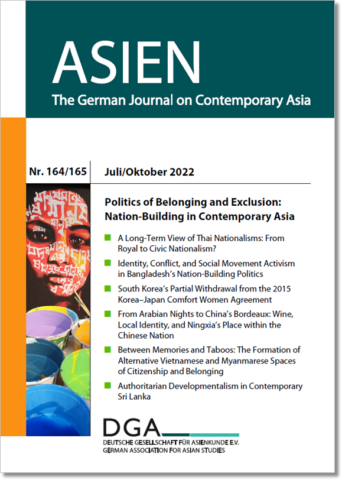
“A Long-Term View of Thai Nationalisms: From Royal to Civic Nationalism?” by David M. Malitz is now available as an open access article (Asien, No. 164/165, July/October 2022). Rejecting a linear evolution of Thai nationalist ideas, it traces the development of very different political imaginations of a Siamese/Thai political community from the early nineteenth century through the student protests of 2020/2021. It does not consider, therefore, these recent demands for reform of the country’s monarchy to represent a radical rupture with established Thai political culture. Rather, the student protests constitute a new iteration of a long-standing trend of contesting official nationalisms in the country. This is evident in the students’ own symbolic embracing of the history of the Siamese Revolution of 1932. For analytical purposes, the article employs a twofold approach: it differentiates between inclusive and exclusive imaginations of the national community on the one hand and between its democratic versus autocratic political organization on the other.
DIJ Newsletter Summer 2023
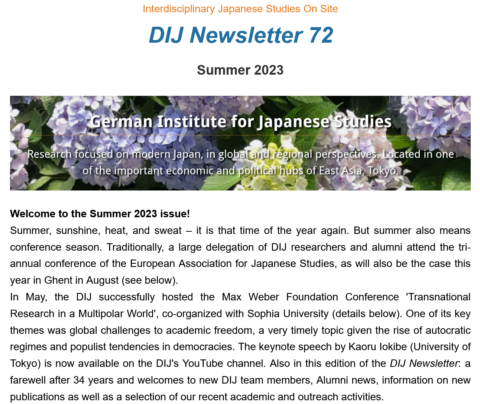
The summer issue of our DIJ Newsletter provides up-to-date insights into our research and publication activities, looks back to recent DIJ events, introduces new researchers, and gives updates on our outreach as well as on DIJ alumni activities. We hope you will enjoy exploring this new edition of the DIJ Newsletter. If you haven’t done so yet, you can subscribe to receive our Newsletters directly to your inbox. The full issues and subscription form are available here.



 Follow us on Bluesky
Call for Submissions

Contemporary Japan
current issue Vol. 38, No. 1
Contemporary Japan is open year-round for rolling submissions, with accepted publications published immediately online. Please see the instructions for submission here.
DIJ Monograph Series
Our monograph series is  Open Access after a one-year embargo period. Downloads are available on our
→ monographs pages.
Access
DIJ Tokyo
Jochi Kioizaka Bldg. 2F
7-1 Kioicho Chiyoda-ku, Tokyo
102-0094 Japan
Where to find us
+81 (0)3 3222-5077
+81 (0)3 3222-5420
dijtokyo@dijtokyo.org

DIJ-ARI Asian Infrastructures Research Partnership