Events and Activities
Joint NIRA/DIJ Opinion Paper “Coping with the Economic Consequences of the COVID-19 Pandemic”
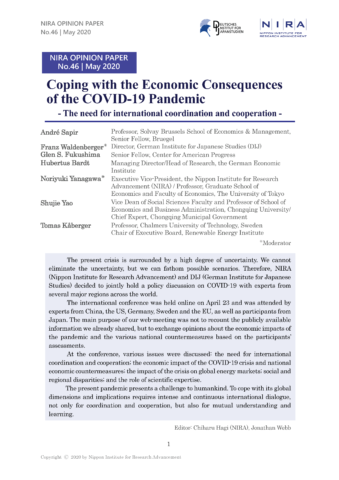 The present crisis is surrounded by a high degree of uncertainty. We cannot eliminate the uncertainty, but we can fathom possible scenarios. Therefore, NIRA (Nippon Institute for Research Advancement) and the DIJ decided to jointly hold a policy discussion on COVID-19 with experts from several major regions across the world. The international conference was held online on April 23 and was attended by experts from China, the US, Germany, Sweden, and Belgium, as well as participants from Japan. The main purpose of the web-meeting was not to recount the publicly available information we already shared, but to exchange opinions about the economic impacts of the pandemic and the various national countermeasures based on the participants’ assessments. Various issues were discussed: the need for international coordination and cooperation; the economic impact of the COVID-19 crisis and national economic countermeasures; the impact of the crisis on global energy markets; social and regional disparities; and the role of scientific expertise. The present pandemic presents a challenge to humankind. To cope with its global dimensions and implications requires intense and continuous international dialogue, not only for coordination and cooperation, but also for mutual understanding and learning. You can read the full joint NIRA/DIJ Opinion Paper here
Book publication on Japan and the Tokyo Olympics
 Japan Through the Lens of the Tokyo Olympics (Routledge 2020) situates the 2020 Tokyo Olympics within the social, economic and political challenges for Japan. Tokyo 2020 is constructed to embrace diversity and inclusiveness in society, foster sustainability, boost Japan’s economy, and create a feeling of unity and pride for the country. Irrespective of the Olympic’s postponement or potential cancellation, this book explains the multifaceted impact of the Tokyo Olympics on Tokyo, on Japan and on its society, businesses, and its self-identity. Written by leading experts on Japan, this volume assembles 34 easily accessible chapters covering all relevant aspects of society, economics, culture, and politics incl. technology, food, security, work, media, sexuality, history, film, linguistics, volunteering, architecture, advertising, and – of course – sports! Project page
Edited by Barbara Holthus, Isaac Gagné, Wolfram Manzenreiter, and Franz Waldenberger, this book contains many contributions by current and former DIJ researchers. It is now available in paperback, hardcover and as open access book.
Book chapter on Decline and Diversification in Coastal Fisheries
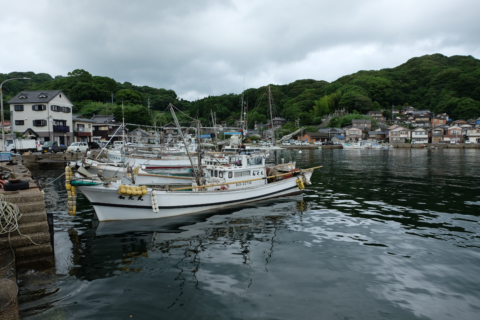
Based on fieldwork in the prefecture of Saga in Northern Kyushu, this chapter by Sonja Ganseforth explores the struggles of small family fishing businesses and cooperatives dealing with global and national transformations since the 1980s. The emergence of buyer-driven global commodity chains in seafood, the proliferation of large supermarket chains and a re-orientation of consumer preferences constitute a profound shift in the seafood business in Japan. Growing resource problems, high input costs and stagnating fish prices contribute to the declining profitability of local coastal fisheries. Drawing on research on rural experiences of globalization as well as critical analyses of development, growth and sustainability discourses, the chapter “Reclaiming the Global Countryside? Decline and Diversification in Saga Genkai Coastal Fisheries” argues that qualitative reform of fishery cooperatives, marketing and resource management is needed to halt socio-economic decline in Japanese coastal fisheries.
This chapter is part of the volume Japan’s New Ruralities. Coping With Decline in the Periphery (Routledge), co-edited by W. Manzenreiter, R. Lützeler, and S. Polak-Rottmann, and draws on Sonja’s research projects on Japan’s Blue Economies and What Is the Local?
New publication on Telehealth Networks in Japan’s Regions
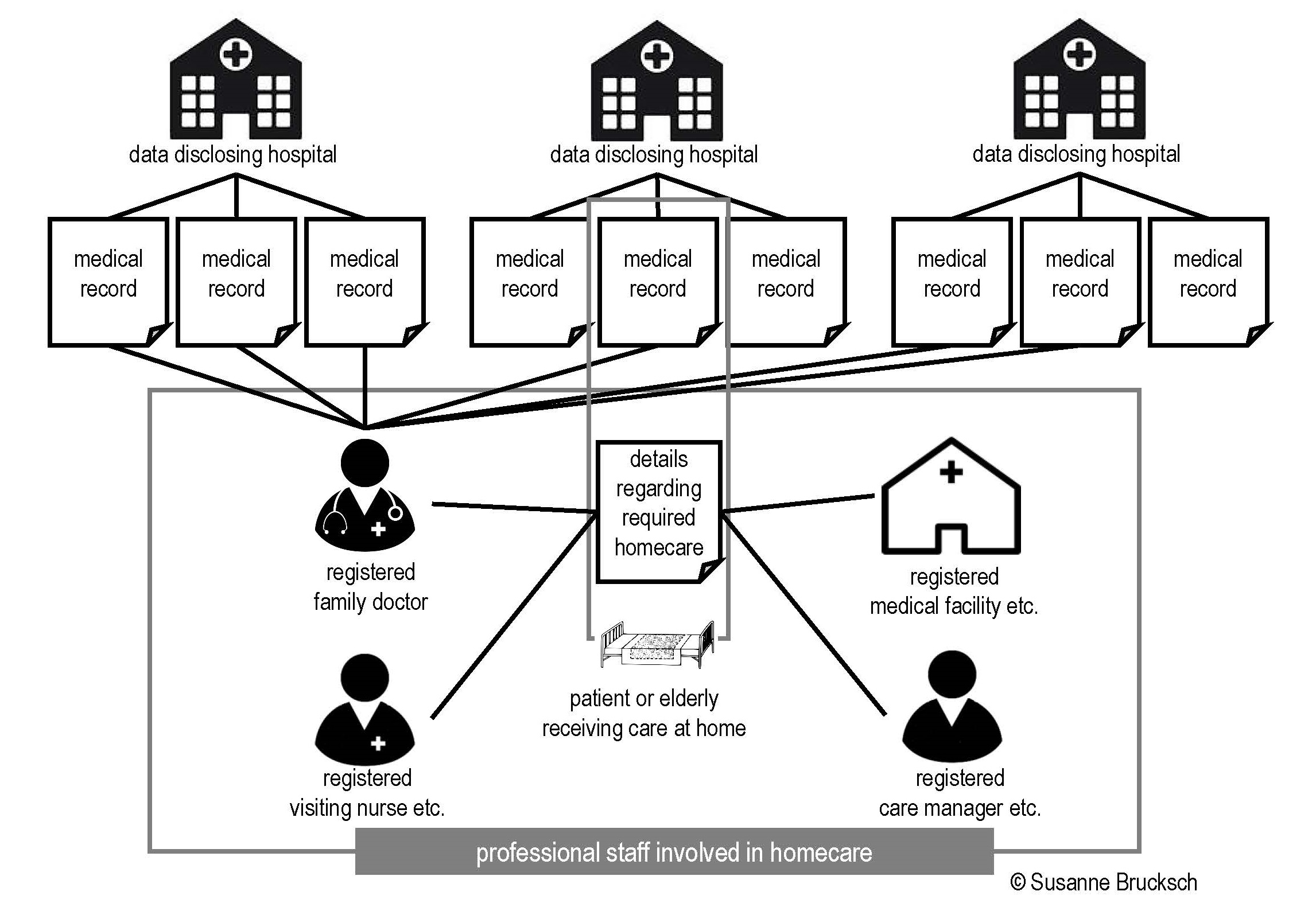 During the ongoing COVID-19 pandemic, telemedicine and telecare receive particular attention as ways to avoid infections and to protect vulnerable groups. In fact, several municipalities and prefectures in Japan have already introduced telehealth networks to link local healthcare institutions and medical practitioners. In her latest publication, Susanne Brucksch examines how these networks promote the establishment of “Regional Integrated Healthcare Systems” and generate synergies between medical and long-term care regarding healthcare staff, services, and infrastructure. The chapter ‘Sustaining Healthcare in Japan’s Regions: The Introduction of Telehealth Networks’ contains findings from an interview study (2017) on two cases regarding the provision of and access to healthcare services, while referring to the theoretical concept of socio-spatial-digital proximity by N. Oudshoorn (2011). Overall, the findings suggest that the telehealth infrastructure is a necessary precondition to promote and to initiate collaboration between various healthcare institutions in order to establish a regional healthcare system.
This chapter is part of the volume Japan’s New Ruralities. Coping With Decline in the Periphery (Routledge), co-edited by W. Manzenreiter, R. Lützeler, and S. Polak-Rottmann, and draws on Susanne’s research projects on Ageing in Japan and Biomedical Engineering in Japan.
New publication on rural Japan
 Several DIJ researchers, alumni, and affiliates have contributed to this new publication on political innovations, transformations, and new residents in rural Japan. Sonja Ganseforth examines the decline and diversification in Saga Genkai coastal fisheries, Daniel Kremers (with Thomas Feldhoff) looks at Japan’s energy transformation and its potential for the remaking of rural communities, Susanne Brucksch studies the introduction of telehealth networks in Japan’s regions, and Hanno Jentzsch analyzes the promotion of wine tourism in Yamanashi. Their research is part of the DIJ’s research focus on The Future of Local Communities in Japan.
The volume is co-edited by Wolfram Manzenreiter, former DIJ research fellow Ralph Lützeler, and Sebastian Polak-Rottmann. It is published in the Nissan Institute/Routledge Japanese Studies series and available as hardback, paperback, and eBook.
Barbara Holthus in JDZB interview on Tokyo Olympics
“Japan and Tokyo are trying to reinvent themselves with the Olympic and Paralympic Games as a place of diversity, inclusion, cosmopolitanism, “coolness”, and hospitality. They will also try to present the nuclear disaster of Fukushima as “overcome”. All in all, Tokyo 2020 serves as a prism in which the hopes of a wide range of stakeholders are paired with the commercial interests of the IOC and the sponsors.”
In the current issue of jdzb echo, the newsletter of the Japanese-German Center Berlin, Barbara Holthus is interviewed on the Tokyo Olympics and the book project Japan through the Lens of the Tokyo Olympics, of which she is a co-editor. Please note: the JDZB event scheduled for April 2 has been postponed. 
New Study: Use of robotic devices in elderly care in Japan
 As part of a study conducted by the IGES Institute, Berlin, Franz Waldenberger (Director of DIJ) and Sieun Park (Scholarship student at DIJ) investigated to what extent robotic devices were applied in elderly care in Japan, how practitioners assessed their potential and what difficulties stood in the way of the spread of the technology. Given the severe labor shortage in elderly care, these questions are of utmost importance. The study was prepared for the German Federal Ministry for Economic Affairs and Energy. An abridged version of the final report (in German) can be downloaded here.
New Article on Anti-Olympic Opposition in Japan
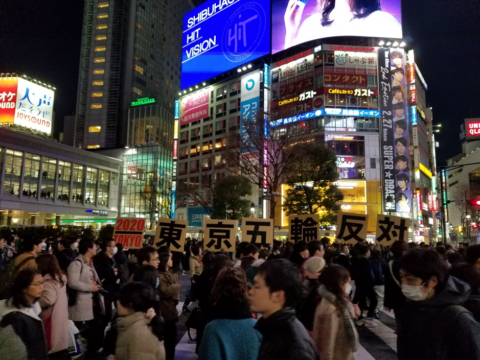 Since the radicalization of some leftist movements in the 1960s and 1970s, political activism in Japan is often met with skepticism or suspicion, and social movements are largely characterized by small and senior membership. Anti-Olympic opposition in Japan is largely sustained by activist veterans from this “invisible civil society”. While this activism may alienate the public, connections to other Japanese social movements are rich, especially to the anti-nuclear movement that has emerged since the 2011 nuclear disaster.
Read more in ‘Anti-Olympic Rallying Points, Public Alienation, and Transnational Alliances’, a contribution by Sonja Ganseforth to the Special Issue on Japan’s Olympic Summer Games in The Asia-Pacific Journal – Japan Focus, edited by Jeff Kingston.



 Follow us on Bluesky
Call for Submissions

Contemporary Japan
current issue Vol. 38, No. 1
Contemporary Japan is open year-round for rolling submissions, with accepted publications published immediately online. Please see the instructions for submission here.
DIJ Monograph Series
Our monograph series is  Open Access after a one-year embargo period. Downloads are available on our
→ monographs pages.
Access
DIJ Tokyo
Jochi Kioizaka Bldg. 2F
7-1 Kioicho Chiyoda-ku, Tokyo
102-0094 Japan
Where to find us
+81 (0)3 3222-5077
+81 (0)3 3222-5420
dijtokyo@dijtokyo.org

DIJ-ARI Asian Infrastructures Research Partnership