イベント&アクティビティ
Cute Masculinity – Investigating the Meaning of Virtual Shōjo and Girl Parody by Young Men in the 2010s
Lecture Series ‘Gender and Sexuality in East Asia’ (2/5)
Around 2010, cute male characters, drawn visually identical to bishōjo (beautiful girl) characters, moved beyond erotic computer games (erogē) and into cosplay and cute cross-dress fashion subculture, on campuses and online. By the middle of the 2010s, M2F cute and girlish boys were also a tangible theme in advertising and major media production. The well-trained bodies and willing faces of young girls lining screens and interfaces in the city, became infiltrated by male talents and pop idols in cute cross-dress. This paper explores the pick-up and adaptation of cute as a male visual aesthetic in subcultural practices and fashion and considers its complex play with transformation and masculine identity. Details
Speaker:
Sharon Kinsella, The University of Manchester
How Real Are Numbers?
Making Sense of National COVID-19 Statistics
 DIJ MFJ Web-Forum
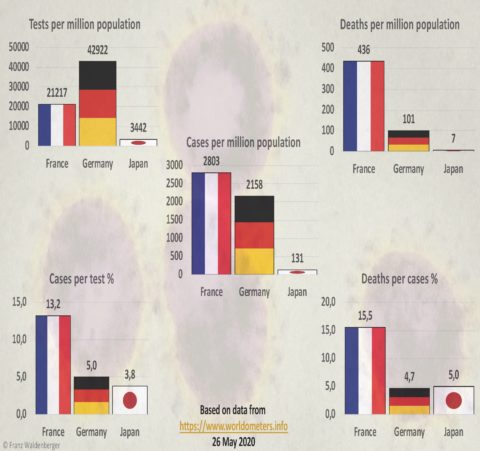
The number of infections, reproduction numbers, doubling speeds, death rates: national pandemic statistics are updated, compared and discussed daily. The numbers are shocking, but so are the huge national differences. Why are there so few people infected in Japan? Why is the death rate in Germany so low? Why is the situation in France so bad? For sure, countries apply different testing and reporting methods. Simple comparisons are likely to be misleading. Nevertheless, these numbers are relevant as they influence important policy decisions. In our Web-Forum we ask leading experts in the field from France, Germany, and Japan to explain the apparent differences in national data related to the COVID-19 pandemic and what the numbers can really tell us about the situation in the three countries. Details
Speakers:
Ansgar Lohse, University Medical Center Hamburg-Eppendorf
Paul-André Rosental, Sciences Po Paris
Kenji Shibuya, King’s College London
You can access this online event here: https://www.youtube.com/watch?v=YnOfeA8nbts
Book chapter on Japan’s energy transformation and its potential for rural communities

Renewable energies have the potential to increase energy security, reduce greenhouse gas emissions, and provide an economic basis for the sustainable development of rural areas. Facing typical peripherality issues such as socio-economic decline, poor accessibility, limited political autonomy and tightened budgets, rural communities in Japan are pressed to venture into new institutional arrangements in order to fulfill their statutory duties. Increasing self-sufficiency has therefore emerged as a key strategy for local governments, including energy self-sufficiency. The book chapter “Local renewables: Japan’s energy transformation and its potential for the remaking of rural communities”, co-authored by Daniel Kremers and Thomas Feldhoff (Bochum), analyzes some key trends in Japan’s recent energy transformation and energy policy, in particular government policies linking renewable energy to local development, and local-level conflicts related to increases in renewable energy generation. Case studies highlight the diversity of challenges and the need for locally-specific solutions that lead to healthier communities.
This chapter is part of the volume Japan’s New Ruralities. Coping With Decline in the Periphery (Routledge), co-edited by W. Manzenreiter, R. Lützeler, and S. Polak-Rottmann, and draws on Daniel’s research project on Energy Transition and Energy Democracy in Japan.
Lecture Series: Gender and Sexuality in East Asia – Cultural Studies and Social Science Perspectives
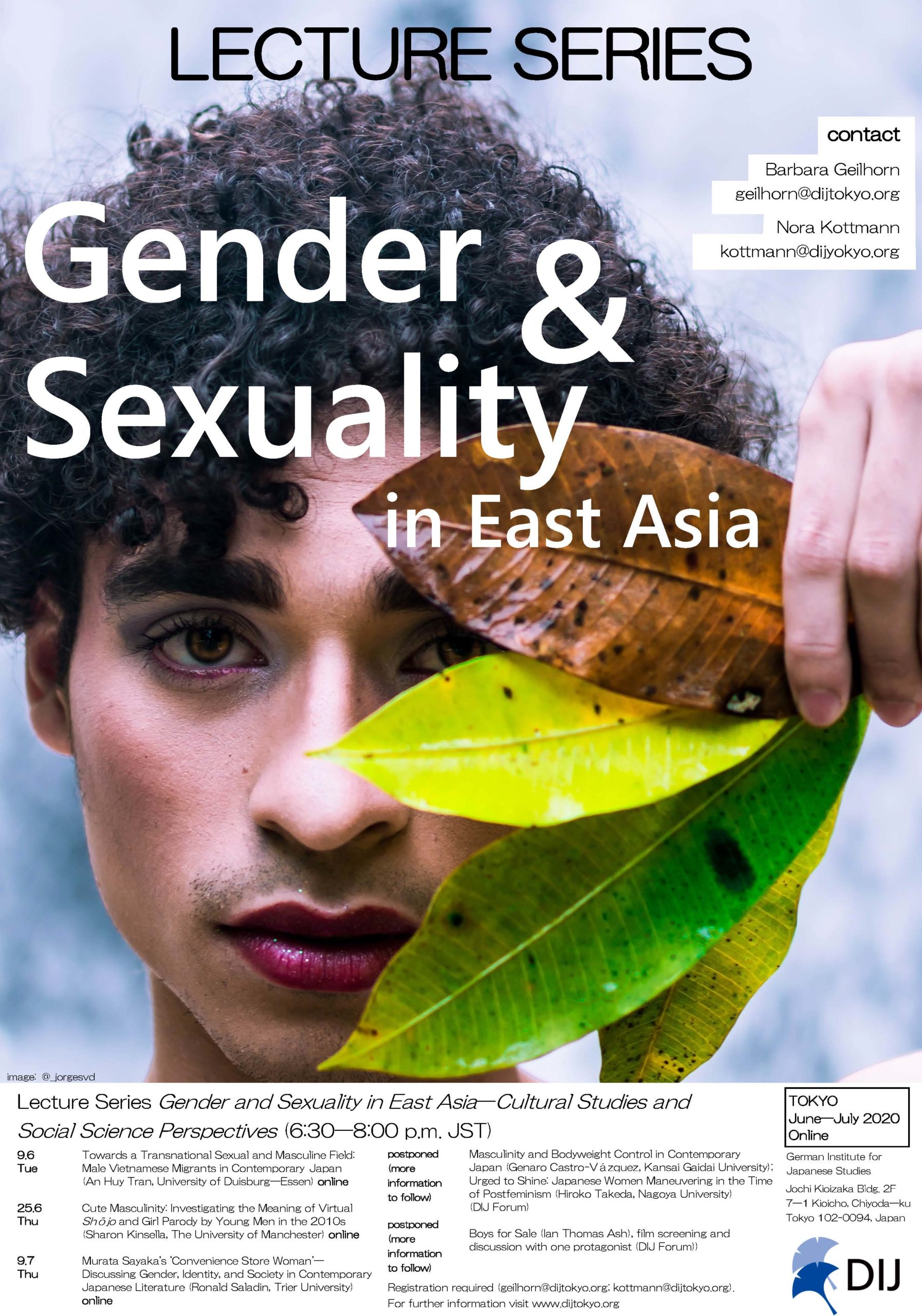 This lecture series sets out to explore ‘Gender and Sexuality in East Asia’ from a cultural studies and social science perspective. It is structured as a set of three online lectures to be followed by a DIJ Forum and a film screening and talk with the producer and one protagonist (dates t.b.c.). Topics that will be addressed are: Sexualities and migration, ‘new’ masculinities, ‘new’ life courses for women, gender constructions in film and literature, bodies and postfeminism.
Online Lectures
An Huy Tran, University of Duisburg-Essen/Waseda University: ‘Towards a Transnational Sexual and Masculine Field: Male Vietnamese Migrants in Contemporary Japan’ (9 June)
Sharon Kinsella, The University of Manchester: ‘Cute Masculinity: Investigating the Meaning of Virtual Shōjo and Girl Parody by Young Men in the 2010s’ (25 June)
Ronald Saladin, Trier University: ‘Murata Sayaka’s ‘Convenience Store Woman’ – Discussing Gender Identity and Society in Contemporary Japanese Literature’ (7 July)
Join us to discuss these issues with internationally established scholars! Further information, incl. technical details will be announced here and on Twitter (@dij_tokyo) in due time. Download Poster
Towards a Transnational Sexual Field: Male Vietnamese Migrants in Contemporary Japan
Lecture Series ‘Gender and Sexuality in East Asia’ (1/5)
Transnational movements of people across borders have been one of the most prominent forces in shaping sexualities and genders. While migrants’ economic and labour practices have constituted a relatively wide spectrum of both academic and non-academic interests, the sexual and gendered dimensions of migration attract less attention. In particular, sexualities have historically been marginalized, and are still ‘absent as a social factor in mainstream sociological studies of migration’ (Carrillo 2017; Manalansan IV 2006). Moreover, in contrast to female migrants’ sexual and gender identities and behaviours, the sexual and gendered experiences of male movers have not been adequately investigated. Details
Speaker:
An Huy Tran, University of Duisburg-Essen/Waseda University
Access (Zoom Meeting):
https://zoom.us/j/92470344725?pwd=c09oRFFoMnRDVktvY2l5cVplT2x3QT09
Meeting ID: 924 7034 4725
Password: 329921
National Approaches to Systemic Risk:
Germany and Japan under the COVID-19 Crisis

DIJ DWIH Web-Forum
The perception, assessment, communication and containment of risks is an ongoing challenge for individuals, organizations and societies at large. The present COVID-19 pandemic reveals the profound problems countries confront and the difficult trade-offs they have to make when facing systemic risks combined with a high degree of uncertainty. It also shows remarkable differences in the way national governments, businesses and citizens are prepared for the crisis and are trying to cope with its various dimensions. In our online forum, two leading risk researchers from Japan and Germany will analyze and evaluate the crisis responses in their countries. The discussion will explore the similarities and differences in the national approaches, possible reasons and implications. Details
Speakers:
Ortwin Renn, Director, Institute for Advanced Sustainability Studies
Norio Okada, Prof. em. Kyoto University, Disaster Prevention Research Institute
You can access this online event here: https://www.youtube.com/watch?v=tdGa3jF7et0
‘Comparing Comparisons’ – new blog series online
 Comparison is back in fashion. In some fields it has spawned a vast literature and become the etiquette for discussions of appropriate focus and methods. The advent of big data and AI debates revolving around this have also rejuvenated comparative quantitative research. In other fields, however, comparison peaked long ago. There is a complex and uneven historical variance across disciplines. The new blog series ‘Comparing comparisons’ investigates which role comparisons play in different research fields, ultimately tackling the question of how and why we compare in the social sciences and humanities. The blog entries originate from the presentations of the international and interdisciplinary meeting by scholars affiliated with the Max Weber Research Group at the National University of Singapore and researchers from the German Institute for Japanese Studies that took place in Tokyo on 2nd and 3rd December 2019. Read the first article “Comparing Comparisons – Introduction and Overview” by James D. Sidaway and Franz Waldenberger on trafo blog for transregional research.
NIRA/DIJ共同オピニオンペーパー
『COVID-19 によるパンデミックの経済的影響への対応』
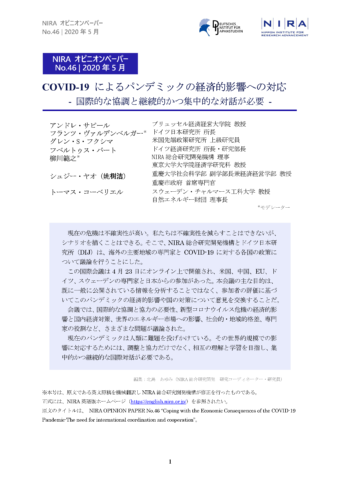 現在の危機は不確実性が高い。私たちは不確実性を減らすことはできないが、 シナリオを描くことはできる。そこで、NIRA 総合研究開発機構とドイツ日本研 究所(DIJ)は、海外の主要地域の専門家と COVID-19 に対する各国の政策に ついて議論を行うことにした。この国際会議は 4 月 23 日にオンライン上で開催され、米国、中国、ベルギー、ド イツ、スウェーデンの専門家と日本からの参加があった。本会議の主な目的は、 既に一般に公開されている情報を分析することではなく、参加者の評価に基づ いてこのパンデミックの経済的影響や国の対策について意見を交換することだ。会議では、国際的な協調と協力の必要性、新型コロナウイルス危機の経済的影 響と国内経済対策、世界のエネルギー市場への影響、社会的・地域的格差、専門 家の役割など、さまざまな問題が議論された。現在のパンデミックは人類に難題を投げかけている。その世界的規模での影 響に対応するためには、調整と協力だけでなく、相互の理解と学習を目指し、集中的かつ継続的な国際対話が必要である。NIRAとDIJの共同オピニオンペーパーの全項目はこちらです。



 Follow us on Bluesky
Call for Submissions

Contemporary Japan
current issue Vol. 38, No.2
Contemporary Japan is open year-round for rolling submissions, with accepted publications published immediately online. Please see the instructions for submission here.
DIJ Monograph Series
Our monograph series is  Open Access after a one-year embargo period. Downloads are available on our
→ monographs pages.
道案内
ドイツ-日本研究所
〒102-0094 東京都千代田区
紀尾井町7-1 上智紀尾井坂ビル 2F
道案内
+81 (0)3 3222-5077
+81 (0)3 3222-5420
dijtokyo@dijtokyo.org