Events and Activities
Gerald D. Feldman Travel Grants for multi-country research projects
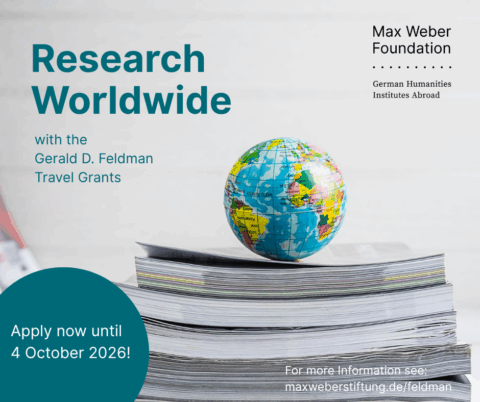 Are you an early career researcher looking for funding for research stays abroad of up to three months? If your countries of interest match, why not consider applying for a Gerald D. Feldman Travel Grant for researchers in the humanities and social sciences? The Max Weber Foundation (MWS) offers travel grants that allow you to conduct your own research project in two or three of the countries where MWS institutes and branches are located or at the Richard Koebner Minerva Center for German History in Israel. We particularly encourage applicants whose research includes Japan. Application deadline: 4 October 2026. Please see the full call, list of possible host countries, and application guidelines here
Onsite Study Group on Loneliness in Japanese Discourses and Screen Culture

The project Serial Solitudes: Audiovisual Cultures of Loneliness and Belonging in Contemporary Japan starts from the assumption that loneliness is not only an individual psychological experience, but also a socially and culturally shaped phenomenon articulated through different forms of knowledge. It therefore combines two forms of discourse analysis: scholarly debates on loneliness and audiovisual representations in films and television series. This presentation introduces the project at an early stage to discuss its methodological design. A key challenge is gaining systematic access to Japanese vocabulary and literature on loneliness without reducing the field to familiar concepts such as hikikomori or kodokushi. To address this, a source-based text-mining workflow supported by language models is being developed around sixty Japanese books, supplemented by Japanese translations of influential Western works. The presentation will outline the workflow, show preliminary examples, and invite discussion of its possibilities and limitations. Details and registration here
DIJ-Soziologin Barbara Holthus in ZDF-Dokumentation „Weltstädte: Tokyo“

In der neuen Folge Tokyo der ZDF-Reihe „Weltstädte“ spricht DIJ-Soziologin Barbara Holthus über Einsamkeit junger Menschen in der japanischen Hauptstadt und erklärt, dass niedrige Gehälter, lange Arbeitsstunden und die eigene, kleine Wohnung zum Einsamkeitsgefühl beitrügen: „Die jungen Leute haben sehr wenig Geld und dann leben sie in ganz kleinen Wohnungen und haben wenig menschliche Beziehungen, wenn sie denn mal nach der langen Arbeit nach Hause kommen.“ Gleichzeitig boomten Tiercafés und der Haustiermarkt. Wie Barbara Holthus erklärt, böten Tiercafés dabei nicht nur Möglichkeiten zum Konsum und zur Unterhaltung, sondern könnten auch das Bedürfnis nach körperlicher Nähe erfüllen: “ein bisschen Austausch mit etwas Lebendem”. Haustiere würden von vielen als gleichwertige Familienmitglieder und Ersatz für menschliche Beziehungen verstanden. Die ganze Folge „Tokyo“ ist in der ZDF-Mediathek verfügbar.
International Symposium on Entangled Trajectories of Modernization in East Asia
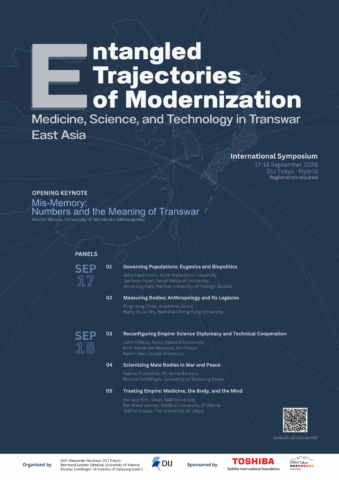 This two-day symposium explores the critical transition from the 1930s to the 1960s, a period marked by colonization, war, and postwar reconstruction in East Asia. Focusing on Japan, Korea and Taiwan, the event highlights the intertwined development of medicine, science, and technology across imperial legacies, Cold War geopolitics, and rapid modernization. Bringing together 14 historians of science, technology, and medicine, the conference seeks to uncover how shared histories and divergent paths shaped state-building, institutional reform, and knowledge production in these nations. Through comparative and transnational perspectives, the symposium invites new insights into the collaborative and contested processes that defined, and still define, the region’s future. The symposium takes place on September 17 and 18 online and on-site at the DIJ. It is organized by DIJ’s Dolf-Alexander Neuhaus, Bernhard Leitner (Medical University of Vienna), and Nicolas Schillinger (University of Duisburg-Essen). Details and registration here
DIJ researchers at EAJS Conference in Poznań
 Four DIJ researchers and more than 20 DIJ alumni will present their latest research at this year’s tri-annual conference of the European Association for Japanese Studies (EAJS) in Poland. Paper presenters include Isaac Gagné (“‘Pragmagic’ in urban East Asia: Tracing pragmatic practices and rituals of magical control in Tokyo and Hong Kong”; co-authored with Dominik Bartmanski), Nicole M. Mueller (“Working the Metaverse: Conceptual Frameworks, Corporate Policy, and Literary Interventions”), Dolf-Alexander Neuhaus (“Industrial education for Koreans under Japanese colonial rule and its postwar legacies, 1910s – 1960s”), and Torsten Weber (“Re-visiting the war in postwar Japan: Takeuchi Yoshimi’s ‘Asia’ versus Japan’s ‘West’”). The conference takes place at Adam Mickiewicz University in Poznań from August 27-30, 2026.
New Open Access book on Capitalism, Innovations, and Health after Covid-19
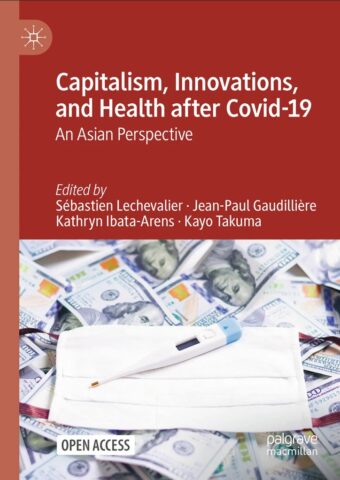 This open access book examines how the Covid-19 pandemic exposed structural tensions in innovation systems and capitalist models in the global economy, with a particular focus on Asian healthcare systems. Co-edited by DIJ Visiting Research Fellow Sébastien Lechevalier, Jean-Paul Gaudillière, Kathryn Ibata-Arens, and Kayo Takuma, Capitalism, Innovations, and Health after Covid-19. An Asian Perspective (Palgrave Macmillan 2026) contributes to debates on post-pandemic capitalism, technological development, and global healthcare management. The book interrogates systemic crises in capitalism and innovation; analyzes Covid-19 responses as a critical moment for rethinking health governance; and presents Asian experiences that challenge dominant models. Chapters draw on comparative political economy, science and technology studies (STS), and health policy to illuminate how Asia’s diverse trajectories offer lessons for more inclusive and sustainable innovation. Sébastien Lechevalier contributed the chapter “Care-led Innovation. A New Paradigm and an Application in the Japanese Context of Society 5.0”
DIJ Newsletter Summer 2026
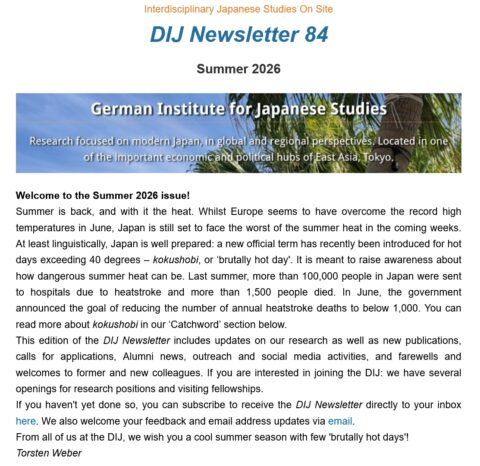
The summer issue of our DIJ Newsletter is now available online! We hope you enjoy this latest edition, which provides insights into our research, new publications, outreach activities, job and research grant opportunities, and a new edition of our Catchword series. We also introduce new team members and bid farewell to two colleagues who have left the DIJ. The DIJ Newsletter is published four times a year and features updates on our research, publications, events, outreach activities and team. If you haven’t done so yet, you can subscribe to receive our Newsletters directly to your inbox. The full issues and subscription form are available here.
Barbara Holthus quoted in AP and DLF media reports
 For a report published by Associated Press, DIJ sociologist Barbara Holthus explained how socialization, collectivism, and the concept of meiwaku, or not wanting to pose an inconvenience to others, contribute to the phenomenon of Japanese soccer fans cleaning up after sports games. “If you grew up with a certain way of how things are being done, you apply that to even cleaning up a stadium afterwards.” Barbara was also interviewed by German radio station Deutschlandfunk Kultur for a feature on Japanese women’s fights against stereotypes (in German). Commenting on changes and continuities in Japanese society regarding gender equality and equal opportunities, she explained that “men in Japan still tend to marry below their social class”. The radio feature also quotes insights on traditional gender roles and recent political developments in Japan from DIJ alumnus Vincent B. Lesch.


 Follow us on Bluesky
Call for Submissions

Contemporary Japan
current issue Vol. 38, No. 2
Contemporary Japan is open year-round for rolling submissions, with accepted publications published immediately online. Please see the instructions for submission here.
DIJ Monograph Series
Our monograph series is  Open Access after a one-year embargo period. Downloads are available on our
→ monographs pages.
Access
DIJ Tokyo
Jochi Kioizaka Bldg. 2F
7-1 Kioicho Chiyoda-ku, Tokyo
102-0094 Japan
Where to find us
+81 (0)3 3222-5077
+81 (0)3 3222-5420
dijtokyo@dijtokyo.org

DIJ-ARI Asian Infrastructures Research Partnership