Events and Activities
Hybrid Study Group on Female Mayors and the Practice of Local Leadership in Japan
 As of February 2026, women hold only 4.3 percent of Japan’s mayoral offices. This figure reflects the country’s well-documented challenges with gender equality in political participation. Directly elected by voters, mayors occupy a prominent position in Japanese local politics. They can shape local policies and advance individual agendas, making them key drivers of local change. This situation raises an important question: how do female mayors perceive their roles and contributions within their local communities and the broader political landscape? Drawing on interviews with female mayors, this presentation aims to produce a contextually grounded understanding of how they perceive and perform their political roles. Through a multi-layered approach, the speaker seeks to explain how female mayors navigate gendered structures through everyday political practice, and to situate their individual perspectives within broader debates on gender and political representation in Japan. Details and registration here
Joint DIJ-RWTH Workshop ‘Digital Capitalism & Varieties of Science’

In recent years, digital technologies have not only given rise to new sociocultural realities but have begun to profoundly alter the ways in which knowledge is produced, validated, and disseminated. Against this backdrop, this workshop explores the intersection of varieties of science and varieties of digital capitalism through a comparative and interdisciplinary lens. Bringing together perspectives from STS, economics, and Japanese studies, along with insights from practice, the workshop seeks to open-up a productive dialogue on how emerging technologies, digital capitalism, and scientific cultures co-constitute one another. The two-day workshop is jointly hosted by the DIJ and RWTH Aachen University. The sessions on March 12 (“Digital Technology in Context”) will be live-streamed. They will examine the co-evolution of digital technologies, digital capitalism, and scientific cultures through institutional, sociocultural, and epistemic contexts — with a specific focus on Japan. Details and registration here
Hybrid Study Group on Social Welfare Work in Colonial Taiwan and Korea

Among the many women’s organisations emerging in late 19th- and early 20th-century Japan, the Aikoku Fujinkai was one of the most prominent. Founded in 1901 by Okumura Ioko to support the Imperial Army through donations and aid supplies, it soon expanded into colonised Taiwan and Korea, where it recruited not only Japanese but also Taiwanese and Korean women as members. While the Aikoku Fujinkai actively promoted imperialist and militarist agendas, it pursued distinctly gendered objectives through large-scale social welfare projects focused on women and children. This presentation will share insights from recent archival fieldwork in Tokyo to discuss how the Aikoku Fujinkai’s social welfare work in interwar Taiwan and Korea can be interpreted within the political and social context of Japanese colonialism. Details and registration here
Celia Spoden presents her research on avatar robots, work, and disability at AAS Conference
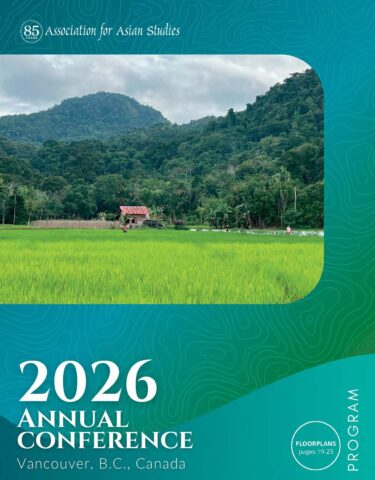 DIJ researcher Celia Spoden will participate in this year’s annual conference of the Association for Asian Studies (AAS) in Vancouver to present her latest research on cyber-physical spaces and avatar technologies. Celia’s presentation “Avatar Robots, Work, and Disability: Neoliberal Responsibilization or Questioning Ableist Notions of Labor?” is part of the panel “From Fingerprint Identification to Avatar Robots: Past and Present of Technology in Japan’s Engineering of the Future”. With papers stretching from the Meiji to the Reiwa eras, the panel asks what is really new—or actually old—about latest technological milestones such as service robots and data economy. Celia’s paper explains how the employees of an avatar robot café in Tokyo, where individuals with disabilities and chronic illnesses work remotely by controlling robots to serve customers on-site, utilize the avatar robots as their extended embodiment and challenge notions of disability, productivity, and labor.
DIJ Roundtable on recruitment and training strategies

Japan is a highly attractive, but difficult market for multinational companies. Their presence is by far the lowest among the OECD when measured by the stock of foreign direct investment relative to GDP. One of the biggest hurdles is the recruitment of qualified personnel. What strategies do foreign companies in Japan pursue to address the human resource challenge? To what extent do their strategies incorporate practices applied in their home market? This DIJ Roundtable presents findings from interviews with 25 experts from the field of human resource management in ten German companies in Japan. The presentation by Matthias Pilz will be followed by a panel discussion with Shigeki Egami and Carolina Kawakubo, moderated by Franz Waldenberger, a Q&A session, and a networking reception. Details and registration here
Deutschsprachiges Kaffeekränzchen „Philosophie-Jause“
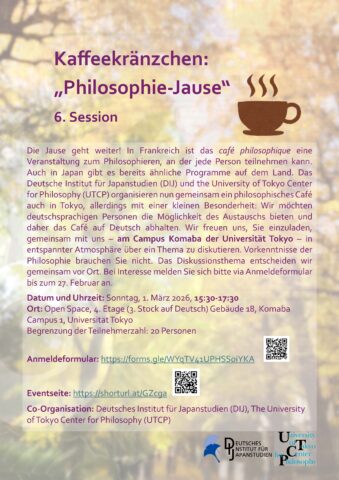 Die Jause geht weiter! In Frankreich ist das café philosophique eine Veranstaltung zum Philosophieren, an der jede Person teilnehmen kann. Auch in Japan gibt es bereits ähnliche Programme auf dem Land. The University of Tokyo Center for Philosophy (UTCP) und das Deutsche Institut für Japanstudien (DIJ) organisieren gemeinsam ein philosophisches Café auch in Tokyo, allerdings mit einer kleinen Besonderheit: Wir möchten deutschsprachigen Personen die Möglichkeit des Austauschs bieten und daher das Café auf Deutsch abhalten. Das Organisationsteam (Yukiko Kuwayama, UTCP und Sebastian Polak-Rottmann, DIJ) freut sich, Sie dieses Mal auf den Campus Komaba der Universität Tokyo einzuladen, um gemeinsam in entspannter Atmosphäre über ein Thema zu diskutieren. Fachliche Vorkenntnisse benötigen Sie nicht. Bei Interesse melden Sie sich bitte bis zum 27. Februar an. Weitere Informationen hier
DIJ co-hosts symposium on animal welfare at Nichibunken

Together with the International Research Center for Japanese Studies in Kyoto (Nichibunken), the DIJ will co-host the international symposium The Current State of Animal Welfare Movement Research (main language: Japanese) on February 14-15. It aims to explore the animal welfare movement in Japan from multiple perspectives, including ethics, history, and society. The term “animal welfare movement” here refers to all social activities aimed at human-animal coexistence, improving animal treatment, protection, and legal recognition. Four researchers from Japan and abroad, including DIJ sociologist Barbara Holthus (“The Sociology of Humans and Pets: Happiness, Loneliness, Multispecies Families”, in Japanese), will give presentations to examine human efforts concerning animal treatment under the umbrella term “animal welfare movement,” re-examining the nature of human-animal relationships. Participation in the symposium is only possible online.
Hybrid Study Group on Haga Yaichi and the Imagination of National Identity
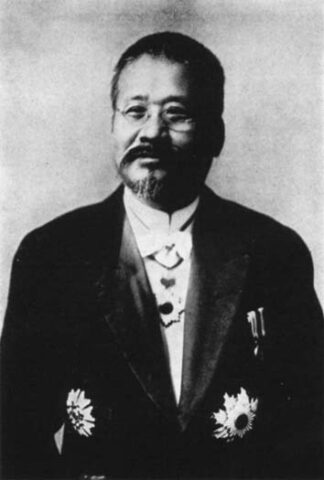
In 1907, amidst the national triumph following the Russo-Japanese War and the domestic unrest symbolised by the Hibiya riots, Haga Yaichi published Kokuminsei jūron [Ten Essays on National Character]. As an heir to the kokugaku tradition, a “father” of Japan’s literary canon, and a transmitter of German philology, Haga identified ten characteristics of the Japanese people in this widely circulated volume. While scholars in the 1970s embraced it as a precursor to nihonjinron, recent scholarship has reinterpreted it primarily as a tool of governmental suppression. This presentation challenges both interpretations through a close reading and contextual analysis. It aims to expand our understanding beyond familiar themes of imperial loyalism or agrarian nostalgia, reframing kokuminsei as a dynamic site of identity production. Details and registration here



 Follow us on Bluesky
Call for Submissions

Contemporary Japan
current issue Vol. 38, No. 1
Contemporary Japan is open year-round for rolling submissions, with accepted publications published immediately online. Please see the instructions for submission here.
DIJ Monograph Series
Our monograph series is  Open Access after a one-year embargo period. Downloads are available on our
→ monographs pages.
Access
DIJ Tokyo
Jochi Kioizaka Bldg. 2F
7-1 Kioicho Chiyoda-ku, Tokyo
102-0094 Japan
Where to find us
+81 (0)3 3222-5077
+81 (0)3 3222-5420
dijtokyo@dijtokyo.org

DIJ-ARI Asian Infrastructures Research Partnership