Veranstaltungen und Aktivitäten
Learning to be funny: Training and social relationships in Rakugo – POSTPONED –
Please note: this event has been postponed. A new date will be announced in due course. We apologize for any inconvenience caused.
Kabuki actors learn their skills from their fathers. Ikebana students pay their master for lessons. In contrast, artistic lineage in rakugo is not hereditary, and performers do not acquire their stories and acting skills in acting schools or from their fathers. Newcomers to the rakugo profession start their apprenticeship with a shishō, a master, without paying any compensation. For the rest of both of their lives the shishō is responsible for his deshi’s (disciple) education and accountable for his off-stage behaviour. In return, the shishō expects his deshi’s unquestioning loyalty, obedience and subordination.
The presentation provides a perspective on access to knowledge, knowledge acquisition, learning processes and structures inside Tokyo’s yose theatres, as well as social relations among the stakeholders of the rakugo world. Sarah Stark’s research is based on an analysis of printed interviews, autobiographies as well as one-on-one interviews with Tokyo rakugoka.
Speaker:
Sarah Stark, Ghent University
„Aktives Altern“ im digitalen Zeitalter. Wie kann Digitalisierung soziale Teilhabe und Inklusion fördern? – POSTPONED –
Die Bevölkerung Japans und Deutschlands altert zusehends. Vor dem Hintergrund sich auflösender Familienstrukturen, immer mehr alleinlebender Seniorinnen und Senioren und nicht mehr selbstverständlicher nachbarschaftlicher Unterstützung wird die gesellschaftliche Teilhabe und Inklusion älterer Bürgerinnen und Bürger zu einer großen gesellschaftspolitischen Heraus¬forderung. Teilhabe und Inklusion bilden die Grundlage für ein „aktives Altern“. Davon profitieren die Älteren, die Gemeinden und die Gesellschaft insgesamt. Digitalisierung und Vernetzung bieten in diesem Kontext große Chancen. Um diese nutzen zu können, müssen die Technologien allerdings zugänglich und nutzbar gemacht werden. Aus diesem Grund ist es wichtig, „digitale Kompetenzen“ unter der älteren Bevölkerung zu fördern. Im Rahmen des Symposiums soll erörtert werden, was in Japan und Deutschland unternommen wird, damit die ältere Generation von den Vorteilen der digitalen Transformation im Hinblick auf Teilhabe und Inklusion profitieren kann.
Sprachen: Deutsch und Japanisch mit Simultanübersetzung
Why Is It So Difficult to Buy a Ticket for the Musical?
Adaptive Innovation in Japanese Musical Theater from the 1960s to the Present
This presentation will offer an overview of Japanese popular musical theater focusing on its systematic and strategic adaptation for the growing and changing needs of its diversifying audience groups. In the past decades, Japanese popular musical theater has drastically transformed, expanding its presence in the domestic entertainment industry by ticket distribution adaptive to new communication systems for better accessibility and consumability.
Speaker:
Rina Tanaka, Meiji University
Money, parenting and happiness: A comparative and historical perspective
Money and parenting are two key factors that can bring considerable joy or misery to our daily lives. Empirical studies have shown that while money is generally associated with greater happiness, having small kids can actually be a source of unhappiness, especially for women. In this session, two experts – a sociologist and an economist – explore the intricate relationship between money, parenting and happiness, from a comparative and historical perspective.
Speakers:
Hiroshi Ono, Hitotsubashi University Business School
Matthias Doepke, Northwestern University
DIJ KAS Roundtable
US-Japan Relations under Donald Trump and Shinzo Abe
US-Japan relations form a core element in Asian regional security and a central pillar of the international trade regime. The quality of the relationship has always been shaped by the personalities representing the two countries. Shinzo Abe, Japan’s now longest-serving prime minister, has been keen to establish good personal ties with Donald Trump, whose “America First” policy implied a major shift in the US approach to regional and global issues. This roundtable will discuss the changes that US-Japan relations underwent since the beginning of Trump’s presidency and analyze the regional and global implications.
Keynote:
Glen S. Fukushima, Center of American Progress
Comments:
Koichi Nakano, Sophia University
Tilman Schmit-Neuerburg, German Federal Foreign Office
Assimilation Policies and Ainu Identity
Questioning Japan’s Recognition of the Ainu People as Indigenous
In April 2020, the Japanese government will open the “Symbolic Space for Ethnic Harmony” in Shiraoi (Hokkaido). The “Symbolic Space” will consist of a National Ainu Museum, a National Ethnic Harmony Park, where Ainu culture can be practiced, and a central depot for Ainu remains. The government is expecting one million visitors per year. According to the official reading, Ainu indigenous rights will be implemented here incrementally, supported by the New Ainu Law, which was adopted in April 2019. Against this backdrop, the talk asks whether the recognition of the Ainu is in accordance with an international understanding of the term “indigenous”.
The lecture addresses the process of colonization (after 1590) and will give a summary of the treatment of the Ainu in Japanese legal history. Policies of assimilation already began a century prior to the modern Meiji state as is evidenced by the Bakufu guidelines for officials in Hokkaido (1799). The “Hokkaido Former Aborigines Protection Act” of 1899 had the objective of forcing the Ainu into a farming existence, and schooling and welfare policies were additional measures. This law was repealed only a century later, in 1997, with the recognition of the Ainu as a group with a distinct culture and history. In 2007, Japan supported the “United Nations Declaration on the Rights of Indigenous Peoples”, and the “New Ainu Law” of April 2019 now addresses the Ainu as “indigenous” for the first time in Japanese legislation. Following this outline, the contribution analyzes the question whether Japan is actually fulfilling its commitments to UNDRIP. Relevant criteria are land, fishing/hunting, and language rights as well as the repatriation of stolen human remains to Ainu communities, among others.
Speaker:
Uwe Makino, Chuo University (Tokyo)
Improving Japan’s Disability Employment
From Separate to Inclusive Workplaces
Japan’s “Act on Employment Promotion of Persons with Disabilities” has been revised in 2013 and 2019. The 2013 amendment prohibited discrimination on the grounds of disability and obliged employers to provide reasonable accommodation to employees with disabilities, and was supposed to be a paradigm shift in Japan’s disability employment policy, which until then had relied on the disability employment quota system. As the law originally intended to improve employment opportunities in the general labor market, the quota and related systems contributed to quantitative improvements. However, it also established the “special but separate” treatment for persons with disabilities (PWD). In order to answer the puzzle why different or separate treatments remained in place in the employment of PWD even after the 2013 amendment, I have analyzed statistical data, administrative guidelines, and the debate preceding the recent 2019 amendment.
Speaker:
Reiko Yoshida, The University of Tokyo
The new Japanese Fishery Policies between Revitalization and Capitalization
Coastal fisheries in Japan have been in decline since the early 1990s. Situated mostly in rural areas, fishing communities suffer from depopulation, aging and a lack of successors. Moreover, stagnating production levels, falling prices, decreasing demand and rising costs have led to income insecurities, further deterring young people to enter the industry. Policymakers and fishermen alike have been struggling to find solutions for this complex mix of challenges.
The dissertation projects analyzes how fishery policies have changed since the implementation of the 2001 Fisheries Basic Act. The Basic Act stipulated the revitalization of small scale coastal fisheries with a focus on communities as one of its the main goals, followed by several programs channeling subsidies into fishing to achieve this. Since 2014, however, we can observe a policy shift with several distinct features. The responsibility of developing measures for revitalization is increasingly put into the hands of the fishermen and local authorities, with a strong emphasis on economic factors. The 2018 reform of the Fishery Law further emphasizes this trend, aiming to usher in more capital-based fisheries. Moreover, management of stocks will increasingly be based on Total Allowable Catch (TAC) systems, a move away from the traditional community based management. This has left many small-scale-fishermen worried about their future in coastal fisheries.
Speaker:
Susanne Auerbach, Freie Universität Berlin
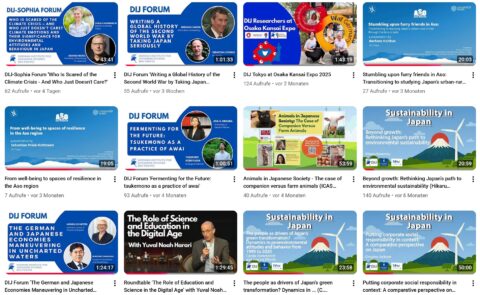
Sustainability-Blog

Lesen Sie die neuesten Artikel unseres DIJ-Blogs Sustainability in Japan and Beyond

 Follow us on Bluesky
Institutsbroschüre
Einblicke in unser Institut und seine Aktivitäten bietet unsere aktuelle DIJ Broschüre (Stand 4/2025)
Call for Submissions

Contemporary Japan
Aktuelle Ausgabe Vol. 38, Nr. 2
Contemporary Japan akzeptiert Einsendungen ganzjährig ohne Abgabefrist. Zur Veröffentlichung angenommene Artikel werden umgehend online publiziert. Weitere Details finden Sie hier.
DIJ Monographienreihe
Unsere Monographien sind nach einem einjährigen Embargo  Open Access und können hier heruntergeladen werden:
→ DIJ Monographien
Wegbeschreibung
DIJ Tokyo
Jochi Kioizaka Bldg. 2F
7-1 Kioicho Chiyoda-ku, Tokyo
102-0094 Japan
Wegbeschreibung
+81 (0)3 3222-5077
+81 (0)3 3222-5420
dijtokyo@dijtokyo.org

DIJ-ARI Asian Infrastructures Research Partnership