Veranstaltungen und Aktivitäten
DIJ Newsletter Autumn 2026
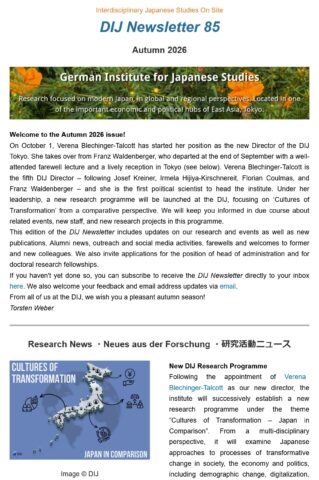
The autumn issue of our DIJ Newsletter is now available online! We hope you enjoy this latest edition, which provides insights into our research, new publications, outreach activities, job and fellowship opportunities. We also introduce new team members and bid farewell to colleagues who have left the DIJ. The DIJ Newsletter is published four times a year and features updates on our research, publications, events, outreach activities and team. If you haven’t done so yet, you can subscribe to receive our Newsletters directly to your inbox. The full issues and subscription form are available here.
New Open Access book on Capitalism, Innovations, and Health after Covid-19
 This open access book examines how the Covid-19 pandemic exposed structural tensions in innovation systems and capitalist models in the global economy, with a particular focus on Asian healthcare systems. Co-edited by DIJ Visiting Research Fellow Sébastien Lechevalier, Jean-Paul Gaudillière, Kathryn Ibata-Arens, and Kayo Takuma, Capitalism, Innovations, and Health after Covid-19. An Asian Perspective (Palgrave Macmillan 2026) contributes to debates on post-pandemic capitalism, technological development, and global healthcare management. The book interrogates systemic crises in capitalism and innovation; analyzes Covid-19 responses as a critical moment for rethinking health governance; and presents Asian experiences that challenge dominant models. Chapters draw on comparative political economy, science and technology studies (STS), and health policy to illuminate how Asia’s diverse trajectories offer lessons for more inclusive and sustainable innovation. Sébastien Lechevalier contributed the chapter “Care-led Innovation. A New Paradigm and an Application in the Japanese Context of Society 5.0”
DIJ Newsletter Summer 2026
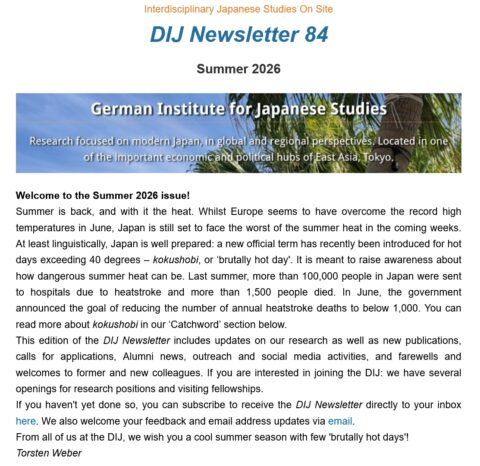
The summer issue of our DIJ Newsletter is now available online! We hope you enjoy this latest edition, which provides insights into our research, new publications, outreach activities, job and research grant opportunities, and a new edition of our Catchword series. We also introduce new team members and bid farewell to two colleagues who have left the DIJ. The DIJ Newsletter is published four times a year and features updates on our research, publications, events, outreach activities and team. If you haven’t done so yet, you can subscribe to receive our Newsletters directly to your inbox. The full issues and subscription form are available here.
New blog posts on sustainability at Aichi Triennale and knowledge production in Korea
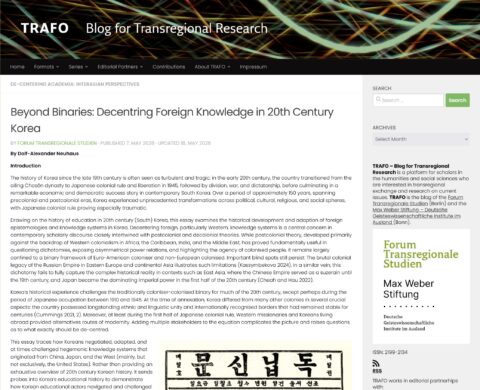 DIJ researchers Carolin Fleischer-Heininger and Dolf-Alexander Neuhaus have contributed articles to the DIJ’s Sustainability in Japan and Beyond blog and the TRAFO Blog for Transregional Research, respectively. Carolin’s article “Tracing Sustainability at the Aichi Triennale 2025 in Japan” reports on her experience as a visitor of the Aichi Triennale 2025, a well-established art festival mainly held in the city of Nagoya, from the perspective of someone who is visually impaired. “Addressing cultural, social and ecological dimensions of sustainability and often also gaining inspiration and authority from personal experience”, she writes, the Triennale “validates sustainability as a matter of responsibility and of justice to give voice to the perspectives that are less prominent in most debates on eco-social sustainability.” Dolf’s article “Beyond Binaries: Decentring Foreign Knowledge in 20th Century Korea”, part of the blog series “De-centering Academia: InterAsian Perspectives”, draws on the history of education in 20th century (South) Korea to examine the historical development and adaption of foreign epistemologies and knowledge systems in Korea.
Open Access book on East Asian startup ecosystems
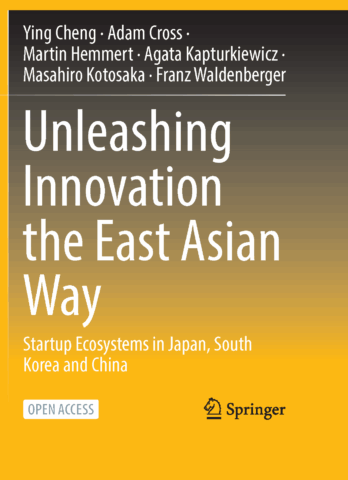 The book Unleashing Innovation the East Asian Way. Startup Ecosystems in Japan, South Korea and China (Springer Singapore 2026) provides new perspectives on startup ecosystems in East Asia – a region which has over decades shaped innovation and global competition. Focusing on Japan, South Korea, and Mainland China, the chapters sketch the dynamic and diverse development of East Asian startup ecosystems considering their wider historical and national contexts. The authors Ying Cheng, Adam Cross, Martin Hemmert, Agata Kapturkiewicz, Masahiro Kotosaka, and DIJ director Franz Waldenberger systematically analyze and compare startup ecosystems. In this way, they show commonalities and differences across East Asia. The chapters use both secondary sources and data from the authors’ decade long collaborative work. Published open access, this book aims to make these findings, which have so far only been presented in academic journals, accessible to a wider readership.
New issue of Contemporary Japan published
 Contemporary Japan Volume 38 Issue 1 is out! The six original research articles include “Rainbows and Ratings: Assessing indices of LGBTQ+ inclusivity in the Japanese workplace” (Clasen & Conrad) on Japanese companies attempts at improving diversity, “Perks or burdens? Being ‘nearly (Im)mobile’ as IT foreign professionals during the COVID-19 pandemic in Japan” (Muranaka) on Vietnamese IT professionals, “Leadership in crisis: Comparing Prime Minister Abe’s and Chancellor Merkel’s response to the Covid-19 pandemic” (Gaunder & Wiliarty) on leadership style, institutional coordination, and policy narratives, “Portraying the refugee crisis: The framing of Afghan, Burmese, and Ukrainian asylum seekers in Japanese print media” (Mitsui & Green) on media portrayals of refugees/asylum seekers, “The Bibliography of Post-War Documentary Literature: Processing war and defeat in post-World War II Japan” (Jeong) on subjective narratives in postwar literature, and “Workers’ uprising: Japanese factories and labor movement in Thailand during the Pacific War” (Takahashi) on anti-colonial labor activism during the Pacific War. The articles are complemented by Wolfram Manzenreiter’s review of Kate Sylvester’s book Women and Martial Art in Japan.
DIJ Newsletter Spring 2026
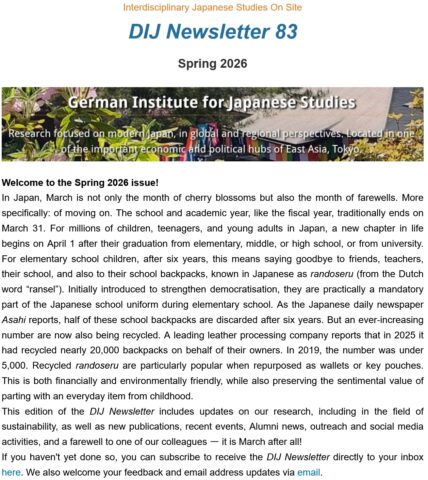 Digital capitalism and science, disability and inclusion, recruitment strategies, and ‘akiya’ problem: the spring issue of our DIJ Newsletter features updates on our research, publications, and events as well as news from the Institute, our team, and our outreach activities. We hope you will enjoy exploring this new edition of the DIJ Newsletter. If you haven’t done so yet, you can subscribe to receive our Newsletters directly to your inbox. The full issues and subscription form are available here.
Open access article co-authored by Celia Spoden on responsibility in research and innovation

The new open access article “REALIGN Toolkit: Reflexivity, Adaptability, Leadership, and Inclusion as Pillars of Responsible Research and Innovation” (Wellcome Open Res 2026, 11:8), co-authored by DIJ’s Celia Spoden, discusses how research and innovation can be made more ethically responsible for societal needs. It introduces a new toolkit — which focuses on the four main principles reflexivity, adaptability, leadership, inclusion (REALIGN) — for those involved in innovation to help ensure that new technologies are developed in ways that are fair, thoughtful, and truly useful to the people they are meant to serve. Based on three real-life examples of technologies designed to help people with frailty, including individuals with disabilities, and other vulnerable populations, the article makes recommendations to ensure key stakeholders are meaningfully involved from the very start of research and development. The article includes a discussion of Celia’s research at Tokyo’s Avatar Robot Café DAWN.

Sustainability-Blog

Lesen Sie die neuesten Artikel unseres DIJ-Blogs Sustainability in Japan and Beyond

 Follow us on Bluesky
Institutsbroschüre
Einblicke in unser Institut und seine Aktivitäten bietet unsere aktuelle DIJ Broschüre (Stand 4/2025)
Call for Submissions

Contemporary Japan
Aktuelle Ausgabe Vol. 38, Nr. 2
Contemporary Japan akzeptiert Einsendungen ganzjährig ohne Abgabefrist. Zur Veröffentlichung angenommene Artikel werden umgehend online publiziert. Weitere Details finden Sie hier.
DIJ Monographienreihe
Unsere Monographien sind nach einem einjährigen Embargo  Open Access und können hier heruntergeladen werden:
→ DIJ Monographien
Wegbeschreibung
DIJ Tokyo
Jochi Kioizaka Bldg. 2F
7-1 Kioicho Chiyoda-ku, Tokyo
102-0094 Japan
Wegbeschreibung
+81 (0)3 3222-5077
+81 (0)3 3222-5420
dijtokyo@dijtokyo.org

DIJ-ARI Asian Infrastructures Research Partnership