イベント&アクティビティ
Hybrid Study Group on Japan’s Youth Climate Movement
Youth climate activism is globally significant but varies across cultures. European studies highlight public protest and digital mobilization, whereas Japan shows subtler engagement, possibly rooted in cultural attitudes toward hierarchy, conformity, and harmony that encourage “quiet activism”. In our project “Mapping Japan’s Youth Climate Movement: Actors, Roles, and Strategies”, we want to identify the main youth climate movements and youth-led organizations in Japan, examining their goals, organization, mobilization and communication strategies, and relationships within the wider movement. Beyond official self-descriptions, we are interested in everyday realities such as leadership, informal structures, and decision-making, and in how these groups try to influence public debate and climate policy. The project is in the middle of fieldwork. Our speaker will present its concept, first learnings from the field, and preliminary findings from two focus groups with youth-led climate organizations. Details and registration here
Special journal issue “Japanese Technofutures” edited by Nicole M. Mueller
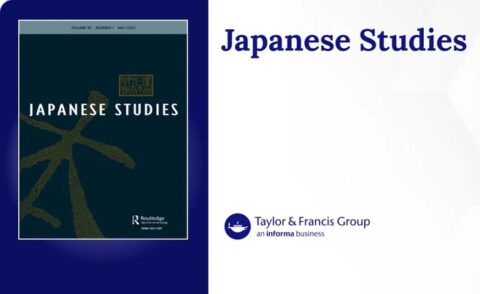 Is Japan truly “living in the future”? What does this mean beyond the hype? And whose future is it; who gets left behind? These questions are at the core of the new special issue “Japanese Technofutures: Imaginaries, Narratives, Social Realities” of Japanese Studies (online first; print in December), edited by Nicole M. Mueller. It bridges STS and Area Studies to explore how future imaginations from and about Japan have evolved since the 1960s and how they are actively challenged. The issue contains six articles, including “The Futuristic Imagination Sprawl: Charting Concepts vs. Social Realities” and “Imagineering the Future: A Mixed-Method Mapping of Japan’s Corporate Imaginaries of Metaverse Sustainability” by Nicole, two articles by former DIJ researchers Christian Oberländer (on cashless payments) and Volker Elis (on Science Fiction) as well as by Paul Christensen and Maj Hartmann. The issue presents results from the DIJ workshop Imagined Futures in Japan and Beyond.
DIJ Newsletter Autumn 2026
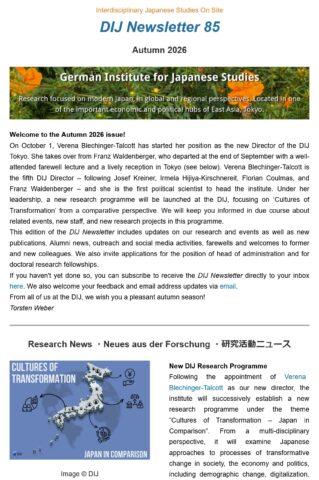
The autumn issue of our DIJ Newsletter is now available online! We hope you enjoy this latest edition, which provides insights into our research, new publications, outreach activities, job and fellowship opportunities. We also introduce new team members and bid farewell to colleagues who have left the DIJ. The DIJ Newsletter is published four times a year and features updates on our research, publications, events, outreach activities and team. If you haven’t done so yet, you can subscribe to receive our Newsletters directly to your inbox. The full issues and subscription form are available here.
Open Access article on Mega-Event Narratives of the Expo and the Olympics in Japan
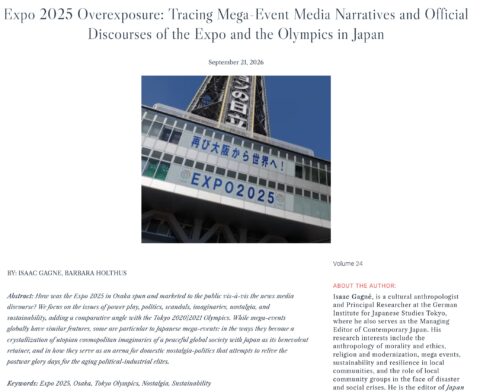 Rebirth of the Shōwa Dreams or a zombie of the past? The new open access publication “Expo 2025 Overexposure: Tracing Mega-Event Media Narratives and Official Discourses of the Expo and the Olympics in Japan” (Asia-Pacific Journal , Vol. 24 , 2026) by DIJ researchers Isaac Gagné and Barbara Holthus studies how the Expo 2025 in Osaka was marketed to the public vis-à-vis the news media discourse. Focusing on power play, politics, scandals, imaginaries, nostalgia, and sustainability, the article adds a comparative angle with the Tokyo 2020/2021 Olympics. “Tokyo 2020/2021 and Expo 2025, as with the Tokyo 1964 Olympics and the Osaka 1970 Expo before them, have been a stage for the many stakeholders involved to play out their political dreams and domestic and international desires. The cycle of mega-events in 21st-century Japan can thus be conceived of as a phoenix-like imaginary, a rebirth of the Shōwa Dreams—but they are also in peril of becoming a zombie of the past”, the authors argue.
POSTPONED Online Study Group on Ideological Receptions of the Anime Series Attack on Titan

Please note: This Study Group session has been postponed to December 2, 2026 and changed to an online only format. In November 2021, Republican US Representative Paul Gosar shared an edited video clip taken from the globally popular anime series Shingeki no Kyojin – Attack on Titan (2013–2023) to attack political opponents and to criticize immigration. This is just one example of how anime is increasingly used in non-Japanese polarized political discourse. Drawing on fieldwork as well as materials from both Japanese industry and the fan community, the presentation focuses on the specific environment of the Japanese anime industry and the reception by Japanese audiences that builds on practices such as derivative works and non-narrative consumption. The aim is to elucidate the role that distinctive features of the Japanese contents industry play in both the national and international reception of anime as a potentially political form of media. Details and registration here
Onsite talk on communicative spaces in rural Japan by Sebastian Polak-Rottmann
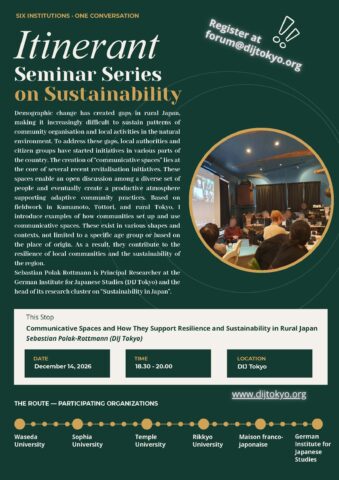 Demographic change has created gaps in rural Japan, making it increasingly difficult to sustain patterns of community organisation and local activities in the natural environment. To address these gaps, local authorities and citizen groups have started initiatives in various parts of the country. The creation of “communicative spaces” lies at the core of several recent revitalisation initiatives. These spaces enable an open discussion among a diverse set of people and eventually create a productive atmosphere supporting adaptive community practices. Based on fieldwork in Kumamoto, Tottori, and rural Tokyo, DIJ researcher Sebastian Polak-Rottmann introduces examples of how communities set up and use communicative spaces and how they contribute to the resilience of local communities and the sustainability of the region. This talk is part of the Itinerant Seminar Series on Sustainability and takes place on December 14, onsite only at the DIJ. Details and registration here
CfP “Fair Share? Intergenerational Justice in Transnational Perspective”
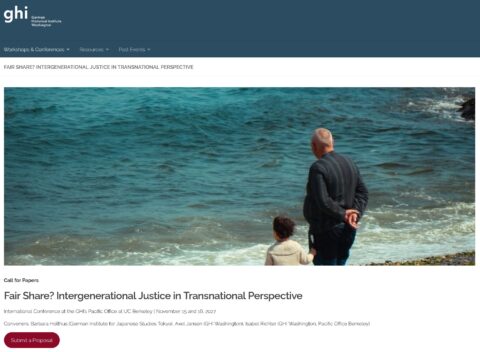 We are currently accepting paper proposals for the international conference Fair Share? Intergenerational Justice in Transnational Perspective, hosted by the German Historical Institute Washington’s Pacific Office at UC Berkeley on November 15-16, 2027. The conference brings together historians and social scientists to explore intergenerational justice as a historical and interdisciplinary problem. It focuses especially on Germany, the United States, and Japan — three affluent, democratic, aging societies with very different welfare models — where demographic change, family structures, inheritance regimes, environmental politics, and postwar legacies have shaped different understandings of obligations across generations. Proposals, which should include a paper title, an abstract of no more than 250 words, and a short CV, must be submitted online by January 22, 2027. Details here
Verena Blechinger-Talcott Panelist bei MWS-Stiftungskonferenz “250 Jahre Unabhängigkeitserklärung”
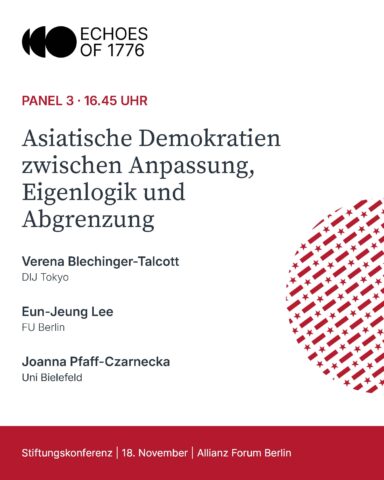 DIJ-Direktorin Verena Blechinger-Talcott nimmt als Sprecherin im Panel “Asiatische Demokratien zwischen Anpassung, Eigenlogik und Abgrenzung” an der Stiftungskonferenz der Max Weber Stiftung teil. Zusammen mit Eun-Jeung Lee (FU Berlin) und Joanna Pfaff-Czarnecka (Universität Bielefeld) wirft sie einen Blick auf demokratische Gesellschaften in Asien, unter anderem Japan und Südkorea, und diskutiert den Einfluss der USA auf das Demokratieverständnis dieser Länder. Das Panel ist Teil der diesjährigen Stiftungskonferenz “Zwischen Vorbild und Herausforderung: Die US-amerikanische Demokratie seit 1776”, die sich mit globalen Perspektiven auf 250 Jahre Unabhängigkeitserklärung der USA befasst. Die Konferenz findet am 18. November im Allianz Forum Berlin statt.


 Follow us on Bluesky
Call for Submissions

Contemporary Japan
current issue Vol. 38, No.2
Contemporary Japan is open year-round for rolling submissions, with accepted publications published immediately online. Please see the instructions for submission here.
DIJ Monograph Series
Our monograph series is  Open Access after a one-year embargo period. Downloads are available on our
→ monographs pages.
道案内
ドイツ-日本研究所
〒102-0094 東京都千代田区
紀尾井町7-1 上智紀尾井坂ビル 2F
道案内
+81 (0)3 3222-5077
+81 (0)3 3222-5420
dijtokyo@dijtokyo.org