Events and Activities
DIJ researchers in Belgian and German media on Tokyo Olympics
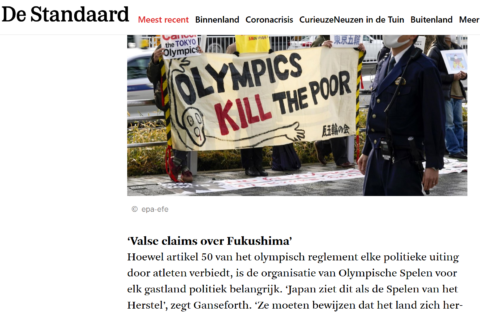
DIJ human geographer Sonja Ganseforth and historian Torsten Weber are quoted in newspaper articles in the Belgian daily De Standaard and the German weekly Die Zeit. Sonja comments on recent criticism in Japan of the Tokyo Olympics. “Activists have been criticizing the exorbitant spending and corruption in the run-up to the Games for years”, she is quoted in the article “Japanners vrezen dat Spelen zullen fungeren als superverspreider” (Japanese fear that Games may act as superspreader). “The expensive postponement due to the Covid crisis also leads to skepticism”, Sonja says. Torsten’s comments on how the Tokyo Olympics have become linked to promoting nationalism in Japan are quoted in “Olympia 2021 in Japan: Japans Nationalisten und ihr Plan mit den Spielen” (Japan’s nationalists and their plan with the Games). Their research on the impact of the 2020 Olympics on Japanese society is part of the DIJ’s special project on the Tokyo Olympics and the open access book publication Japan Through the Lens of the Tokyo Olympics.
New DIJ Working Paper on social movements in post-3.11 Japan
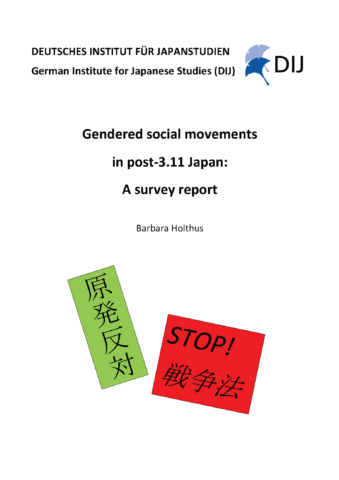 In the post-3.11 decade, Japan has seen at least two peaks in social movements: anti-nuclear protests in the year following the triple disaster of 2011 and a second one in 2015 in response to the Diet passing the National Security Act legislation. Together they mark the largest protest wave Japan has seen since the 1970s. In her latest DIJ Working Paper, deputy director Barbara Holthus introduces the findings of a large-scale survey undertaken in 2017 with close to 80,000 participants in the larger Tokyo metropolitan area. Questions focus on understanding who was sympathetic to the 3.11 movement, who was mobilized, and who participated in the protests. The goal was to understand what distinguishes the participants from the non-participants and to understand the role values and political views play in this. Gendered social movements in post-3.11 Japan: A survey report is the first English-language publication to present an overview of the data that was originally published in Japanese in 3.11go no shakai undō: 8mannin no dēta kara wakatta koto (eds. Naoto Higuchi & Mitsuru Matsutani) in 2020. This publication is part of Barbara’s ongoing research project Social movements and gender in post-3.11 Japan.
New book chapter on Japanese occupation of China

DIJ historian Torsten Weber has contributed a chapter on Chinese Asia discourse to the sourcebook Translating the Occupation. The Japanese Invasion of China, 1931–45, published by the University of British Columbia Press in February 2021 and edited by Jonathan Henshaw, Craig A. Smith, and Norman Smith. It is the first English-language volume to provide a diverse selection of important primary sources on Japan’s occupation of China translated from Chinese, Japanese, and Korean. Torsten’s chapter “Finding China’s ‘Asia’ in Japanese Asianism” studies how Chinese elites in the pro-Japanese Reorganized National Government (1940-45) tried to find a balance between cooperation and resistance to Japan by appropriating Japanese Asianist rhetoric of a ‘New Order in East Asia’ and an ‘East Asian League’. This chapter draws on his earlier research on Japanese and Chinese Asianism and his monograph Embracing ‘Asia’ in China and Japan. Asianism Discourse and the Contest for Hegemony (Palgrave 2018).
Online cooperation meeting with University of Vienna
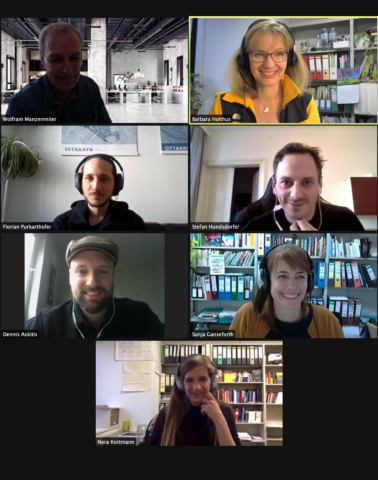
On February 4, seven researchers from the DIJ and its cooperation partner at the University of Vienna met online. Due to the pandemic, Vienna doctoral students are forced to modify their Japan research: travel to Japan has not been possible for over a year, and the doctoral students turn to hiring a Japanese company to conduct survey research on their behalf. DIJ deputy director Barbara Holthus and DIJ researchers Sonja Ganseforth and Nora Kottmann, who have all conducted their own surveys in Japan provided hands-on advice on research companies, costs involved, possible sampling strategies, questionnaire construction and the importance of sharei (incentives). Former DIJ PhD students Florian Purkarthofer and Dennis Askitis as well as Stefan Hundsdorfer, who are all currently doctoral students at Vienna, attended the meeting. It was part of the tight-knit cooperation between the DIJ and Japanese Studies at the University of Vienna. The cooperation started in 2010 with Wolfram Manzenreiter, who also participated in the online meeting, joining the editorial board of Contemporary Japan. Since 2014, one DIJ researcher per year has been teaching a class in Vienna.
Blog posts introduce survey on unmarried adults in Japan
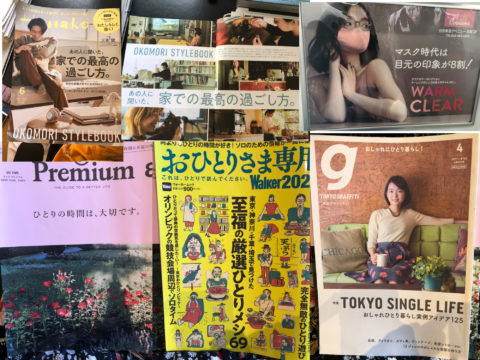
Being single is an increasingly common experience for Japanese adults. Not only has the average age at first marriage risen continuously over the last decades, so too has the rate of permanent singlehood. Research on the unmarried is therefore critical to an understanding of contemporary Japanese society. DIJ social scientist Nora Kottmann and Laura Dales (University of Western Australia) are currently conducting a survey that aims to better understand how the lives and relationship worlds of unmarried adults (‘singles’) have been affected by the ongoing COVID-19 Coronavirus pandemic and how this might affect future practices and perceptions of the increasing numbers of ‘singles’ in Japan (and beyond). Both researchers introduce this survey in their recent co-authored blog posts ‘Solo-camping and solo-hotpots: Rethinking practices and perceptions of singlehood in Japan in COVID-time’ and ‘Looking to capture practices of intimacy in times of social distancing: Mixed-methods research on singles in Japan’. Updates will be published on the project’s webpage.
Free access to highlight article from Asian Business & Management
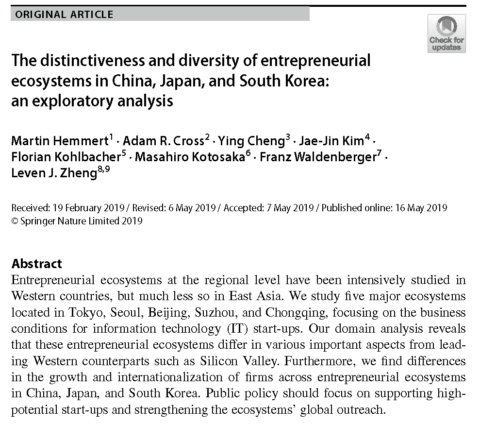
An article co-authored by DIJ director Franz Waldenberger was selected by Palgrave Macmillan and the editorial team of the Asian Business & Management journal as best content and can now be accessed for free. The original article “The distinctiveness and diversity of entrepreneurial ecosystems in China, Japan, and South Korea: an exploratory analysis” by DIJ alumni Martin Hemmert and Florian Kohlbacher, Adam R. Cross, Ying Cheng, Jae‑Jin Kim, Masahiro Kotosaka, Franz Waldenberger, and Leven J. Zheng studies five major ecosystems located in Tokyo, Seoul, Beijing, Suzhou, and Chongqing. It focuses on the business conditions for information technology (IT) start-ups and reveals that these entrepreneurial ecosystems differ in various important aspects from leading Western counterparts, including in the growth and internationalization. It concludes that public policy should focus on supporting high-potential start-ups and strengthening the ecosystems’ global outreach. The article is an outcome of the DIJ research project Start-ups in Asia – the role of agglomerations and international linkages and can be accessed here.
New working paper on ‘Unconventional Monetary Policy’
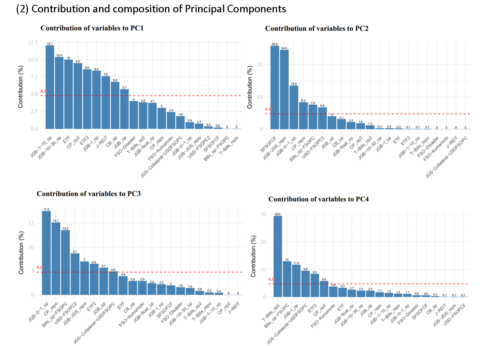
A new working paper, co-authored by Senior Research Fellow Markus Heckel and Kiyohiko G. Nishimura (Graduate Institute for Policy Studies GRIPS/Center for Advanced Research in Finance CARF, University of Tokyo) examines the unconventional monetary policies of the Bank of Japan from 2002 to 2019 with a focus on open market operations. The CARF working paper Unconventional Monetary Policy through Open Market Operations: A Principal Component Analysis applies a principal component analysis to investigate the complexity of the operations. The authors find that four principal components (PCs) explain most of the variance of the Bank of Japan’s operations of various facilities and measures. They also observe that open market operations of the Shirakawa era (2008-2013) were the most complex, resulting in an increased number of PCs. In contrast, the corresponding number in the other eras has been at most two (Fukui, 2003-2008) and four (Kuroda, 2013-present). This paper is a result of Markus’ research project Economic Discourses of Monetary Policy – The Case of the Bank of Japan.
Barbara Holthus im DLF Kultur-Interview zu Tokyo 2020

Ein halbes Jahr vor der geplanten Eröffnung der olympischen Spiele hat Soziologin und stellvertretende Direktorin Barbara Holthus im Interview mit DLF Kultur die geschwundene Olympia-Begeisterung in Japan kommentiert. Die Euphorie von 2013, als Tokyo die Spiele zugesprochen wurden, sei Skepsis und Unverständnis über die ausufernden Kosten gewichen. Meinungsumfragen zufolge befürworteten aktuell rund 80% der Bevölkerung eine Absage oder neuerliche Verschiebung. In der andauernden Pandemie bestünde zudem die Gefahr, dass “Olympia zu einem Super-Spreader-Event würde”, so Holthus. Dennoch wolle “Tokyo unbedingt diese Spiele haben, komme was wolle”. Barbara Holthus ist Mitherausgeberin des Olympia-Buches Japan through the lens of the Tokyo Olympics (Routledge 2020, open access), das Japans Gesellschaft, Politik und Wirtschaft anhand der Vorbereitungen auf Tokyo 2020 untersucht. Das DLF-Interview kann hier nachgehört werden.



 Follow us on Bluesky
Call for Submissions

Contemporary Japan
current issue Vol. 38, No. 1
Contemporary Japan is open year-round for rolling submissions, with accepted publications published immediately online. Please see the instructions for submission here.
DIJ Monograph Series
Our monograph series is  Open Access after a one-year embargo period. Downloads are available on our
→ monographs pages.
Access
DIJ Tokyo
Jochi Kioizaka Bldg. 2F
7-1 Kioicho Chiyoda-ku, Tokyo
102-0094 Japan
Where to find us
+81 (0)3 3222-5077
+81 (0)3 3222-5420
dijtokyo@dijtokyo.org

DIJ-ARI Asian Infrastructures Research Partnership