Veranstaltungen und Aktivitäten
Culture at work. On the interplay of cultural change and job satisfaction in a Japanese multinational company

Job satisfaction in Japan has become a widely-debated issue, especially since research findings indicated that it ranks among the lowest in the world (e.g. Hipp and Givan Kolins 2015).
Moreover, surveys suggest that compared to other aspects of life, such as family or education, Japanese are least satisfied with their working lives (Holthus et al. 2015).
At the same time, global megatrends and market forces are reshaping Japanese workplaces, for example in the form of international mergers and acquisitions, which lead to direct confrontations of different cultures and elicit inevitable changes to the existing work culture. So far, however, the implications of such changes for organizational cultures and employee satisfaction have rarely been addressed in qualitative research. My study aims to provide a deeper understanding of the interrelations between job satisfaction, globalization and culture and asks to what extent job satisfaction interacts with and depends on culture.
Gemeinsame Bücherausstellung
Bakumatsu – das Ende der Edo-Zeit

150 Jahre sind seit dem Taiseihōkan vergangen, der förmlichen Herrschaftsübergabe des Shoguns an den Tennō.
Die Ausstellung gibt einen Einblick in historische Quellen zu Japans Auslandsbeziehungen seit der Ankunft von Commodore Perry 1853 bis zum Taiseihōkan im Jahr 1867.
Für weitere Informationen zum Inhalt oder Besuch der Ausstellung kontaktieren Sie bitte die jeweilige Bibliothek.
Humans & Machines in Medical Contexts: Case Studies from Japan

Medical instruments and technologies can be used to manipulate the human body, ranging from general devices with extremely low risk to such ones highly invasive to patients. Many technologies and electronic appliance nowadays in use; however, took their roots in the second half of the 19th century and increasingly merged into clinics and hospitals during the following century. At present, there can be observed a thrust of technological progress at high pace in the field of biomedical engineering and medical informatics, which contribute additionally to new configurations in in the human-device interplay in Japan.
In order to explore the issues arising from the clinical practices vis-à-vis applications of the (then new) medical devices”, the workshop casts light on their various aspects. The participants will address features regarding the historical, legal, socio-structural, engineering and bioethical conditions and consequences of the interplay between humans and medical technologies or instruments, respectively health care practices in contemporary Japan.
Towards an Intellectual History of Japan’s 1980s Bubble Culture and Economy
In the popular imagination of contemporary Japan, the so-called ‘Bubble Economy’ of the late 1980s has become a place of nostalgia by itself. In it, the 1980s live on as a spectacular feast with endless excitement and seemingly bottomless resources, while contemporary Japan seems mired in dearth and boredom of the everyday. Of course, things were not quite what they seem, as 1980s Japan was also a deeply neurotic society, beset by anxieties and fears that were shared by many cold-war societies, but in part also entirely local. Thus, studies of the culture of the period either focus on the sense of loss and of nostalgia for vanishing traditions (whatever their claims to authenticity) or on the relentless commodification that went hand in hand with it but seemed strangely disconnected.
The Status of Japanese Career Women in their Professional and Private Life

Not that long ago, the term “Japanese career women” almost had been a contradiction in itself. Times have changed and Japanese women pursuing a career is a much talked about topic in politics (“womenomics”) and the media. But has the situation really changed for career women “on the ground”? What are their opportunities and what are their challenges? To what extent are profes-sional expectations and expectations in their private life contradicting each other? And finally, are contradicting expectations resulting in identity conflicts and what are the strategies to cope with these conflicts?
These are questions to be addressed in the presentations. The presentation by Markus Pudelko is based on more than 70 interviews that he has conducted in Japan over the course of several years.
Energiewende エネルギー転換 – The Future of Energy Transition in Germany and Japan

Energy transition, or Energiewende in German, describes a set of policies and practices to phase out the use of fossil fuels and nuclear energy for electricity generation, heat and mobility and to rely more on renewable energy while improving energy efficiency.
This joint event will offer a chance to discuss the potentials and challenges related to energy transition in Japan and Germany together with Dimitri Pescia of Agora Energiewende and Mika Ōbayashi of the Renewable Energy Institute (自然エネルギー財団).
In March, the two organizations are going to publish the report “10 Q&A on the German Energiewende – A contribution to the Japanese energy debate” (『ドイツのエネルギー転換 10のQ&A-日本への教訓』).
Are the elderly a cost factor for society or its safety net? A comparison of family regimes and National Transfer Accounts data in Germany and Japan
Various works have argued that ageing societies’ increasing dependency ratios provoke generational conflict over scarce financial resources. In post-industrial economies, younger cohorts face disadvantages in the labour market and regarding the generosity of the welfare state compared to previous generations. However, there has also been the tendency to alleviate these imbalances through informal inter-generational family transfers. Comparing Japan and Germany – two of the fastest aging societies worldwide – this presentation investigates whether and to what extent the family can serve as a bulwark against potential generational conflict.
With regard to demographic and household-financial dynamics and policy responses, the presentation will compare differences in the capacity of families to serve as an inter-generational safety net.
Who pays for whom? Intergenerational Transfers in Japan and Germany
Population ageing tends to increase the share of financially dependent members in a given society, which is why it is often assumed to be a trigger for generational conflict. The data on this question paint an ambivalent picture. On the one hand, in many post-industrial economies, today’s younger birth cohorts are put at a disadvantage in the labour market and also in terms of public sector spending compared to older cohorts. On the other hand, there is a tendency of private transfers inside the family to flow downwards – from old to young. It appears that a potential generational conflict in the public domain (welfare state, labour market) is at least partly balanced in the family domain. To what extent this is the case will be analysed by using data from National Transfer Accounts, an internationally harmonized macro-level database of financial intergenerational transfers.
Speakers:
Naohiro Ogawa is a population economist who specializes in studying the effects of demographic change on economic growth and social security systems.
Gerhard Naegele has been a professor of gerontology at the Technical University of Dortmund, Institute of Gerontology since 1992.
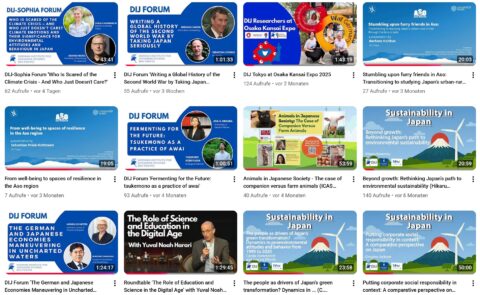
Sustainability-Blog

Lesen Sie die neuesten Artikel unseres DIJ-Blogs Sustainability in Japan and Beyond

 Follow us on Bluesky
Institutsbroschüre
Einblicke in unser Institut und seine Aktivitäten bietet unsere aktuelle DIJ Broschüre (Stand 4/2025)
Call for Submissions
Contemporary Japan
Aktuelle Ausgabe Vol. 38, Nr. 2
Contemporary Japan akzeptiert Einsendungen ganzjährig ohne Abgabefrist. Zur Veröffentlichung angenommene Artikel werden umgehend online publiziert. Weitere Details finden Sie hier.
DIJ Monographienreihe
Unsere Monographien sind nach einem einjährigen Embargo  Open Access und können hier heruntergeladen werden:
→ DIJ Monographien
Wegbeschreibung
DIJ Tokyo
Jochi Kioizaka Bldg. 2F
7-1 Kioicho Chiyoda-ku, Tokyo
102-0094 Japan
Wegbeschreibung
+81 (0)3 3222-5077
+81 (0)3 3222-5420
dijtokyo@dijtokyo.org

DIJ-ARI Asian Infrastructures Research Partnership