Veranstaltungen und Aktivitäten
Call for Papers: Workshop ‘Imagined Futures in Japan and Beyond’
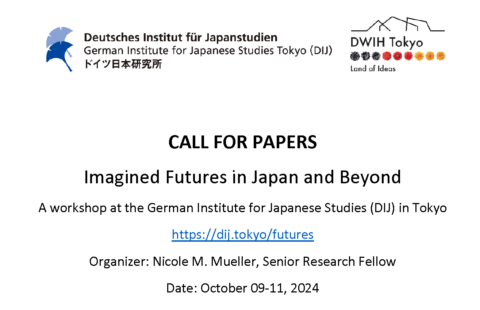 The DIJ, in collaboration with the German Centre for Research and Innovation (DWIH) Tokyo, is hosting an interdisciplinary workshop delving into both fictional and nonfictional portrayals of Japan’s technological future. We will juxtapose these visions with those from other cultures and analyze them through the lens of “narrative” and “sociotechnical imaginary” theoretical frameworks. Scholars whose research aligns with the thematic scope of our workshop are invited to send their abstracts for their planned presentations via E-Mail to mueller@dijtokyo.org by June 15, 2024. We welcome paper proposals by scholars from different career stages (including PhD students) and from a variety of cultural and disciplinary backgrounds. Participants who are accepted for the workshop will be notified by July 5, 2024. Before submitting your abstract, please see the full Call for Papers here
Japan-Stipendien für Promovierende
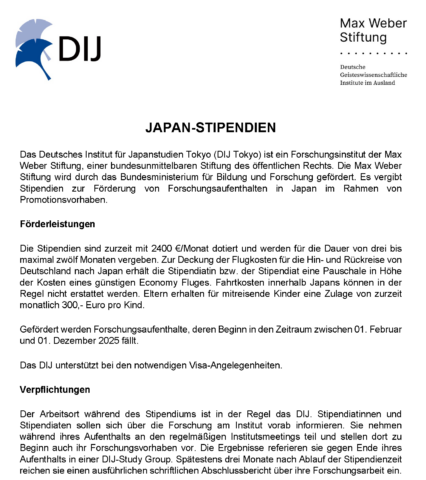 Auch dieses Jahr vergibt das DIJ wieder attraktive Stipendien zur Förderung von Forschungsaufenthalten in Japan im Rahmen von Promotionsvorhaben. Die Stipendien sind mit zurzeit 2400 Euro/Monat dotiert und werden für die Dauer von drei bis maximal zwölf Monaten vergeben. Gefördert werden Forschungsaufenthalte, deren Beginn in den Zeitraum zwischen 1. Februar und 1. Dezember 2025 fällt. Über die Voraussetzungen sowie das Bewerbungsverfahren informiert unsere Ausschreibung und Stipendienordnung hier. Bewerbungsschluss für diese Ausschreibung ist der 15. September 2024.
Online Study Group on contemporary Japanese art
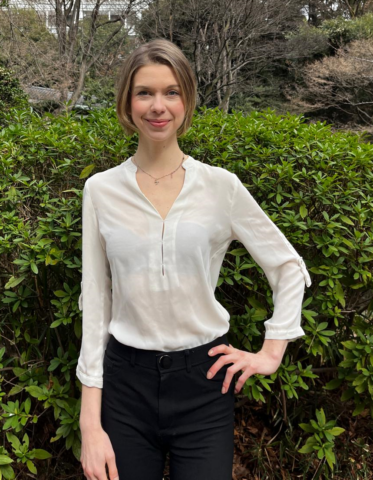
Please note: this Study Group session has changed to online only. Western perspectives on Japanese art and artistic practices are often divided into traditional Japanese art movements, such as Nihonga painting, and contemporary art characterized by Pop-Art-like Manga and Anime characters. This presentation examines the fusion of these two worlds by exploring how contemporary Japanese artists utilize traditional Japanese materials and artistic methods commonly associated with Nihonga-art. Focusing on contemporary artists living and working in Kyoto, Alexandra Faust will discuss how these artists integrate traditional Japanese materials and techniques into their artistic practice. Empirical data collected over the last five months not only provides insights into the use of these materials and techniques but also reveals their connection to traditional, often forgotten knowledge about limited natural resources and sustainability. Details and registration here
Hybrid Study Group on Gendered Educational Trajectories
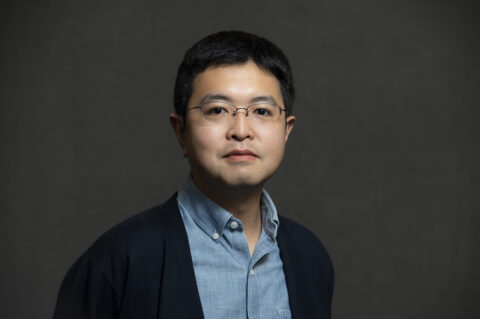 In Japan, despite women’s improved access to higher education, still only one in five applicants to the nation’s top university are women. This presentation focuses on the role of high school students’ “imagined futures” in the context of highly uncertain admission and diversified higher education to provide explanations for the underrepresentation of women in Japanese selective universities. It draws on data from qualitative interviews with high school seniors and teachers in high schools where almost everyone goes to college. In contrast to the expectation that students in these schools are homogeneous in terms of meritocratic aspirations, this study finds significant gender differences in “aiming high.” This presentation provides theoretical insights into how gendered imagined futures and macro-level contexts combine to allocate men and women with similar academic potential into different educational and occupational trajectories, with implications for inequality in higher education in other sociocultural contexts. Details and registration here
Stellenausschreibung “Mitarbeiterin / Mitarbeiter (m/w/d) in der Verwaltung”
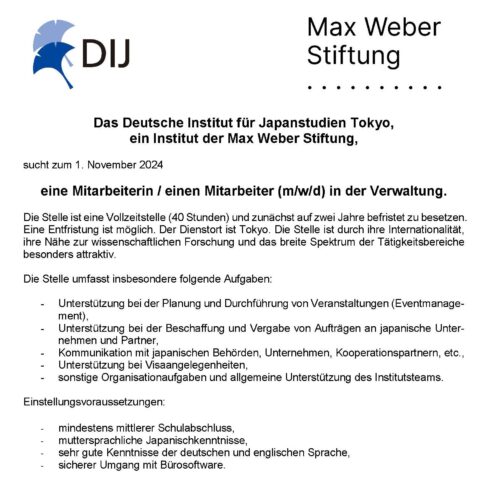 Das DIJ sucht Verstärkung im Verwaltungsteam. Die Stelle umfasst insbesondere folgende Aufgaben: Unterstützung bei der Planung und Durchführung von Veranstaltungen (Eventmanagement); Unterstützung bei der Beschaffung und Vergabe von Aufträgen an japanische Unternehmen und Partner; Kommunikation mit japanischen Behörden, Unternehmen und Kooperationspartnern; Unterstützung bei Visaangelegenheiten; sonstige Organisationsaufgaben und allgemeine Unterstützung des Institutsteams. Wenn Sie mindestens einen mittleren Schulabschluss, muttersprachliche Japanischkenntnisse, sehr gute Kenntnisse der deutschen und englischen Sprache haben sowie sicher sind im Umgang mit Bürosoftware, freuen wir uns auf Ihre Bewerbung bis zum 15. Juli 2024. Die vollständige Ausschreibung finden Sie hier auf Deutsch und auf Japanisch
Online Study Group on fairness in law in Japan and Germany
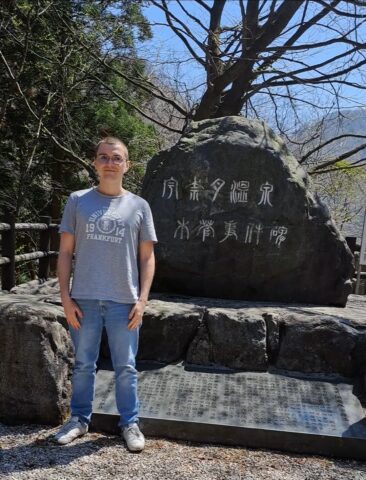
When the legal system is abused to merely cause harm to another person or the exercise of the law is grossly contrary to social norms, judges can prohibit the exercise of a legal right. This principle, known as “abuse of rights”, was adopted by Japan from Europe after the Meiji Restoration to resolve conflicts between written law and social norms. This presentation deals with the historical development and contemporary practice of the prohibition of abuse of rights in Japan and Germany. Decisions and the theoretical discussion from the first application in Japan to today will be presented, analyzed, and contrasted with German theory and practice. The aim is to answer the question of how and why the Japanese understanding of the prohibition of abuse of rights differs from that in Germany. This also leads to very fundamental questions about the relationship between legislators and courts, and society’s understanding of law as a whole. Please note that this is an online only event. Details and registration here
Journal article by Nicole M. Mueller examines historical change in Japanese translation strategies
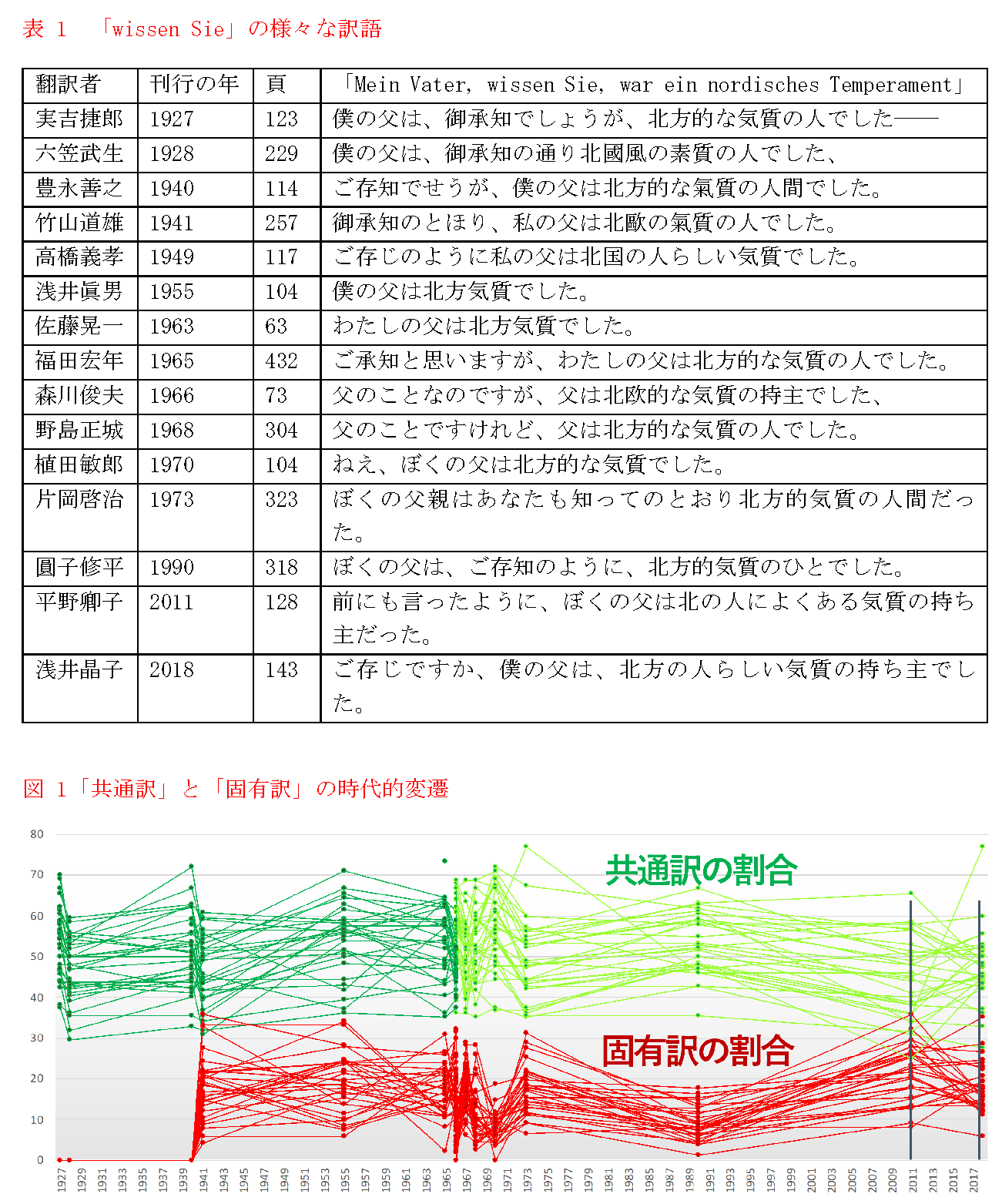
What happens if the same literary source text is translated again and again into the same target language? In her PhD research, Nicole M. Mueller set out to answer this question by conducting a digitally augmented analysis of the 15 Japanese (re)translations of Thomas Mann’s novel Tonio Kröger – a seminal text for the elitist kyōyōshugi movement that had a lasting influence on Japanese humanities and on scholarly translation culture. By implementing digital Topic Modeling as a means of operationalizing similarity scores between literary (re)translations, Nicole retraces previously hidden patterns of influence and similarity between different takes on the same source text. This reveals connections between varying historical factors and translation priorities such as faithfulness towards the source text or a natural expression in the Japanese target language. The article (in Japanese) summarizes key findings from Nicole’s PhD project and is published open access in Keiō University’s bulletin Nihongo to Nihongo kyōiku.
New issue of Contemporary Japan with ‘Art and Regional Revitalization’ special section
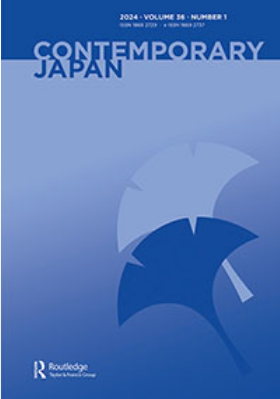 We have just published a new issue of Contemporary Japan (vol. 36, no. 1), containing a special section curated by DIJ alumna Barbara Geilhorn on “Art and Regional Revitalization – Case Studies from Japan”. It features four research articles by Eimi Tagore, Carolin Funck & Meng Qu, Anemone Platz, and Peter Eckersall & Tom Looser that assess how art festivals, exhibitions, and theatre in rural communities can “create new types of social, cultural and economic capital”. The issue also contains research articles on motherhood discourses and political activism (Rosemary Soliman Dawood), women and organized crime in popular culture (Erik Ropers), and conscription insurance in pre-war Japan (YingYing Jiang). CJ’s first “Current Topic Commentary” article by Igor Prusa analyses the media rituals surrounding the Johnny & Associates sex abuse scandal. The book review section covers Japan’s nationalist right, a cultural analysis of Japan’s national character, immigration, and prison chaplaincy. Please see the full issue here
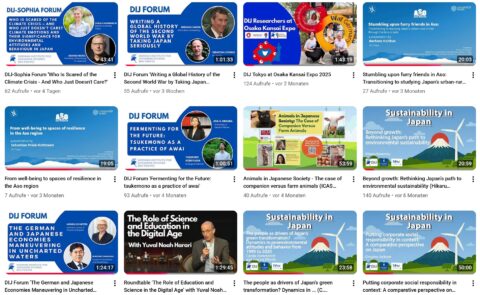
Sustainability-Blog

Lesen Sie die neuesten Artikel unseres DIJ-Blogs Sustainability in Japan and Beyond

 Follow us on Bluesky
Institutsbroschüre
Einblicke in unser Institut und seine Aktivitäten bietet unsere aktuelle DIJ Broschüre (Stand 4/2025)
Call for Submissions

Contemporary Japan
Aktuelle Ausgabe Vol. 38, Nr. 2
Contemporary Japan akzeptiert Einsendungen ganzjährig ohne Abgabefrist. Zur Veröffentlichung angenommene Artikel werden umgehend online publiziert. Weitere Details finden Sie hier.
DIJ Monographienreihe
Unsere Monographien sind nach einem einjährigen Embargo  Open Access und können hier heruntergeladen werden:
→ DIJ Monographien
Wegbeschreibung
DIJ Tokyo
Jochi Kioizaka Bldg. 2F
7-1 Kioicho Chiyoda-ku, Tokyo
102-0094 Japan
Wegbeschreibung
+81 (0)3 3222-5077
+81 (0)3 3222-5420
dijtokyo@dijtokyo.org
DIJ-ARI Asian Infrastructures Research Partnership