Veranstaltungen und Aktivitäten
School’s out Forever – Examining Career Guidance and Transition Mechanisms at Japanese Senior High Schools

Irregular employment and average job turnover rates have been increasing for many years in Japan. At the same time, a shift from a credential society (gakureki shakai) to a learning capital society can be observed. According to Kariya (2010) this results in three challenges: (a) an increasing performance pressure on young people, (b) the emergence of a new dynamic of class cleavage and (c) a shift to a flexible labor regime. Once a defining characteristic of Japan’s credential society educational achievements no longer reliably translate into desirable occupational success (Tachibanaki 2006). Employment in unstable and low-pay jobs, reduced career mobility, and fragmented work biographies have so far often been explained with insufficient education (Honda 2004). However, this neglects the uneven distribution of critical factors for success in the job market, such as the educational opportunities schools offer and individual learning competencies.
Evolution and Transformations of Japan’s Multilateral Diplomacy

From a purely geopolitical point of view in international relations theory, Japan could focus on its bilateral relations with the United States to ensure its national security and neglect multilateral diplomacy. However, Japan shows a remarkably active behavior in multilateral arenas, such as the United Nations: as the second largest financial contributor to the United Nations regular budget, as the most frequently elected non-permanent member of the United Nations Security Council, and in its commitment to particular issues such as Human Security (Shin’yo 2017).
Since geopolitical reasoning cannot sufficiently explain Japan’s international actions and multilateral commitment, this research aims for a more eclectic approach by adopting a constructivist perspective. Taking into account recognition, identity, norms and other social factors contributes to a better understanding of Japanese multilateral diplomacy (Kratochwil 2011). The research project looks back at 60 years of Japanese UN membership. Of particular interest are the notions that are central to Japanese diplomacy and their interpretation by Japanese actors, constructing a certain image of Japan and its diplomacy.
Prolonging Youthfulness: An Investigation of the bimajo Phenomenon in Japan
For the past five, six years, bimajo (美魔女) has come into media attention in Japan. Bimajo are women in their 35 and above, who look much younger than their actual age. They put on nice make up, their hair is nicely arranged, and they are very fashionable, too. On top of that, they maintain their skin very well, hardly have wrinkles and age spots, and keep their body fit.
Bimajo is an extreme example of women who want to stay young. More generally, this research has observed that many Japanese women around the age of 40, regardless of their marital status and occupation, try to be young; not only by their appearance but they also try to make the way they speak, and tone of their voice appear younger. The presentation will also investigate the social expectations of being young towards Japanese women through textual analysis of media discourse as well as an ethnographic approach: interacting with Japanese women in their 30s and 40s.
Do labour market inequalities erode support for democracy? Experiences and perspectives from France, Germany and Japan

For decades, many policymakers and international organisations such as OECD and the IMF, have emphasised the need of structural, especially labour market reforms to improve competitiveness. While many arguments of this debate are still present today (e.g. in the 2017 French election campaign), it is now widely accepted that growing social inequalities have contributed to an increase in income inequality and that rising inequalities in the labour market could be a major factor behind feelings of political marginalisation and alienation, vote abstention, support for extremist and/or anti-establishment parties and growing distrust in parties and democratic institutions.
This workshop seeks to investigate links between labour market inequalities and falling support for and trust in democracy by bringing together scholars and experts from France, Germany and Japan.
Gemeinsame Bücherausstellung:
90-jähriges Gedenken an Akutagawa Ryūnosuke

Das Jahr 2017 markiert den 90. Todestag von Akutagawa Ryūnosuke, welcher als Japans herausragendster Autor der Taishō-Zeit angesehen wird.
Die International House of Japan Library, die Bibliothèque de la Maison franco-japonaise, und die Bibliothek des Deutschen Instituts für Japanstudien stellen Übersetzungen von Akutagawas Arbeiten und kritischen Studien aus.
Genießen Sie bei dieser Gelegenheit die zahlreichen Meisterwerke auf Englisch, Französisch und Deutsch.
VSJF Annual Conference 2017: “Rural Japan Revisited: Autonomy and Heteronomy in the Peripheries”

We would like to draw your attention to this year’s annual meeting of the German Association for Social Science Research on Japan, which takes place in Vienna. Its main focus is rural Japan. DIJ collaborated with the Department of East Asian Studies – Japanese Studies at Vienna University in the organization of the conference. We will present and discuss our research on the future of local communities in Japan on two panels.
For more information and if you want to register, please click here.
Changing dynamics of multilevel democracy in Japan

Since the 1990s, local democracy and representation in Japan have been changing. Political reforms at the national level, decentralization, reduced clientelism, and broader socio-economic challenges such as depopulation have transformed the roles of local legislatures and executives. These changes have not least affected important national policies.
The talk will analyze overall trends in the “quality” of local democracy in terms of some indicators of responsiveness, accountability and participation in local representation at municipal and prefectural level. It will further discuss how changes in local representation and local party organizations have affected national processes regarding public works, energy, and security. The talk concludes with reflections on how aggravated regional inequality will affect decentralization and the quality of local and national democracy in the near future.
DIJ Newsletter Nr. 55 ist erschienen!
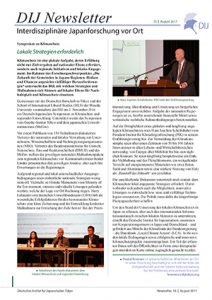
Die Themen der aktuellen Ausgabe beinhalten unter anderem einen ausführlichen Bericht über das Deutsch-Japanische Symposium zu Klimaschutz und regionaler Entwicklung, welches in Zusammenarbeit mit der Deutschen Botschaft Tokyo und der School of International Liberal Studies (SILS) der Waseda University veranstaltet wurde.
Darüber hinaus berichten wir aber natürlich auch über weitere DIJ-Veranstaltungen aus jüngster Vergangenheit, stellen Ihnen unsere neusten Publikationen vor und begrüßen einen neuen Mitarbeiter.
Der DIJ Newsletter ist wie immer verfügbar in einer PDF- und Print-Variante.

Sustainability-Blog

Lesen Sie die neuesten Artikel unseres DIJ-Blogs Sustainability in Japan and Beyond

 Follow us on Bluesky
Institutsbroschüre
Einblicke in unser Institut und seine Aktivitäten bietet unsere aktuelle DIJ Broschüre (Stand 4/2025)
Call for Submissions

Contemporary Japan
Aktuelle Ausgabe Vol. 38, Nr. 2
Contemporary Japan akzeptiert Einsendungen ganzjährig ohne Abgabefrist. Zur Veröffentlichung angenommene Artikel werden umgehend online publiziert. Weitere Details finden Sie hier.
DIJ Monographienreihe
Unsere Monographien sind nach einem einjährigen Embargo  Open Access und können hier heruntergeladen werden:
→ DIJ Monographien
Wegbeschreibung
DIJ Tokyo
Jochi Kioizaka Bldg. 2F
7-1 Kioicho Chiyoda-ku, Tokyo
102-0094 Japan
Wegbeschreibung
+81 (0)3 3222-5077
+81 (0)3 3222-5420
dijtokyo@dijtokyo.org

DIJ-ARI Asian Infrastructures Research Partnership