イベント&アクティビティ
New DIJ Miscellanea Venezianische Wahrheiten (in German)

Japan and Italy have many things in common. Both are rich, industrialised countries with a long cultural tradition that is held in high esteem worldwide. People in both countries enjoy a longer life than almost anywhere else in the world. For both countries, the processes of ageing and population shrinkage are challenges with diverse social, economic, and political facets. But Japan and Italy also differ in many respects, e.g. in social conventions, etiquette, work ethics and everyday behaviour. These similarities and differences make a comparison attractive. Former DIJ director Florian Coulmas has recorded his observations, insights, and experiences during a semester he spent at the University of Venice Ca’ Foscari in the new publication Venezianische Wahrheiten. Japanische Lektionen in der Stadt Marco Polos (in German). The booklet is published as volume 20 in the DIJ Miscellanea series and available for download here.
Journal article on agenda-cutting as a neglected media phenomenon
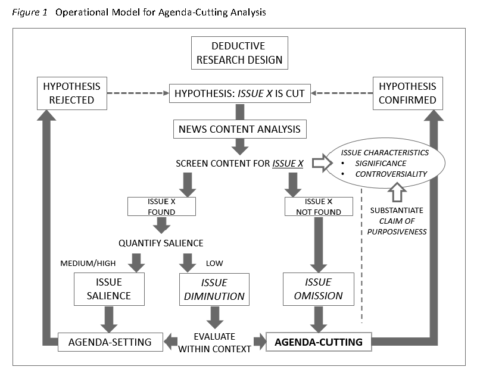
The journal Journalism Studies has published a new article by our PhD fellow Yosuke Buchmeier on agenda-cutting as a neglected media phenomenon. While agenda-setting has developed into one of the leading concepts in communication studies, “agenda-cutting” – a media phenomenon that can be observed when a relevant issue is de-emphasized, entirely omitted or removed from a news agenda – has so far remained a theoretical blind spot. Based on observations from Japan, Yosuke’s paper “Towards a Conceptualization and Operationalization of Agenda-Cutting: A Research Agenda for a Neglected Media Phenomenon” proposes agenda-cutting as a result of media’s anticipatory obedience and self-censorship. It argues that the non-reflected, tacit assumption of agenda-cutting as a by-concept to agenda-setting represents one cause for its theoretical neglect. This paper aims to initiate a scholarly debate by establishing conceptual common ground and proposing a research direction for what the author considers an unduly neglected media phenomenon. Available open access here
Barbara Holthus reviews Aaron Skabelund’s Empire of dogs
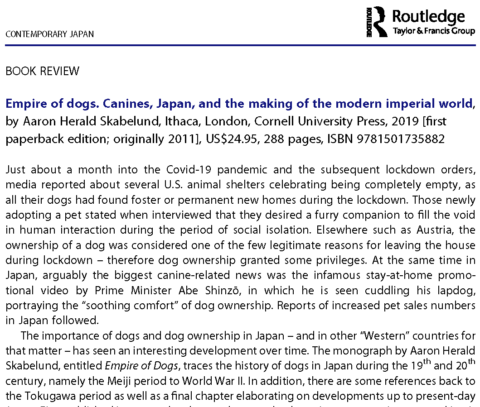 “The book on the history of (dog) culture is situated in the crosshairs of culture, history, modernity, society, and animals, and therefore makes for a rare and eye-opening account of the times. […] Skabelund does a great job showing how the construction of human races and animal breeds are interrelated and interwoven.” Barbara Holthus‘ book review of Aaron Herald Skabelund’s Empire of dogs. Canines, Japan, and the making of the modern imperial world (Cornell University Press, 2019) has just been published online first in Contemporary Japan. Details
New book chapter on gender gap in social movement participation
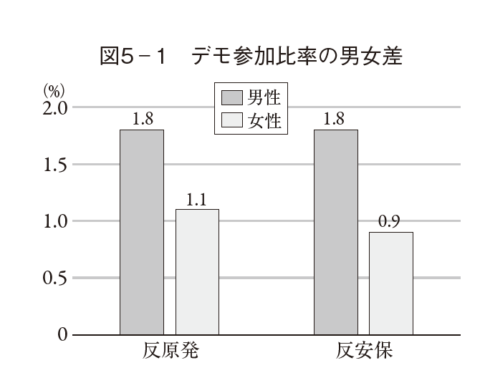
DIJ deputy director Barbara Holthus has co-authored with Naoto Higuchi (Waseda University) a chapter on the gender gap in social movement participation. Their chapter “Demo sanka ni meguru jendā gyappu” (in Japanese) is based on a survey conducted among close to 80.000 Japanese on their social movement sympathies, mobilization and participation patterns, as well as their environmental concerns, personal values, and political views. It shows that participation, concerns, and views are significantly gendered. This large-scale data set allows to give statistical proof and support to many of the previous existing studies, which to the most part until now had been qualitative in nature. The chapter is part of a volume on post-3.11 social movements, co-edited by Naoto Higuchi and Mitsuru Matsutani, and published by Chikumashobo (Tokyo 2020). Details (in Japanese)
Japan and the Tokyo Olympics: Author Interviews on DIJ YouTube channel
 On July 24, 2020, more than one billion people worldwide were expected to watch the opening ceremony of the 2020 Tokyo Olympics. What was supposed to be a glorious year for Japan, 2020 instead catapulted the world into a pandemic, sees the Olympic Games postponed and their future for Tokyo uncertain. Despite its postponement and potential cancellation, the build-up to the 2020 Olympic Games has already had a major impact on Tokyo, Japan, and the many stakeholders in government, business, and society involved. The publication Japan Through the Lens of the Tokyo Olympics (Routledge 2020) explains this multifaceted impact and is available open access (free download). To learn more about the book’s chapters you can watch interviews with our authors on the new DIJ YouTube channel. The playlist will be updated periodically. In the first episode, main editor and DIJ deputy director Barbara Holthus introduces the book and her own chapter on volunteering.
New issue of DIJ Newsletter published
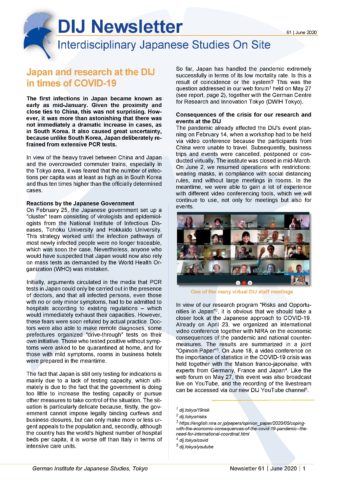 The latest issue of our DIJ Newsletter features reflections on the impact of COVID-19 on Japan and Japanese Studies, summarizes our first web forum on the pandemic in Germany and Japan, and introduces a new DIJ research project on Digital Transformation as well as a book publication on the Olympic Games. We also congratulate one of our colleagues on the receipt of a prestigious award, give an update on recent publications, and announce recent personnel changes in our “Staff News” section.
Visit our DIJ Newsletter webpage to download the most recent issue or to order your free print copy.
Book chapter on Japan’s energy transformation and its potential for rural communities

Renewable energies have the potential to increase energy security, reduce greenhouse gas emissions, and provide an economic basis for the sustainable development of rural areas. Facing typical peripherality issues such as socio-economic decline, poor accessibility, limited political autonomy and tightened budgets, rural communities in Japan are pressed to venture into new institutional arrangements in order to fulfill their statutory duties. Increasing self-sufficiency has therefore emerged as a key strategy for local governments, including energy self-sufficiency. The book chapter “Local renewables: Japan’s energy transformation and its potential for the remaking of rural communities”, co-authored by Daniel Kremers and Thomas Feldhoff (Bochum), analyzes some key trends in Japan’s recent energy transformation and energy policy, in particular government policies linking renewable energy to local development, and local-level conflicts related to increases in renewable energy generation. Case studies highlight the diversity of challenges and the need for locally-specific solutions that lead to healthier communities.
This chapter is part of the volume Japan’s New Ruralities. Coping With Decline in the Periphery (Routledge), co-edited by W. Manzenreiter, R. Lützeler, and S. Polak-Rottmann, and draws on Daniel’s research project on Energy Transition and Energy Democracy in Japan.
‘Comparing Comparisons’ – new blog series online
 Comparison is back in fashion. In some fields it has spawned a vast literature and become the etiquette for discussions of appropriate focus and methods. The advent of big data and AI debates revolving around this have also rejuvenated comparative quantitative research. In other fields, however, comparison peaked long ago. There is a complex and uneven historical variance across disciplines. The new blog series ‘Comparing comparisons’ investigates which role comparisons play in different research fields, ultimately tackling the question of how and why we compare in the social sciences and humanities. The blog entries originate from the presentations of the international and interdisciplinary meeting by scholars affiliated with the Max Weber Research Group at the National University of Singapore and researchers from the German Institute for Japanese Studies that took place in Tokyo on 2nd and 3rd December 2019. Read the first article “Comparing Comparisons – Introduction and Overview” by James D. Sidaway and Franz Waldenberger on trafo blog for transregional research.



 Follow us on Bluesky
Call for Submissions

Contemporary Japan
current issue Vol. 38, No.2
Contemporary Japan is open year-round for rolling submissions, with accepted publications published immediately online. Please see the instructions for submission here.
DIJ Monograph Series
Our monograph series is  Open Access after a one-year embargo period. Downloads are available on our
→ monographs pages.
道案内
ドイツ-日本研究所
〒102-0094 東京都千代田区
紀尾井町7-1 上智紀尾井坂ビル 2F
道案内
+81 (0)3 3222-5077
+81 (0)3 3222-5420
dijtokyo@dijtokyo.org