イベント&アクティビティ
New issue of Contemporary Japan published
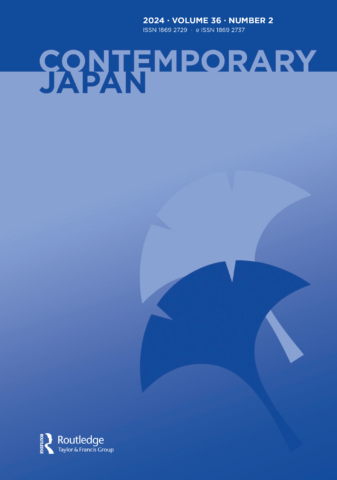
The new issue of Contemporary Japan (vol. 36, no. 2) features five research articles, the biennial 2023 VSJF award-winning paper, and a book review section. The research articles include an inquiry into the relevance and effectiveness of national apologies by Jane Munro; Ryotaro Takahashi addresses the relationship of income inequality and the size of the government in Japan; Ken Hijino analyzes the politics of depopulation in local elections; Silvia Croydon investigates the politics of inclusiveness in terms of consultation on disability policies; and Kristina Iwata-Weickgenannt and Aidana Bolatbekkyzy explore how foodscapes are invoked in critical commentary on the “capitalocene” in post-3.11 Japanese literature. The English translation of the VSJF award-winning paper by David Adebahr offers unprecedented access to the conversations and thought processes behind Japan’s security policy among key political actors in Japan. CJ’s book review section includes recent publications on religion and fundamentalism, the history of Kyoto, public discourse on fertility policies, and the use of robots in eldercare.
New open access article analyses impact of civic engagement on women’s well-being
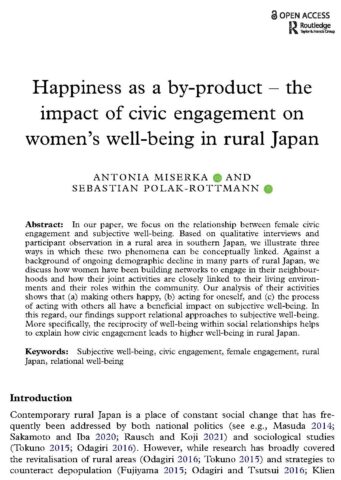 A new open access research article by Antonia Miserka (University of Vienna) and DIJ social scientist Sebastian Polak-Rottmann analyses the relationship between female civic engagement and subjective well-being. Their article “Happiness as a by-product – the impact of civic engagement on women’s well-being in rural Japan”, published in Japan Forum (online first), is based on qualitative interviews and participant observation in a rural area in southern Japan. The analysis shows that (a) making others happy, (b) acting for oneself, and (c) the process of acting with others all have a beneficial impact on subjective well-being. In this regard, the findings support relational approaches to subjective well-being. More specifically, the reciprocity of well-being within social relationships helps to explain how civic engagement leads to higher well-being in rural Japan. The article is an outcome of Sebastian’s research project Supplementing activities of resilience: The impact of demographic change on local activities and civic engagement.
Book by Dolf Neuhaus on Korean-Japanese Interactions and Japanese Colonial Rule in Korea
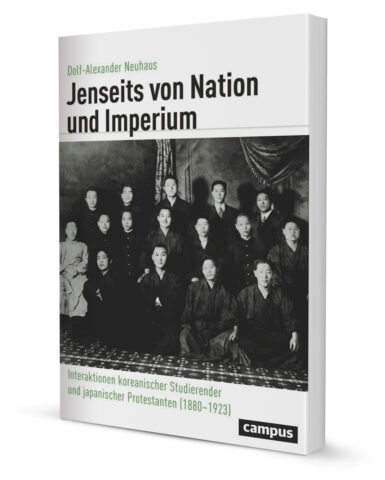
What role did Korean students who came to Japan between 1880 and 1923 play in the discourse on Japan’s colonial and East Asian policies? How did their encounter with Japanese intellectuals of Protestant faith, especially in the environment of the YMCA and the Imperial University of Tokyo, influence their views? Drawing on a wide range of Japanese and Korean sources, Dolf-Alexander Neuhaus‘ new book Jenseits von Nation und Imperium. Interaktionen koreanischer Studierender und japanischer Protestanten (1880–1923) (Beyond nation and empire. Interactions between Korean students and Japanese Protestants, 1880-1923) examines how these students and intellectuals discussed Japanese colonial rule in Korea and the ‘Korean question’ and how their exchange of ideas influenced Japanese and Korean perceptions of empire, nation, and East Asia. The book is based on Dolf’s doctoral dissertation and is published by Campus in the Global History series.
Open access book by Nicole M. Mueller studies Japanese Thomas Mann translations
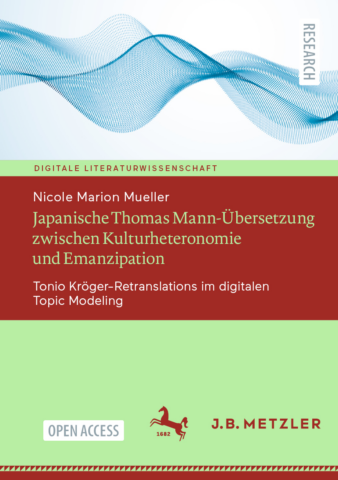
In her new book Japanische Thomas Mann-Übersetzung zwischen Kulturheteronomie und Emanzipation: Tonio Kröger-Retranslations im digitalen Topic Modeling (Japanese Thomas Mann translation between Cultural Heteronomy and Emancipation: Digital Topic Modeling of Tonio Kröger Retranslations), DIJ researcher Nicole Marion Mueller uses innovative digital methods to study Japanese translation pluralism in the 20th century. Focusing on Japanese translations of Mann’s novel Tonio Kröger, she retraces the intensive reception of Mann’s literary works in Japan while paying special attention to the interrelations between translation and a variety of historical contexts and actors – most prominently the elitist kyoyoshugi movement rooted in Japan’s prewar education system. Nicole combines this extensive research work with a topic modeling-based mixed methods approach, which enables her to reveal the previously hidden interactions between the re-translated texts as well as patterns of influence and distinction spanning decades of translation history. The book is published by J.B. Metzler in the Digital Literary Studies series and available open access.
Barbara Holthus explains Germany’s fertility rate development in Japanese journal article
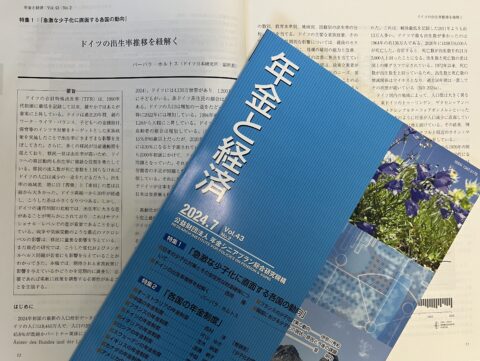 Unlike Japan, Germany’s total fertility rate has shown a slow but steady increase since its lowest point in the early 1990s. What are the factors behind this development? In the article 「ドイツの出生率推移を紐解く」(“Unraveling Germany’s fertility rate development”, in Japanese), DIJ sociologist Barbara Holthus explains how Germany has implemented a mix of family policies targeting time, money, and infrastructure measures for parents. Over the last 20 years, they have had varying influences on the fertility rate. As data shows, migration trends into Germany also play a complex role for its fertility rate, as many migrants are of child-bearing age and first-generation migrants have higher birthrates. In addition, there are significant differences in fertility rates at the sub-national level. Recent macro level influences like war and climate change are also important influences on Germany’s youth, coupled with rising rates in mental health problems. The article is published in a special section on countries facing a rapidly declining birthrate in the summer issue of the Japanese journal Pension and the Economy (『年金と経済』).
Book chapter by Nicole M. Mueller on the historical and institutional contexts that shaped Japanese retranslation
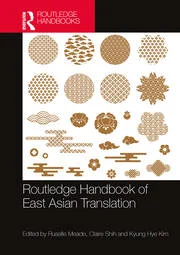 Since ancient times, translation into Japanese has facilitated innovation across a variety of disciplines. Translators functioned as mediators of a foreign culture that was commonly perceived as superior. This tradition became all the more essential after Japan’s forced reopening in the late 19th century after 200 years of self-imposed cultural isolation. In this context, retranslations of Thomas Mann’s classic novel Tonio Kröger form a crucial interface between Japan’s academic, educational, and literary history shaped by the elitist kyōyōshugi movement and its idealisation of 19th century European culture. Based on the digitally augmented analysis of 15 such retranslations, DIJ researcher Nicole M. Mueller retraces how 20th and 21st century Japanese retranslation can be understood as the result of an ongoing negotiation between heteronomy and autonomy toward the West that shaped Japan’s cultural self-image. “Japanese Retranslations in the Twentieth and Twenty-first Centuries: Between Heteronomy and Autonomy toward the West” is published in the Routledge Handbook of East Asian Translation.
Working Paper by Harald Kümmerle on Japanʼs COVID-19 response, surveillance capitalism and cyber civilization
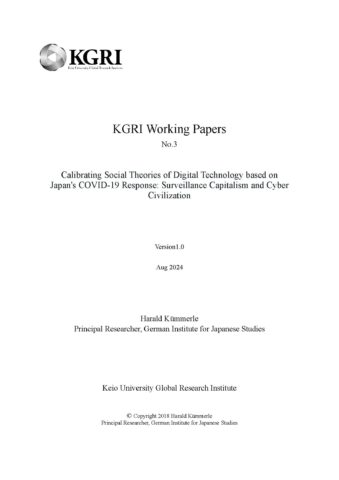
A new working paper by DIJ researcher Harald Kümmerle examines Japan’s response to the COVID-19 pandemic in comparison to other East Asian countries. Drawing on Shoshana Zuboffʼs perspective of surveillance capitalism and Jiro Kokuryoʼs theory of cyber civilization, it argues that Japanʼs aerosol and droplet simulations on the supercomputer Fugaku helped devise efficient countermeasures that did not aim for the complete elimination of the virus. The paper also demonstrates the importance of understanding how the measures in Japan related to the idea of trust and successfully relied on self-restraint (jishuku). Calibrating Social Theories of Digital Technology based on Japan’s COVID-19 Response: Surveillance Capitalism and Cyber Civilization is published open access as Working Paper No. 3 by Keio University’s Global Research Institute.
Open access article by Celia Spoden on end-of-life decision-making in ALS
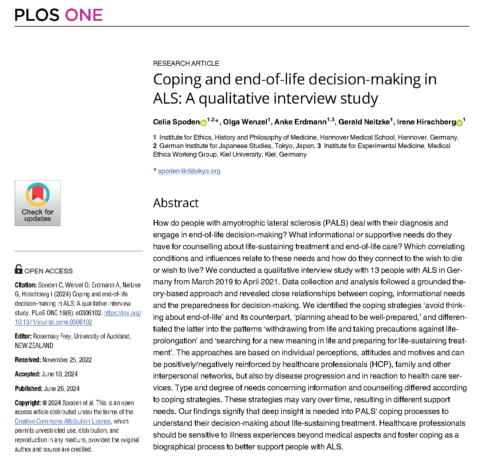 How do people with amyotrophic lateral sclerosis (ALS) deal with their diagnosis and engage in end-of-life decision-making? This new study, co-authored by DIJ researcher Celia Spoden, Olga Wenzel, Anke Erdmann, Gerald Neitzke, and Irene Hirschberg, addresses these and related questions based on qualitative interviews with 13 people with ALS. Data collection and analysis followed a grounded theory-based approach and revealed close relationships between coping, informational needs, and the preparedness for decision-making. The authors identified the coping strategies ‘avoid thinking about end-of-life’ and its counterpart, ‘planning ahead to be well-prepared,’ and differentiated the latter into the patterns ‘withdrawing from life and taking precautions against life-prolongation’ and ‘searching for a new meaning in life and preparing for life-sustaining treatment’. The study recommends healthcare professionals to be sensitive to illness experiences beyond medical aspects and foster coping as a biographical process to better support people with ALS. The article is available open access here


 Follow us on Bluesky
Call for Submissions

Contemporary Japan
current issue Vol. 38, No.2
Contemporary Japan is open year-round for rolling submissions, with accepted publications published immediately online. Please see the instructions for submission here.
DIJ Monograph Series
Our monograph series is  Open Access after a one-year embargo period. Downloads are available on our
→ monographs pages.
道案内
ドイツ-日本研究所
〒102-0094 東京都千代田区
紀尾井町7-1 上智紀尾井坂ビル 2F
道案内
+81 (0)3 3222-5077
+81 (0)3 3222-5420
dijtokyo@dijtokyo.org