Events and Activities
New DIJ Miscellanea The Digital Transformation published
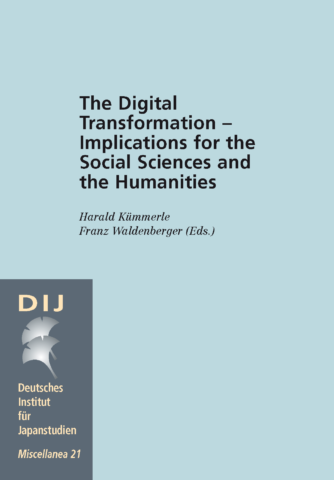 The term digital transformation (DT) has become omnipresent in our personal, social, economic, political, cultural, and academic lives. What are the implications of DT for the social sciences and humanities? This new volume of our DIJ Miscellanea series approaches DT by exploring technological developments and methodology, research data and infrastructure, new research objects and perspectives as well as shifting boundaries of the social sciences and humanities. The publication is the outcome of the workshop “The Digital Transformation – Implications for the Social Sciences and the Humanities” at the DIJ in September 2019. Co-organized by the Nippon Institute for Research Advancement (NIRA) and the German Centre for Research and Innovation Tokyo (DWIH), it brought together scholars from Japan and abroad. The volume consists of ten chapters, including one each by DIJ social scientist Susanne Brucksch (“Insights into the Digital Transformation From the Fields of Medicine and Healthcare in Japan”) and the co-editors Harald Kümmerle (“Postscript: Comparative and historical perspectives on the digital transformation”) and Franz Waldenberger (“Knowledge production and the role of SSH in the digital age”). It is available for free download here
From New Normal to New Work? Insights from Japan and Germany
 DIJ Web-Forum
Due to the corona pandemic, work organization has been subject to dramatic change, and teleworking from home offices had to be suddenly implemented to keep businesses running. Mobile working, software-based collaboration, web-based meetings and new means of performance control were installed at a large scale. Have we suddenly reached the long-discussed digital future of work? Or is this only a temporary phase, and work life will return to what it was before the pandemic? Our speakers will outline the major changes in the organization of work caused by the pandemic in Japan and Germany. They will also discuss to what extent national regulations have been obstructing, shaping or supporting respective adjustments and assess to what extent the newly introduced workstyles can be expected to last. Details
Speakers:
Andrea Hammermann, German Economic Institute
Nobuko Nagase, Ochanomizu University
Michael Johannes Pils, Taylor Wessing
Chisako Takaya, Mori Hamada & Matsumoto
moderated by Franz Waldenberger, DIJ
Symposium ‘Global Views of Japanese Parliamentarism’
 Online Symposium (26-27 November 2020)
On November 29, 1890, the parliament of the Empire of Japan, the Imperial Diet, met for the first time marking the beginning of parliamentary government not only in Japan but also in Asia. While the recognition of Japan as a role model for successful ‘modernization’ of a non-Western society in the wake of the Russo-Japanese War has received much scholarly attention, the transnational appeal of this successful establishment of representative governance in Japan has not yet received much interest. Together with the Faculty of Arts, Chulalongkorn University, Bangkok, the DIJ will take the occasion of this year’s 130th anniversary of the opening of the Imperial Japanese Diet as an opportunity to hold a symposium to discuss the global appeal of this first functioning constitutional government in Asia and beyond. For the programme and registration information see our event page.
DIJ researchers at VSJF Sections’ Meetings
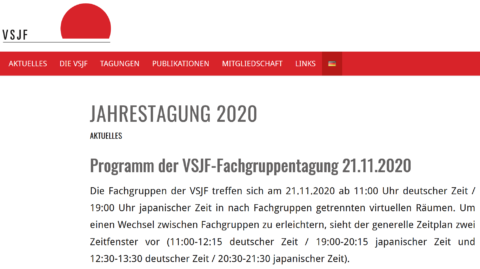
Several DIJ researchers and alums will participate in this year’s sections’ meetings of the German Association for Social Science Research on Japan (VSJF). The sections’ meetings replace the annual conference which has been postponed to 2021 due to the Corona pandemic. Research fellow Nora Kottmann and DIJ alum Carola Hommerich are organizers of the Sociology Section (with Celia Spoden). The History Section is convened by VSJF president Anke Scherer and research fellow Torsten Weber. The Technology Section is convened by DIJ alum Cosima Wagner and research fellow Susanne Brucksch who will also give a paper (“Trend report: Digital health developments in Japan during the pandemic”) in that section. Former DIJ research fellow Harald Conrad organizes the Economy Section. The sections meet online on Saturday, 21 November, from 19.00-20.15 and 20.30-21.30 (JST). During the VSJF members’ meeting, the Contemporary Japan Best Paper Award 2020 will be presented by CJ’s Managing Editor Isaac Gagné. For the programme of all sections’ meetings see the VSJF website.
Sonja Ganseforth quoted in news reports on anti-Olympic protests

Comments by social scientist Sonja Ganseforth on recent anti-Olympic protests in Tokyo have appeared in international media. “Once the decision to hold the Olympics in Tokyo had been made, many (Japanese) also considered it anti-social or even unpatriotic to protest openly against the Games”, Sonja is quoted in the AP news article Critics speak out on Tokyo Olympic costs, pandemic, fairness published on 13 November. A version of the article also appeared in the Japan Times on 17 November. On 22 November, an interview with Sonja appeared in the German daily newspaper taz. In “Eine Absage ist möglich”, she explains the role of anti-Olympic activism in Japanese society. Sonja has been researching anti-Olympic movements in Japan as part of the DIJ special project on the Tokyo Olympics and its book publication Japan through the lens of the Tokyo Olympics. Her chapter “The difference between zero and one” is available for free download, alongside all other chapters in this open access book.
Sonja Ganseforth’s research at Coastal Transitions conference
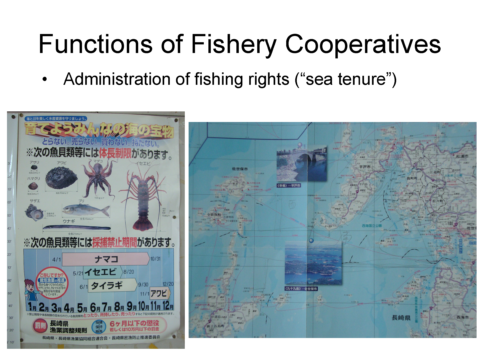 On November 6, human geographer Sonja Ganseforth presented her latest research on the implications of the Japanese Fishery Law reform for small-scale coastal fisheries at the “Coastal Transitions: Blue Economy” 2020 conference. Based on qualitative field research in rural Japan, Sonja’s paper “Blue Growth or Decline in Japanese Coastal Fisheries” analyzed how global discourses of sustainable growth and institutional reform in the Japanese fishing sector are driving the enclosure of one of the last vestiges of natural resource commons. The focus on private capital and presuppositions of economic and scientific rationality drives the commodification and enclosure of this contracting commons – a process supported by domestic political circles as well as through international agenda setting campaigns. Sonja’s presentation is part of her ongoing research project on Fishing communities between growth and demise in Japan. The online conference “Coastal Transitions: Blue Economy” was jointly organized by Liverpool John Moores University, Southern Connecticut State University and MIC University of Limerick.
Japan’s new Ambassador to Germany visits DIJ
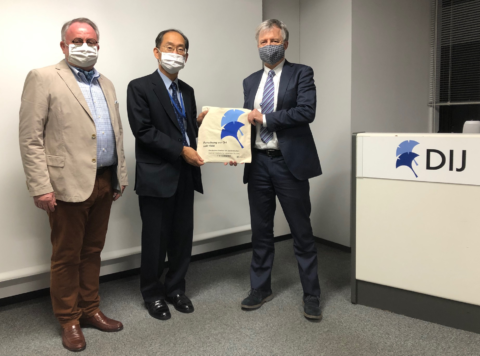
On November 4, Japan’s new Ambassador to the Federal Republic of Germany, Hidenao Yanagi, visited our institute. Director Franz Waldenberger and Administrative Director Joachim Röhr informed Ambassador Yanagi about the ongoing research at the DIJ and the international network of the Max Weber Foundation. In perfect German, Mr. Yanagi reported that he is very much looking forward to his second posting in Berlin, also to deepen his understanding and connection to the new German states. Furthermore, he is looking forward to the upcoming celebrations of the 160th anniversary of the relations between Japan and Germany next year, even though not all of them may be realised due to the ongoing pandemic.
During his visit Mr. Yanagi praised the important role the DIJ has played over the past 30 years in developing German-Japanese relations. From 2014 to 2017 Mr. Yanagi was Consul General in Munich, followed by almost three years as Ambassador to Jordan. We are very pleased and honoured that Ambassador Yanagi took the time to visit our institute a few days before his departure for Berlin.
Issue 32(2) of Contemporary Japan published
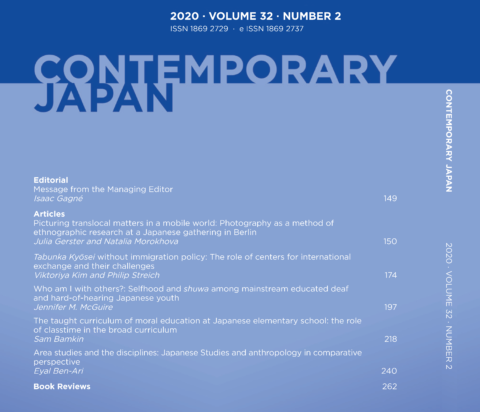
The latest issue of Contemporary Japan is now available online and in print. CJ32(2) features a range of articles exploring: photography and ethnographic research among Japanese in Berlin (Julia Gerster & Natalia Morokhova); the role of centers for international exchange in multicultural community building (Viktoriya Kim & Philip Streich); notions of selfhood among deaf and hard-of-hearing youth (Jennifer M. McGuire); and moral education in elementary school classrooms (Sam Bamkin). This issue also features an Invited Commentary by Eyal Ben-Ari reflecting on the relationship between area studies and the disciplines and the adaptive potential of Japanese Studies. Plus: five reviews of recently published books on the self-defense forces, food safety, gardening, memory in Hiroshima, and economic history. Please see the full issue here


 Follow us on Bluesky
Call for Submissions

Contemporary Japan
current issue Vol. 38, No. 1
Contemporary Japan is open year-round for rolling submissions, with accepted publications published immediately online. Please see the instructions for submission here.
DIJ Monograph Series
Our monograph series is  Open Access after a one-year embargo period. Downloads are available on our
→ monographs pages.
Access
DIJ Tokyo
Jochi Kioizaka Bldg. 2F
7-1 Kioicho Chiyoda-ku, Tokyo
102-0094 Japan
Where to find us
+81 (0)3 3222-5077
+81 (0)3 3222-5420
dijtokyo@dijtokyo.org

DIJ-ARI Asian Infrastructures Research Partnership