Events and Activities
New ‘Citizen Science in the Digital Age’ Opinion Paper
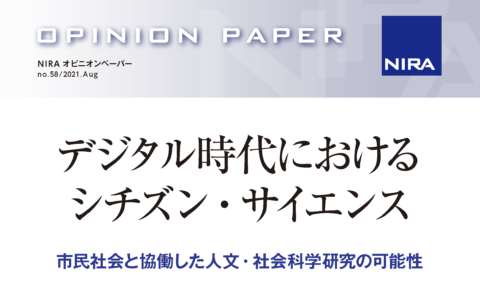
Citizen science, in which citizens and scientists collaborate to generate and utilize data and knowledge, is an important approach to co-creating society. While citizen science in the natural sciences is well established, it is still in its infancy in the humanities and social sciences. To use the citizens’ knowledge to solve social problems it is necessary to design protocols for citizen participation, to involve universities in supporting citizen science, and to build data provision and management systems that take into account data ownership and privacy protection. At a conference co-organized by the NIRA Research Institute, the DWIH Tokyo, and the DIJ, researchers from Japan and abroad discussed the possibilities of citizen science to contribute to the development of research in the humanities and social sciences. DIJ director Franz Waldenberger contributed the closing comments. The opinion paper ‘Citizen Science in the Digital Age’ based on this conference has now been published (in Japanese). A PDF version is available for download here
New journal article examines post-3.11 plays and cultural trauma
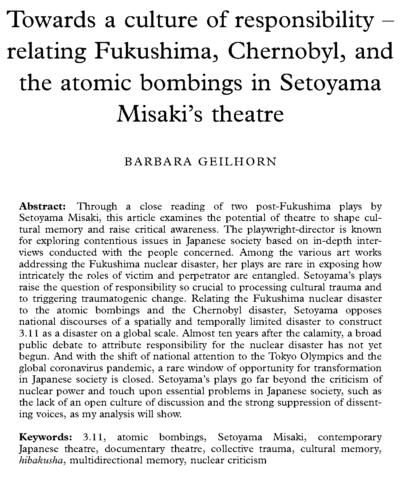 A new journal article by DIJ researcher Barbara Geilhorn studies two post-Fukushima plays by Setoyama Misaki to examine the potential of theatre to shape cultural memory and raise critical awareness. Among the various art works addressing the Fukushima nuclear disaster, Setoyama’s plays are rare in exposing how intricately the roles of victim and perpetrator are entangled. Relating Fukushima to the atomic bombings and the Chernobyl disaster, Setoyama opposes national discourses of a spatially and temporally limited disaster to construct 3.11 as a disaster on a global scale. Setoyama’s plays go far beyond the criticism of nuclear power and touch upon essential problems in Japanese society, such as the lack of an open culture of discussion and the strong suppression of dissenting voices, as the analysis shows. The article is an outcome of Barbara’s research project Local Issues Take Stage – Culture and Community Revitalization. It was published in Japan Forum, online first, and can be accessed here.
Summer issue of DIJ Newsletter published
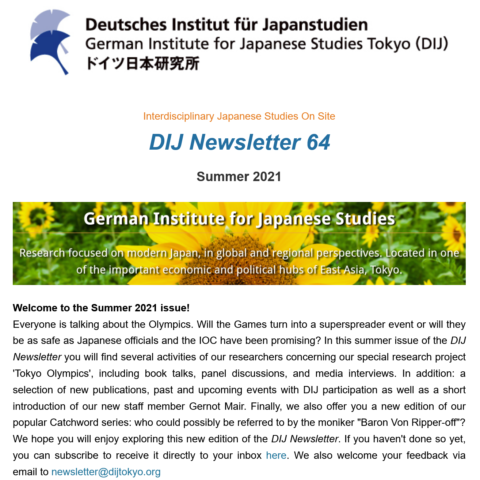
We have just published the summer issue of our DIJ Newsletter featuring updates on our research, publications, and outreach activities. In this issue you will find a selection of our recent and forthcoming activities, including a panel discussion on the Tokyo Olympics in cooperation with the Japanese-German Center Berlin (JDZB); a Web-Forum series on Digital Transformation; new book publications by Susanne Brucksch, Barbara Geilhorn, Sonja Ganseforth, and our alumnus Hanno Jentzsch; a profile of our new staff member Gernot Mair; a new edition of our Catchword series; and much more. We hope you will enjoy exploring this new edition of the DIJ Newsletter. If you haven’t done so yet, you can subscribe to receive it directly to your inbox. The full issue and subscription form are available here.
New Edited Volume on Health and Technology
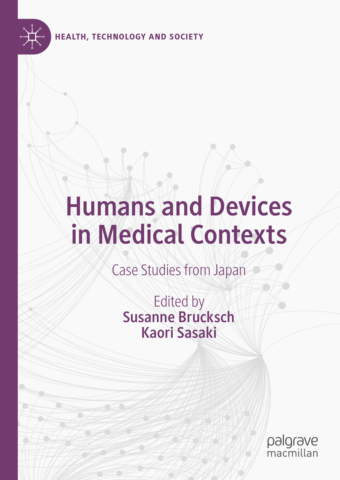
The new book publication Humans and Devices in Medical Contexts. Case Studies from Japan explores the ways in which socio-technical settings in medical contexts are articulated in Japan. It consists of a detailed theory chapter and nine case studies on topics concerning: experiences with radiation in Hiroshima, Nagasaki, and Fukushima; patient security, end-of-life and high-tech medicine in hospitals; innovation and diffusion of medical technology; and the engineering and evaluating of novel devices in clinical trials. The individual chapters situate humans and devices in medical settings in their given semantic, pragmatic, institutional and historical context. A highly interdisciplinary approach offers deep insights beyond the manifold findings of each case study, thereby enriching academic discussions on socio-technical settings in medical contexts amongst affiliated disciplines. The book is edited by DIJ researcher Susanne Brucksch and Kaori Sasaki (Sapporo Medical University). Details
Understanding ‘Self-responsibility’ in Japan – New DIJ Monograph
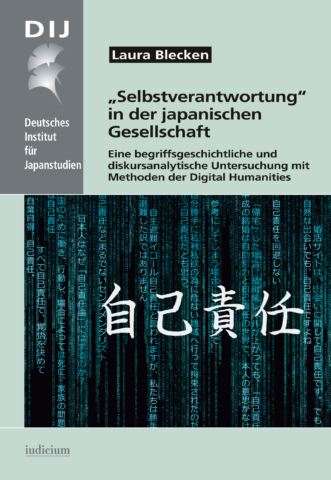
Hostages in war zones, nuclear refugees from Fukushima, and workers in precarious conditions: all have been assigned personal responsibility for their situation by the Japanese word jikosekinin. The term – literally translated as “self-responsibility” – has become a keyword in contemporary Japanese society. But what does jikosekinin mean and how was the term established in the Japanese language? This study (in German) by Laura Blecken examines this multi-faceted concept by combining methods of conceptual history and discourse analysis with tools from the digital humanities. It traces the word back to its roots and creates a model for its different meanings through which various discourses converge. Finally, the study investigates how jikosekinin is used today by analyzing almost 40,000 blog posts. The latest volume in the DIJ Monographs Series examines the omnipresence of jikosekinin in everyday life and its role between traditional moral values and the impact of global neoliberalism. Details, including summaries of the book in English and Japanese, can be found here
“You cannot not compare.” Concluding contribution to Comparing Comparisons blog
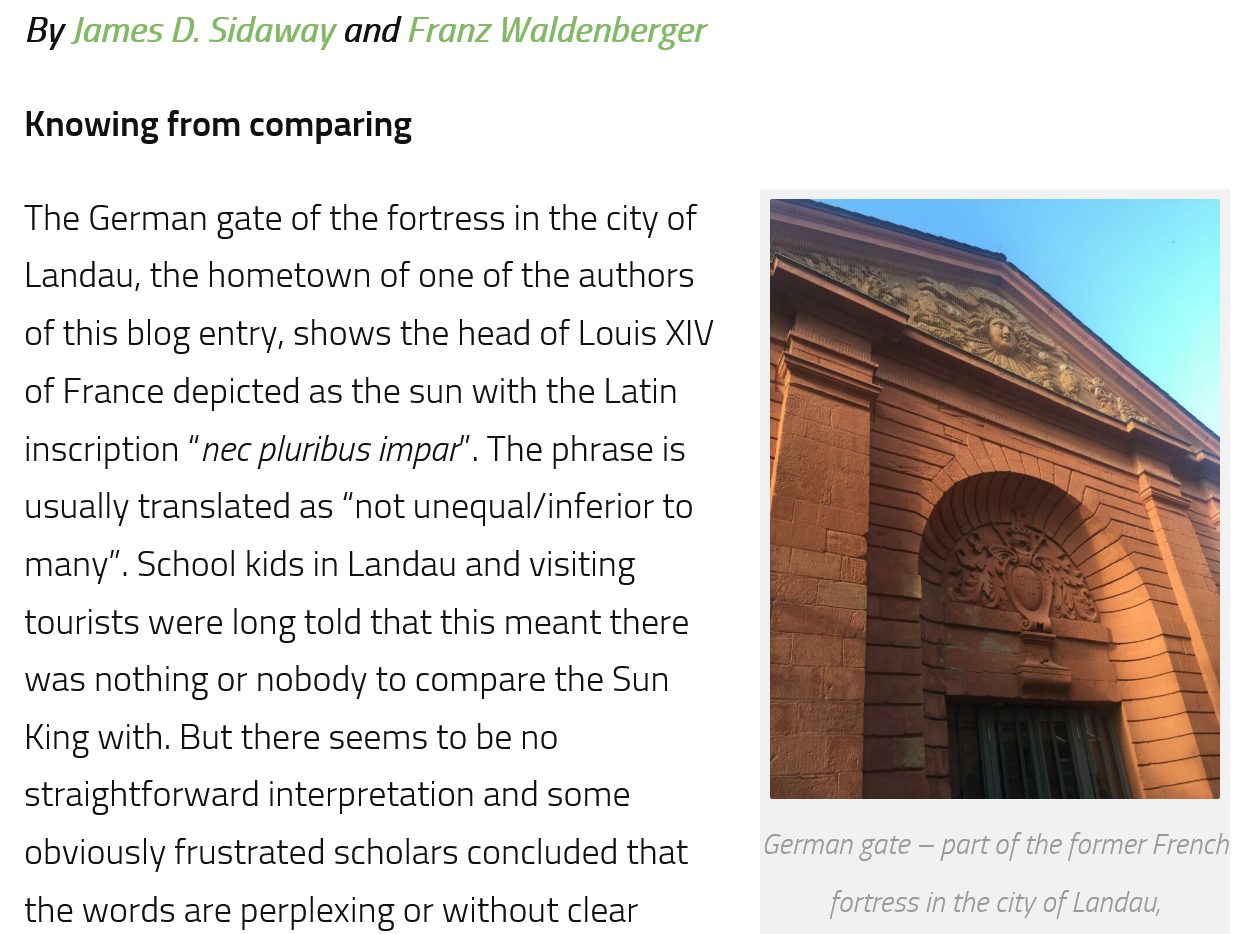
In their concluding contribution to the Comparing Comparisons blog, DIJ director Franz Waldenberger and James D. Sidaway (Professor of Political Geography, NUS) emphasize the invaluable benefits from comparing as a method in the humanities and social sciences. “You can do it wrong or be seduced by too easy comparisons, but you cannot easily do without some”, they conclude. Their article “Who compares? The commodification and decolonization of comparison” is the final contribution to the blog which originates from the international and interdisciplinary meeting by scholars affiliated with the Max Weber Foundation Research Group at the National University of Singapore and DIJ researchers in Tokyo in December 2019. Previous contributions offer variations of the blog’s theme and draw examples from the authors’ respective areas of specialization, including anthropology, ethnography, Japanese studies, political geography, economics, cross-cultural studies, business and management research.
Spring issue of DIJ Newsletter published
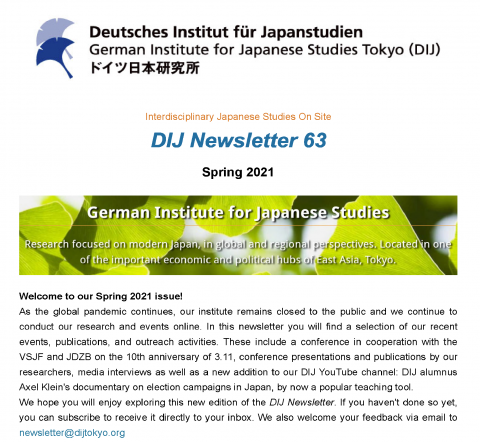
We have just published the spring issue of our DIJ Newsletter featuring updates on our research, publications, and outreach activities. In this issue you will find a selection of our recent and forthcoming activities, including a conference in cooperation with the German Association for Social Science Research on Japan (VSJF) and the Japanese-German Center Berlin (JDZB) on the 10th anniversary of 3.11; conference presentations and publications by our researchers; media interviews as well as a new addition to our DIJ YouTube channel: DIJ alumnus Axel Klein’s documentary on election campaigns in Japan, by now a popular teaching tool. We hope you will enjoy exploring this new edition of the DIJ Newsletter. If you haven’t done so yet, you can subscribe to receive it directly to your inbox. The full issue and subscription form are available here.
New article by Markus Heckel on Japan’s fiscal policy
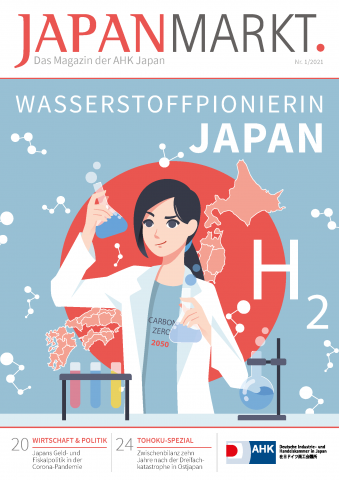
DIJ economist Markus Heckel has contributed an article on Japan’s monetary and fiscal policy to the latest issue of Japanmarkt, the German-language quarterly published by the German Chamber of Commerce and Industry (AHK) in Japan. The Corona pandemic has caused a global economic standstill and also the Japanese economy has weakened since the beginning of the crisis. The Japanese government and central bank have therefore launched huge economic stimulus and aid programmes. In “Japans Geld- und Fiskalpolitik im Spiegel der Corona-Pandemie” (Japan’s Monetary and Fiscal Policy in the Light of the Corona Pandemic), Markus explains how the Bank of Japan and the Japanese government have coordinated their monetary and fiscal policies. He also analyzes risks and side effects of Japan’s debt problems and its ultra-loose monetary policy. The full article is available for download here. It draws on Markus’ ongoing research project Economic Discourses of Monetary Policy – The Case of the Bank of Japan.


 Follow us on Bluesky
Call for Submissions

Contemporary Japan
current issue Vol. 38, No. 1
Contemporary Japan is open year-round for rolling submissions, with accepted publications published immediately online. Please see the instructions for submission here.
DIJ Monograph Series
Our monograph series is  Open Access after a one-year embargo period. Downloads are available on our
→ monographs pages.
Access
DIJ Tokyo
Jochi Kioizaka Bldg. 2F
7-1 Kioicho Chiyoda-ku, Tokyo
102-0094 Japan
Where to find us
+81 (0)3 3222-5077
+81 (0)3 3222-5420
dijtokyo@dijtokyo.org

DIJ-ARI Asian Infrastructures Research Partnership