Veranstaltungen und Aktivitäten
DIJ researchers at ASCJ Annual Conference
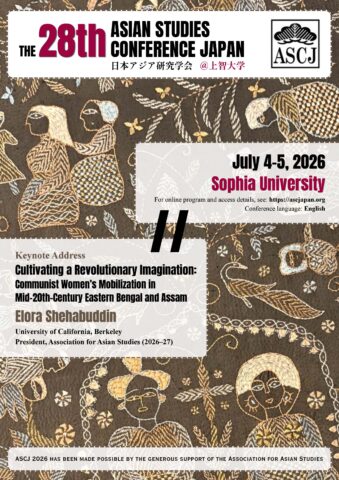 DIJ research fellows Dolf-Alexander Neuhaus and Torsten Weber, doctoral researchers Merle Kartscher and Francesca Lerz as well as eight DIJ alumni will participate as presenters, discussants, and chairs in the Annual Meeting of the Asian Studies Conference Japan (ASCJ). Dolf will present his paper “The Essence of Japanese Development Aid? Genealogies of Liberal Thought from Empire to Postwar” in the panel “Imagining Empire, Constructing Asia: Knowledge and Authority in Japanese Thought from Prewar to Postwar”, chaired by Torsten who will also serve as discussant. Merle will give her paper “Women on the Savage Border: Discourses of Indigeneity and Gender in the ‘Taiwan aikoku fujin'” in the panel “(Re)Creating Japanese Colonial Peripheries: Gender, Education, and Science Across Empire and Cold War” and Francesca will present her paper “Negotiating Identity: Zeami’s Nō Aesthetics in Medieval Japan” in the panel “Reimagining Nō Theatre: Tradition, Modernity, and the Multiplicity of Identity”. The conference takes place at Sophia University Tokyo from July 4-5, 2026. Programme and details here.
Hybrid Study Group on Right-Wing Movements in Japan and South Korea

In recent decades, right-wing movements have gained renewed visibility across the globe, and East Asia is no exception to this global trend. Right-wing movements in Japan and South Korea are deeply embedded in disputes over the colonial past and postwar memory. In these debates, right-wing discourses of “historical truth” have become influential frameworks for interpreting and contesting the colonial past and collective memory within each national context. What is notable is that right-wing actors in these two countries have increasingly engaged in cross-border interactions around historical revisionism since the 2000s. This raises the question: how do right-wing discourses of “historical truth” circulate across Japan and South Korea, and through which networks, practices, and media are they produced and reinforced across national borders? Based on fieldwork and archival research, this talk will share preliminary findings and discuss the transnational circulation of revisionist narratives. Details and registration here
Deutschsprachiges Kaffeekränzchen „Philosophie-Jause“
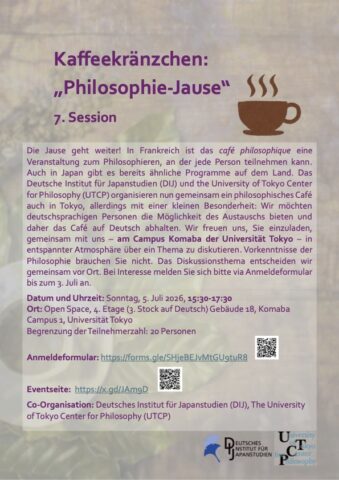 Die Jause geht weiter! In Frankreich ist das café philosophique eine Veranstaltung zum Philosophieren, an der jede Person teilnehmen kann. Auch in Japan gibt es bereits ähnliche Programme auf dem Land. The University of Tokyo Center for Philosophy (UTCP) und das Deutsche Institut für Japanstudien (DIJ) organisieren gemeinsam ein philosophisches Café auch in Tokyo, allerdings mit einer kleinen Besonderheit: Wir möchten deutschsprachigen Personen die Möglichkeit des Austauschs bieten und daher das Café auf Deutsch abhalten. Das Organisationsteam (Yukiko Kuwayama, UTCP und Sebastian Polak-Rottmann, DIJ) freut sich, Sie dieses Mal auf den Campus Komaba der Universität Tokyo einzuladen, um gemeinsam in entspannter Atmosphäre über ein Thema zu diskutieren. Fachliche Vorkenntnisse benötigen Sie nicht. Bei Interesse melden Sie sich bitte bis zum 3. Juli an. Weitere Informationen hier
Gerald D. Feldman Travel Grants for multi-country research projects
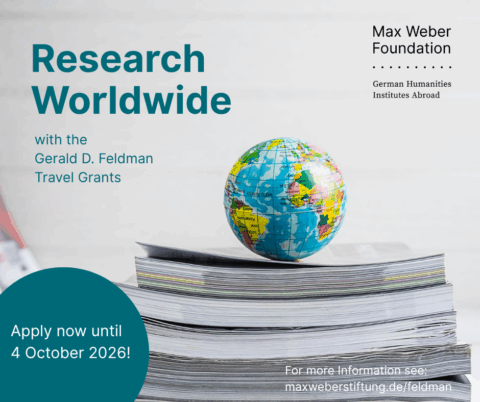 You are an early career researcher looking for funding for research stays abroad of up to three months? If your countries of interest match, why not consider applying for a Gerald D. Feldman Travel Grant for researchers in the humanities and social sciences? Offered by the Max Weber Foundation (MWS), the travel grants allow you to conduct your own research project in two or three of the countries which are home to MWS institutes and branches or at the Richard Koebner Minerva Center for German History in Israel. We particularly encourage applicants whose research includes Japan. Application deadline: 4 October 2026. Please see the full call, list of possible host countries, and application guidelines here
Open Access book on East Asian startup ecosystems
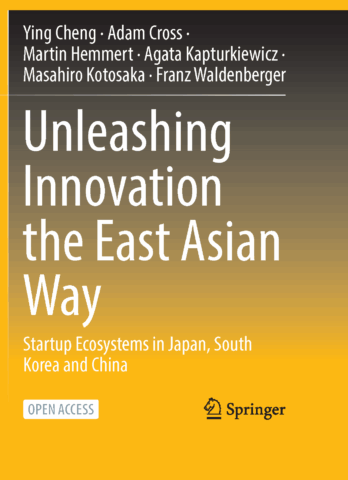 The book Unleashing Innovation the East Asian Way. Startup Ecosystems in Japan, South Korea and China (Springer Singapore 2026) provides new perspectives on startup ecosystems in East Asia – a region which has over decades shaped innovation and global competition. Focusing on Japan, South Korea, and Mainland China, the chapters sketch the dynamic and diverse development of East Asian startup ecosystems considering their wider historical and national contexts. The authors Ying Cheng, Adam Cross, Martin Hemmert, Agata Kapturkiewicz, Masahiro Kotosaka, and DIJ director Franz Waldenberger systematically analyze and compare startup ecosystems. In this way, they show commonalities and differences across East Asia. The chapters use both secondary sources and data from the authors’ decade long collaborative work. Published open access, this book aims to make these findings, which have so far only been presented in academic journals, accessible to a wider readership.
Barbara Holthus quoted in AP and DLF media reports
 For a report published by Associated Press, DIJ sociologist Barbara Holthus explained how socialization, collectivism, and the concept of meiwaku, or not wanting to pose an inconvenience to others, contribute to the phenomenon of Japanese soccer fans cleaning up after sports games. “If you grew up with a certain way of how things are being done, you apply that to even cleaning up a stadium afterwards.” Barbara was also interviewed by German radio station Deutschlandfunk Kultur for a feature on Japanese women’s fights against stereotypes (in German). Commenting on changes and continuities in Japanese society regarding gender equality and equal opportunities, she explained that “men in Japan still tend to marry below their social class”. The radio feature also quotes insights on traditional gender roles and recent political developments in Japan from DIJ alumnus Vincent B. Lesch.
New blog posts on sustainability at Aichi Triennale and knowledge production in Korea
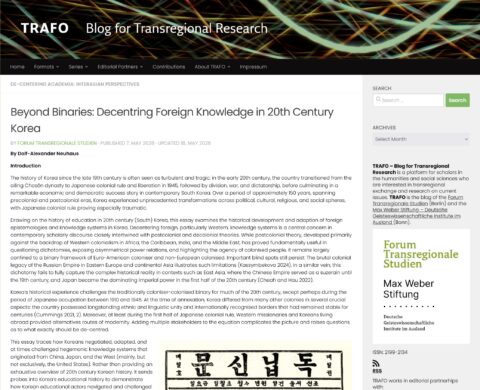 DIJ researchers Carolin Fleischer-Heininger and Dolf-Alexander Neuhaus have contributed articles to the DIJ’s Sustainability in Japan and Beyond blog and the TRAFO Blog for Transregional Research, respectively. Carolin’s article “Tracing Sustainability at the Aichi Triennale 2025 in Japan” reports on her experience as a visitor of the Aichi Triennale 2025, a well-established art festival mainly held in the city of Nagoya, from the perspective of someone who is visually impaired. “Addressing cultural, social and ecological dimensions of sustainability and often also gaining inspiration and authority from personal experience”, she writes, the Triennale “validates sustainability as a matter of responsibility and of justice to give voice to the perspectives that are less prominent in most debates on eco-social sustainability.” Dolf’s article “Beyond Binaries: Decentring Foreign Knowledge in 20th Century Korea”, part of the blog series “De-centering Academia: InterAsian Perspectives”, draws on the history of education in 20th century (South) Korea to examine the historical development and adaption of foreign epistemologies and knowledge systems in Korea.
Onsite Study Group on Independent Bookstores and Zine Communities

The fragmentation of the public into separated echo chambers, accelerated by social media, algorithms, and AI swarms, has furthered the polarization of democracies, with a wave of right-wing populist parties worldwide. In the midst of rising hate speech, a new trend towards the rediscovery of analogue places of social exchange has emerged: small bookshops, self-published zines, and festivals of independent literature have been on the rise in Japan, significantly soaring since the corona pandemic. The project explores dokuritsu-shoten, a wave of newly founded independent bookstores since the late 2010s, deeply intertwined with self-published books and zines, under the concept of third places. The presentation introduces preliminary findings from fieldwork in independent bookstores and literature festivals in Japan, drawing on interviews with bookstore owners and self-publishers, as well as independent books and zines found in these spaces. Details and registration here
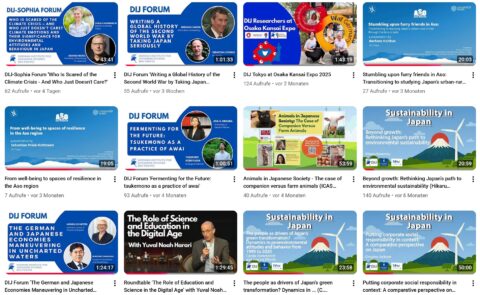
Sustainability-Blog

Lesen Sie die neuesten Artikel unseres DIJ-Blogs Sustainability in Japan and Beyond

 Follow us on Bluesky
Institutsbroschüre
Einblicke in unser Institut und seine Aktivitäten bietet unsere aktuelle DIJ Broschüre (Stand 4/2025)
Call for Submissions

Contemporary Japan
Aktuelle Ausgabe Vol. 38, Nr. 1
Contemporary Japan akzeptiert Einsendungen ganzjährig ohne Abgabefrist. Zur Veröffentlichung angenommene Artikel werden umgehend online publiziert. Weitere Details finden Sie hier.
DIJ Monographienreihe
Unsere Monographien sind nach einem einjährigen Embargo  Open Access und können hier heruntergeladen werden:
→ DIJ Monographien
Wegbeschreibung
DIJ Tokyo
Jochi Kioizaka Bldg. 2F
7-1 Kioicho Chiyoda-ku, Tokyo
102-0094 Japan
Wegbeschreibung
+81 (0)3 3222-5077
+81 (0)3 3222-5420
dijtokyo@dijtokyo.org

DIJ-ARI Asian Infrastructures Research Partnership