Veranstaltungen und Aktivitäten
Shrinking but Happy? Investigating the Interplay of Social and Individual-Level Predictors of Well-Being in Rural Japanese Communities
Rural communities in Japan have been facing accelerating structural and demographic decline in recent decades. Yet, there is limited evidence on how these challenges impact communities and the quality of life of their inhabitants in Japan. Much of the available international data shows that rural municipalities report higher subjective well-being than urban areas despite being affected by greater structural decline in objective well-being indices.
This presentation will introduce a comprehensive, multidimensional approach to well-being, sensitive to individual and ‘Japanese’ constructions of happiness, and provide tentative insights into well-being in the rural Japanese town of Aso, Kumamoto Prefecture, which is average in terms of its demographic and economic situation.
Speaker:
Dionyssios Askitis, University of Vienna
Renewable Energy in Germany and Japan – Prospects for the Citizen Energy Movement
Citizen energy, known as “Bürgerenergie”, forms a major pillar of the transition to renewable energies (RE) in Germany. From as early as the 1990s German citizens pioneered in in solar and wind power or biomass energy projects and invested into RE as individual households, companies or as members within more than 900 energy cooperatives. Similarly, though less known, Japan as well has a long-established vibrant citizen energy movement, also referred to as “community power”. While initially focusing on building RE capacity, a growing number of citizen energy companies ventured into direct marketing of “green energy”.
The shift from a feed-in-tariff (FIT) to a feed-in-premium (FIP) and auction scheme, the institutional framework for grid integration, the deregulation of electricity markets, but also the changing social acceptance of RE and the ecological consciousness among the wider public present major challenges for citizen energy projects and their business models. Highlighting differences in the regulatory environment and public opinion, our speakers will be comparing the development of citizen energy in Germany and Japan. Despite differences, the citizen energy movement in both countries is presently challenged by tighter regulations for RE, growing local resistance to RE projects, and barriers to market integration. At the same time, direct markets for “green energy” are underdeveloped in Japan and, albeit more developed, contribute little to the expansion of renewables in Germany. Eiji Oishi will comment the discussion from a practitioner and business point of view.
Speakers:
Carsten Herbes, Nuertingen-Geislingen University, Germany
Jörg Raupach-Sumiya, Ritsumeikan University, Osaka
Eiji Oishi, Minna Denryoku, Tokyo
The Mountains Belong to Everybody? Conflicts about Recreational Forest Use in Austria and Japan
 Recreational outdoor sports, such as hiking, mountain biking, and trail running are enjoying increased popularity in Japan and worldwide. Proponents argue that these activities contribute to physical and mental health on the one hand and bring about economic and social benefits for rural areas on the other. At the same time there are concerns of over-use and environmental degradation. Focusing on mountain biking, Prof. Yuichiro Hirano and Prof. Wolfram Manzenreiter will be comparing the current situation in Austria and Japan and try to line out possible futures for sustainable outdoor tourism that benefits rural areas and protect the environment equally.
Speakers:
Yuichiro Hirano, Forestry and Forest Products Research Institute, Tsukuba
Wolfram Manzenreiter, University of Vienna
DIJ Newsletter 59 published
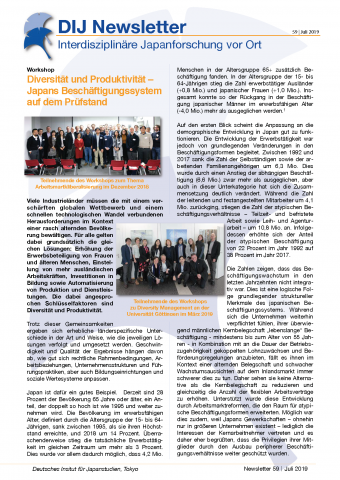 Bericht: Diversität und Produktivität – Japans Beschäftigungssystem auf dem Prüfstand
Viele Industrieländer müssen die mit einem verschärften globalen Wettbewerb und einem schnellen technologischen Wandel verbundenen Herausforderungen im Kontext einer rasch alternden Bevölkerung bewältigen. Für alle gelten dabei grundsätzlich die gleichen Lösungen: Erhöhung der Erwerbsbeteiligung von Frauen und älteren Menschen, Einstellung von mehr ausländischen Arbeitskräften, Investitionen in Bildung sowie Automatisierung von Produktion und Dienstleistungen. Die dabei angesprochen Schlüsselfaktoren sind Diversität und Produktivität.
Neue Ära: Japans neue Ära hat einen Namen: Reiwa
Es war kein Aprilscherz: am 1. April verkündete Chefkabinettssekretär Yoshihide Suga Reiwa als neues nengō (auch gengō). Unter dieser Devise – flexibel übersetzbar als „Japan herrsche“ oder „angeordneter Frieden“ – stehen die Thronjahre des neuen Kaisers Naruhito seit dem 1. Mai 2019.
DFG-Projekt: Nankinger Kriegstagebücher
Als japanische Truppen im Herbst 1937 auf die chinesische Hauptstadt Nanking vorrücken, entscheidet sich der deutsche Siemens-Repräsentant John Rabe (1882-1950) nicht zu flüchten, sondern in Nanking zu bleiben.
Contemporary Japanese Theatre Workshop
This workshop investigates recent themes and issues in contemporary Japanese theatre. Themes that will be discussed include regional theatre, theatre and community, the role of the avantgarde and contemporary challenges. We consider some of the urgent issues that Japanese theatre is addressing today. Featuring a mix of presentations by senior scholars and new voices in the field, this workshop is open to everyone interested in theatre in the contemporary world. Presentations are in English.
Organizer:
Barbara Geilhorn
Studying Japan: The impact of transnationalization and technological innovation on methods, fieldwork and research ethics
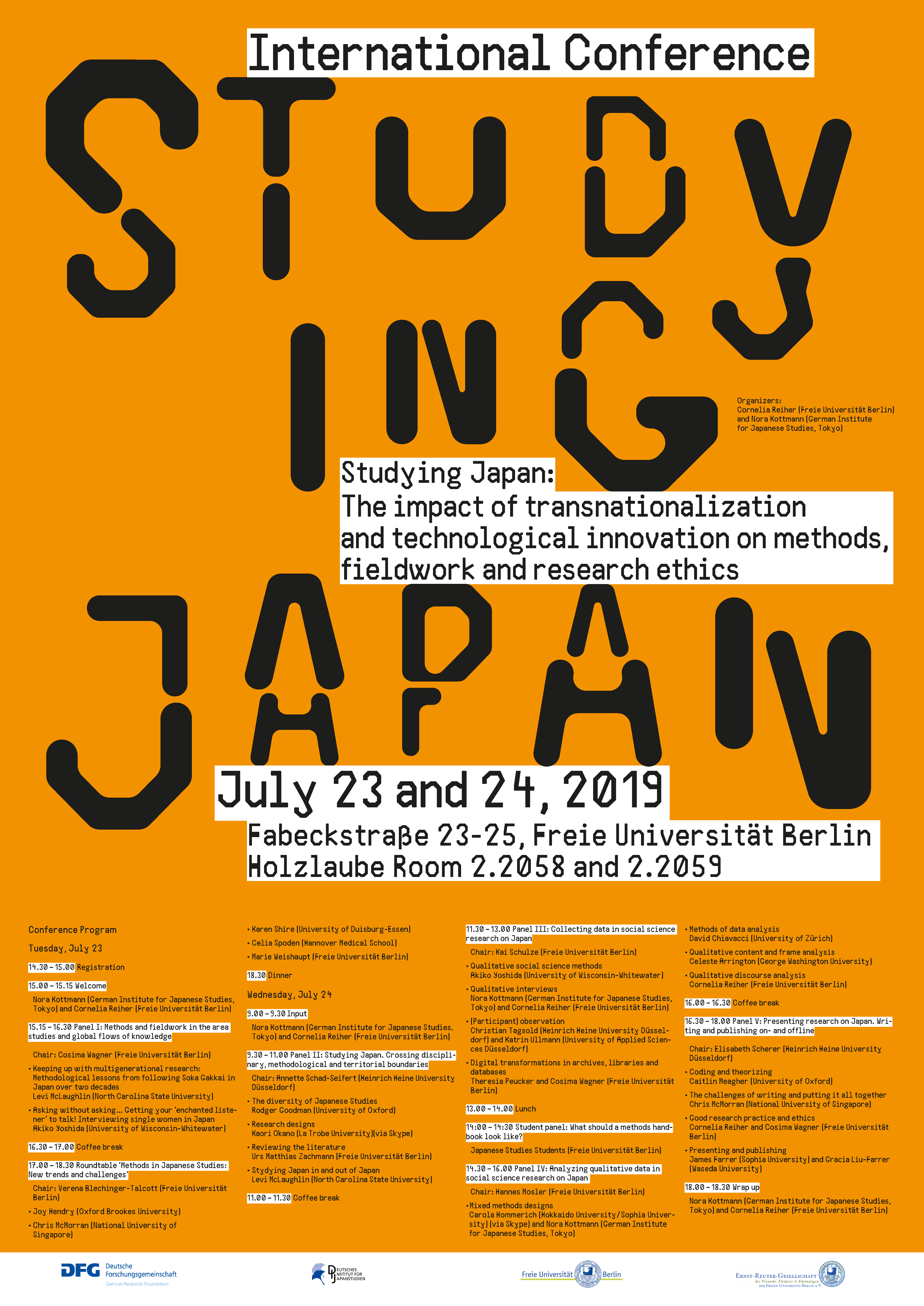 During two days an interdisciplinary group of renowned scholars from Australia, Europe, Singapore and the US will discuss new trends, opportunities and challenges that have changed the conduct of research on Japan. Starting out with a general discussion of research methods in area studies as well as social science research on Japan, the conference will discuss practices of collecting, analyzing and presenting data and findings individually, and the role and function of these practices within the whole research process. The conference focuses mainly on the methodological opportunities and challenges brought about by transnationalization as well as by technological innovations and digital transformation, with attention being paid to good research practice and ethics.
The conference is organized by Cornelia Reiher (Freie Universität Berlin) and Nora Kottmann (German Institute for Japanese Studies Tokyo) and jointly funded by the German Research Foundation (DFG), the German Institute for Japanese Studies (DIJ), the Freie Universität Berlin and the Ernst-Reuter-Gesellschaft.
The DIJ travels to the ICAS conference in Leiden
The DIJ travels to Leiden. The ICAS conference is held July 10 to 15 in Leiden, the Netherlands. More than 2000 scholars are expected to present their research.
The DIJ is represented through Barbara Holthus, Hanno Jentzsch and Nora Kottmann. Nora is the organizer of the panel on (No) Sex in the City, in which she and Barbara present their research. Hanno will present his paper on Governing the Man-Made Disaster – Revitalizing Local Governance in Japan’s Peripheries.
Detailed information on the breadth of the DIJ research activities and publications is available at the Max Weber Foundation exhibition table in the book exhibit hall. Please come see us there!
Looking forward to seeing many of you in Leiden!
Governance in the Age of Ignorance: The Role of Knowledge Infrastructures

Franz Waldenberger, director of DIJ, was invited to contribute to the magazine for the G20 meeting held in Osaka, June 28 to 29. His article can be found on page 42-43 in the digital versions of the magazine under the links below:

Sustainability-Blog

Lesen Sie die neuesten Artikel unseres DIJ-Blogs Sustainability in Japan and Beyond

 Follow us on Bluesky
Institutsbroschüre
Einblicke in unser Institut und seine Aktivitäten bietet unsere aktuelle DIJ Broschüre (Stand 4/2025)
Call for Submissions

Contemporary Japan
Aktuelle Ausgabe Vol. 38, Nr. 2
Contemporary Japan akzeptiert Einsendungen ganzjährig ohne Abgabefrist. Zur Veröffentlichung angenommene Artikel werden umgehend online publiziert. Weitere Details finden Sie hier.
DIJ Monographienreihe
Unsere Monographien sind nach einem einjährigen Embargo  Open Access und können hier heruntergeladen werden:
→ DIJ Monographien
Wegbeschreibung
DIJ Tokyo
Jochi Kioizaka Bldg. 2F
7-1 Kioicho Chiyoda-ku, Tokyo
102-0094 Japan
Wegbeschreibung
+81 (0)3 3222-5077
+81 (0)3 3222-5420
dijtokyo@dijtokyo.org

DIJ-ARI Asian Infrastructures Research Partnership