Veranstaltungen und Aktivitäten
Tokyo as Fashion Space: Usage Practices, Social Space and Media Discourse
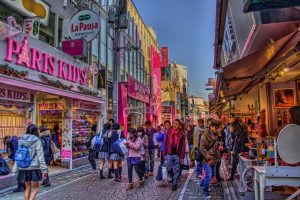
For the world of street fashion, the seemingly small neighborhood of Harajuku has become a nationally as well as internationally renowned hotspot where all kinds of trends are shaped and reinterpreted every day. Harajuku also is a prime example of how social attribution processes work within a city: If popular discourse had not defined and named the area, it would only exist as Shibuya-ku Jingūmae and Takeshita dōri or Cat Street would only be nameless roads.
The aim of this research is to explore how this small piece of land came to be recognized as a fashion space from the early 1970s onwards and how it has continued to attract creatives and shoppers alike, even in a fashion world that has seemingly shifted to location-indifferent online media.
Speaker:
Jana Katzenberg, University of Cologne
Picture Copyright: CC BY-NC-ND 2.0 | flickr/jun560
Informal Figures of Japanese Imperialism: the political activism of the Gen’yōsha
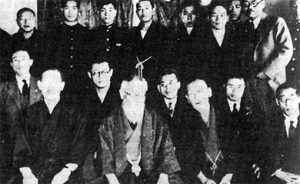
The history of Japanese nationalism and expansionism remains a controversial part of the nation-building process in postwar Japan. Many historians have struggled to come to terms with the ambivalent role of the past in the processes of modern nationalism and imperialism. In this respect, the history of the Meiji era is particularly controversial.
This talk will focus on the political association Gen’yōsha and its members during the 1868-1910 period. It will show how the association was an integral part of the Freedom and People’s Rights Movement and its spearhead in the Kyūshū region. After presenting the historical process that led to the foundation of the Gen’yōsha, it will explain how the group played an instrumental role in the uprising of the so-called tairiku rōnin, and how these political activists where important elements of Japan’s expansionist policies.
Picture: Public Domain | wikimedia
AI/IOT and the Future of Society

The workshop brings together scholars and researchers from Japan, Germany and the U.S. to discuss a social science research agenda in the face of the oncoming digital revolution, i.e., the arrival of the internet-of-things, with artificial intelligence, ubiquitous sharing, autonomous systems, and the so-called Industry 4.0, Society 5.0 and Life 3.0.
So far, futuristic visions of the implications associated with digital connectivity, big data and AI have been mostly the bailiwick of engineers and science fiction authors. The social sciences are only just now beginning to seriously consider the subject matter.
WeberWorldCafé: Demographic Change – Challenges and Answers for Local Communities

Many modern societies are increasingly confronting demographic change, i.e. the ageing and shrinking of population. This is particularly true for Japan and Germany, which are the worldwide “front-runners”. The social, economic and political implications are most strongly and directly felt at the level of local communities.
The idea of the WeberWorldCafé on “Demographic Change – Challenges and Answers for Local Communities” jointly conceived and organized by the German Institute of Japanese Studies (Tokyo) and the Institute of Gerontology at the Technical University of Dortmund is to bring together researchers, policy makers and civic society representatives with proven expertise in local demographic policies from Germany, the EU and Japan, to discuss how local communities can best prepare to cope with the demographic challenge.
DIJ Newsletter 56 ist erschienen!
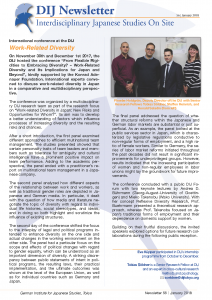
Die aktuelle Ausgabe befasst sich mit diesen Themen:
Internationale Konferenz am DIJ: Diversität in der Arbeitswelt
Vom 30. November bis 1. Dezember 2017 veranstaltete das DIJ mit Förderung der Konrad-Adenauer-Stiftung die Konferenz „From Flexible Rigidities to Embracing Diversity? – Work-Related Diversity and its Implications in Japan and Beyond“.
Lokale Anti-Atom-Bewegungen in Japan
Die Errichtung von Atomkraftwerken ist stets eine äußerst kontroverse Angelegenheit, insbesondere in den betroffenen Kommunen selbst.
Japans ländlicher Raum – Herausforderungen und Bewältigungsstrategien
Japans demographische Entwicklung stellt sich in den Regionen außerhalb der Ballungszentren teilweise sehr dramatisch dar.
Untergraben Ungleichheiten auf dem Arbeitsmarkt den Rückhalt für Demokratie?
Ein Workshop im Oktober 2017 untersuchte, inwiefern sich Ungleichheiten auf dem Arbeitsmarkt auf die Politik auswirken.
Ausländische Beschäftigte in Japan
Seit der globalen Finanzkrise nimmt die Zahl der ausländischen Beschäftigten in Japan wieder zu.
Der DIJ Newsletter ist auf Deutsch und Englisch verfügbar. Er wird als Download-Variante sowie in Print angeboten.
German Prisoners of War in Japan 1914-1920: towards a new narrative

In 2014 the 100th anniversary of the outbreak of the First World War was globally remembered in academic and public functions, in lectures, exhibitions, and publications. The centenary in itself demonstrated a rejection of the prevailing narratives of the First World War and smoothed the way for alternative points of view. In the memory culture of the First World War also Japan takes its part since it entered the war in 1914 against the German Reich and was represented in Versailles in 1919 as one of the victorious powers.
As far as the German-Japanese relations are concerned, however, a major point of interest are the German prisoners of war who were taken captives by the Japanese in November 1914 after having defended Tsingtao for three months. In the context of German-Japanese relations they are taken up time and again. In the wake of the centennial of the First World War historical science is at present revising earlier conceptions of the historiography of the First World War. With the exception to the last major study on the subject by Ulrike Klein (Freiburg, 1993), however, research on the German POWs interned in Japan during World War I has never moved beyond a biased and euphemistic conception of German captivity in Japan.
Japan’s Industrial Policy toward Technology Transfers and Business History: Signalling and Administrative Guidance, 1950-1975

Post-war Japanese industrial policy has been both hailed and criticized by a diverse range of scholars, including economists, sociologists and historians. For some researchers, the Japanese government’s industrial policy was a major contributor to high economic growth in the 1950s and 1960s. Other researchers, however, hold the view that it was unnecessary for or even detrimental to growth.
This talk will discuss how a business history approach can fruitfully be applied to the analysis of industrial policy and present two preliminary case studies from the chemical industry as concrete examples of signalling and administrative guidance in the international market for technology transfers.
Picture Copyright: CC BY-SA 4.0 | wikimedia/Nanashinodensyaku
Politicians and Bureaucrats in Contemporary Japan: New Twists on a Tumultuous Relationship
In a state’s political system, the bureaucracy plays a pivotal role, as the efficiency of the government’s policies and the realization of the democratic principle are at stake. Since the 1990s, Japanese bureaucracy has been the target of growing criticism blaming it for administrative failures and an excess of autonomy from elected political power. In response to this criticism, a number of reforms inspired by the New Public Management movement were implemented at the beginning of the 21st century, such as the reorganisation of the ministries and the introduction of new recruitment and promotion methods.
After a brief review of these reforms, we will analyse how decision-making processes have changed in practice and how political-administrative relations during the last fifteen years have evolved.

Sustainability-Blog

Lesen Sie die neuesten Artikel unseres DIJ-Blogs Sustainability in Japan and Beyond

 Follow us on Bluesky
Institutsbroschüre
Einblicke in unser Institut und seine Aktivitäten bietet unsere aktuelle DIJ Broschüre (Stand 4/2025)
Call for Submissions

Contemporary Japan
Aktuelle Ausgabe Vol. 38, Nr. 2
Contemporary Japan akzeptiert Einsendungen ganzjährig ohne Abgabefrist. Zur Veröffentlichung angenommene Artikel werden umgehend online publiziert. Weitere Details finden Sie hier.
DIJ Monographienreihe
Unsere Monographien sind nach einem einjährigen Embargo  Open Access und können hier heruntergeladen werden:
→ DIJ Monographien
Wegbeschreibung
DIJ Tokyo
Jochi Kioizaka Bldg. 2F
7-1 Kioicho Chiyoda-ku, Tokyo
102-0094 Japan
Wegbeschreibung
+81 (0)3 3222-5077
+81 (0)3 3222-5420
dijtokyo@dijtokyo.org

DIJ-ARI Asian Infrastructures Research Partnership