Veranstaltungen und Aktivitäten
The Value and Meaning of a “Useless” Robot: An Ethnographic Study of Japanese Communication Robots

Although Japan has been at the forefront of the technological imagination of human-like robots for decades, a major turning point came with the release of Softbank’s Pepper in 2015. Marketed as “the world’s first robot that stays close to people,” Pepper quickly entered the public eye and everyday experience of those living in large Japanese cities. Between 2015 and 2016 alone, the variety and number of such communication robots—a fluid subcategory of service robots designed to enrich or enhance human communication—doubled. Yet users found that the capabilities of these robots were nowhere near the human-like entities that they had seen in popular media and anticipated for so long.
Through unpacking the paradox of an “useless” robot, my dissertation investigates how these technological objects and society affect one another.
Speaker:
Keiko Nishimura, University of North Carolina at Chapel Hill
Market Reactions to Downsizing Announcements – the Role of Strategy and Knowledge Intensity
Japanese firms are generally less likely to execute radical downsizing measures. Confronted with legal and societal restrictions to lay off large numbers of employees, they implemented several adaptive downsizing strategies, such as early/voluntary retirement, transfers to subsidiaries (Shukkō/Tenseki), hiring freezes, lay-offs of non-regular employees, and wage-cuts. To get a more nuanced understanding of these adaptive strategies, I collected a unique dataset on corporate downsizing actions from the Nihon Keizai Shimbun (Japan’s premier business newspaper) for the time period 2007-2009.
Building on the resource-based view of the firm, I study how these strategic choices affect the likelihood of losing critical organizational knowledge and in turn, how these strategies affect investor response to downsizing announcements. Further, I show that investor response to downsizing strategies is highly contingent on the knowledge intensity of the firm.
Speaker:
Daniel Ehnes, Goethe University Frankfurt
The Role of Mediating Institutions for Brazilian Return Migrants in Japan
In the 1980s, the economic downturn and hyperinflation in Brazil motivated many descendants of Japanese migrants (Nikkeijin) living in Brazil to ‘return’ to Japan, where an aging population and a booming economy had led to a labor shortage. Another incentive was the revision of the Japanese Immigration Law in 1990 that allowed Nikkeijin up to the third generation to obtain special permanent residency visa. Approximately 220.000 Latin American returnees arrived in the 1990s, and more than 180.000 Brazilians live in Japan today, constituting the fifth largest group of foreigners. As many have decided to stay in Japan for the time being, integration and multiculturalism have become important societal challenges, especially on the local level.
Based on qualitative field research, Chaline Timmerarens from Freie Universität Berlin analyzes how mediating institutions affect the process of integration into the host society and the relations to Japanese residents. She focuses on cultural centers, international associations, libraries, churches, and NPOs in cities with a high population of Brazilian Nikkeijin and Brazilians, namely Hamamatsu (Shizuoka), Toyota (Aichi), and Ōizumi (Gunma).
Speaker:
Chaline Timmerarens, Freie Universität Berlin
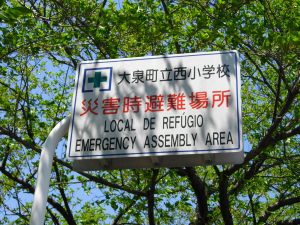
Picture: Multilingual (Japanese, Portuguese, English) Emergency Assembly Area Sign in Oizumi, Gunma
History-writing and the Public Sphere in Japan: 1945-1955
History-writing in Japan after World War II was more than just documenting the past; it was also about how to reconstruct the present and future. Japan was occupied by the United States and Allied powers and this occupation quickly turned to a new form of repression for many intellectuals, students, women, and others, even after it formally ended in 1952. In this climate, history-writing became part of social activism and the desire to change Japan in fundamental ways. Radical forms of history-writing became prominent and these sought to incorporate ordinary people in everyday life. They also sought engagement with the public sphere on a number of different levels and in ways that continued to have an impact on the writing of history after 1955.
This presentation will argue that history-writing during the first decade after World War II brought a kind of “plebian public sphere” into focus in ways that had not been seen in Japan during the prewar period.
Speaker:
Curtis Anderson, Waseda University
Destiny: The Secret Operations of the Yodogō Exiles
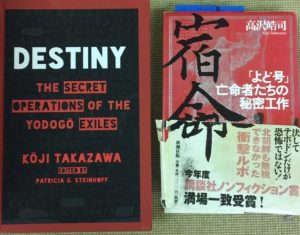
In 1970, nine members of a Japanese New Left group called the Red Army Faction hijacked a domestic airliner to North Korea with dreams of acquiring military training in order to bring about a revolution in Japan. The North Korean government accepted the hijackers ̶ who became known in the media as the Yodogō group ̶ and two years later they announced their conversion to juche, North Korea’s political ideology.
This talk will trace the story of the Yodogō exiles to North Korea, Kōji Takazawa’s involvement in their story and his work of investigative journalism.
Speakers:
Patricia G. Steinhoff, University of Hawai‘i at Mānoa
Scott North, Osaka University
Japanese Development Cooperation as a Political Tool

The world of development cooperation is changing quickly. There are several reasons for this. First of all, the objectives of the Sustainable Development Goals (SDGs) adopted by the United Nations go well beyond poverty reduction. Another reason is the fact that once dominant western thinking in the field of Official Development Assistance (ODA) is fading away as new donors, such as China, are advancing their positions.
In this lecture Marie Söderberg will give a picture of how Japanese foreign aid now plays a central role as a foreign policy instrument. Taking the Philippines as an example, she analyses the implementation of Japan’s 2015 Development Cooperation on the ground.
Naohiro Kitano will contribute his expertise on China’s foreign aid. China’s ODA is undergoing a transformation as China is rapidly stepping up its activities and expanding its influence especially in Southeast Asia.
Speakers:
Marie Söderberg, Stockholm School of Economics
Naohiro Kitano, Waseda University
Gemeinsame Bücherausstellung:
Kabuki・Bunraku
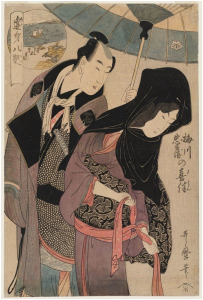
Wie wird die klassische japanische Bühnenkunst im Ausland gesehen und welche Forschung gibt es dazu?
Die International House of Japan Library, die Bibliothèque de la Maison franco-japonaise sowie die Bibliothek des Deutschen Instituts für Japanstudien geben im Rahmen einer gemeinsamen Bücherausstellung Einblicke in englisch-, französisch- und deutschsprachige Übersetzungen sowie Forschungsliteratur zum Thema Kabuki und Bunraku.
Picture Copyright: 国立博物館所蔵品統合検索システム
space AGE space – Elderly Care in a Digitally Connected World

How can sensor technology and connectivity support care-taking? How far are we away from implementation? Which countries are taking the lead? What major obstacles need to be overcome?
A central part of Society 5.0 – Japan’s vision of fully digitally connected future – focuses on how connectivity, big data and AI can contribute to solve Japan’s pressing problems in the field of elderly care. Prof. Thomas Bock, a leading German engineer in the field of building robotics, and Prof. Shuichi Matsumura, a leading Japanese engineer specializing in system design for housing and urban spaces, will talk about the potential of the digital revolution for elderly care in living environments.
Speakers:
Thomas Bock, Technical University of Munich
Shuichi Matsumura, The University of Tokyo
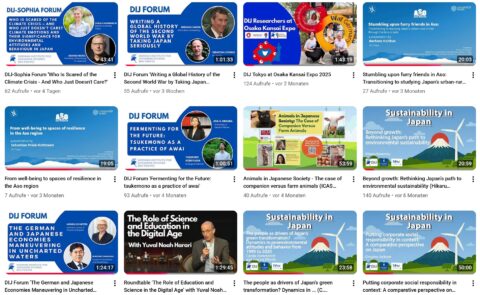
Sustainability-Blog

Lesen Sie die neuesten Artikel unseres DIJ-Blogs Sustainability in Japan and Beyond

 Follow us on Bluesky
Institutsbroschüre
Einblicke in unser Institut und seine Aktivitäten bietet unsere aktuelle DIJ Broschüre (Stand 4/2025)
Call for Submissions

Contemporary Japan
Aktuelle Ausgabe Vol. 38, Nr. 2
Contemporary Japan akzeptiert Einsendungen ganzjährig ohne Abgabefrist. Zur Veröffentlichung angenommene Artikel werden umgehend online publiziert. Weitere Details finden Sie hier.
DIJ Monographienreihe
Unsere Monographien sind nach einem einjährigen Embargo  Open Access und können hier heruntergeladen werden:
→ DIJ Monographien
Wegbeschreibung
DIJ Tokyo
Jochi Kioizaka Bldg. 2F
7-1 Kioicho Chiyoda-ku, Tokyo
102-0094 Japan
Wegbeschreibung
+81 (0)3 3222-5077
+81 (0)3 3222-5420
dijtokyo@dijtokyo.org

DIJ-ARI Asian Infrastructures Research Partnership