Veranstaltungen und Aktivitäten
DIJ Web-Forum on Data and Values in Japan and Germany
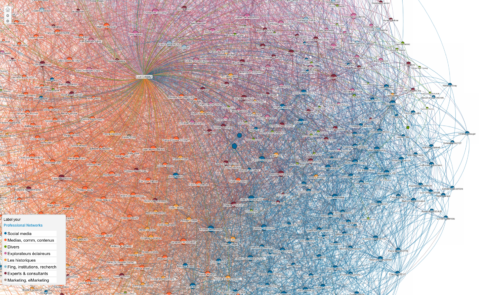
Data are widely considered to be the “oil” of the digital economy. But whereas the concept seems essential and ubiquitous, social, economic, and legal aspects associated with the meaning, ownership, exchange, use, and protection of data remain highly contested even among countries with similar economic and political systems like Japan and Germany. Our speakers will present the main legal regulations and public discourses related to the concept of data in Japan and Germany. In the discussion, we will try to pinpoint major differences in the understanding of data and their implications for the ownership, protection, use, and international exchange. Details and registration here
Speakers:
Axel v.d. Bussche, Taylor Wessing
Stefan Heumann, Stiftung Neue Verantwortung
Hitomi Iwase, Nishimura & Asahi
Koichi Sumikura , National Graduate Institute for Policy Studies (GRIPS)
moderated by Franz Waldenberger, German Institute for Japanese Studies
Public talk ‘Tokyo Olympics – An Uphill Battle’ with Barbara Holthus

What are the latest developments and challenges that overshadow the Tokyo Olympics? Join DIJ deputy director Barbara Holthus, Olympic expert Vanessa Åsell Tsuruga, and special advisor to former Japanese Prime Minister Shinzo Abe, Tomohiko Taniguchi, for an online discussion of the risks and opportunities ahead and their impact on Tokyo and Japan. The event ‘Tokyo Olympics: An Uphill Battle’ is hosted by the Japan Center at the Institute for Security & Development Policy (ISDP), a Stockholm-based non-profit and non-partisan research and policy organization. The webinar will be moderated by Jon Thunqvist, Senior Research Fellow at the ISDP, and takes place on Monday, 31 May, 10.00-11.00 (CEST) / 17.00-18.00 (JST). Registration is required via the ISDP.
First lecture of DIJ Method Talks series: Sakura Yamamura on Mental Mapping
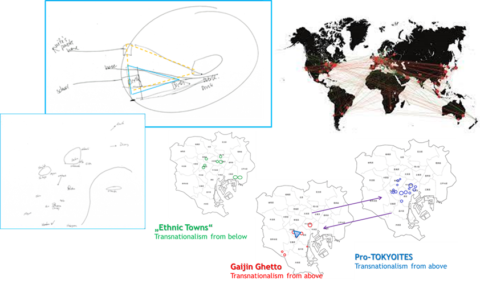
The diversification in and of urban spaces through rising mobility is inevitable, yet the actual capturing of socio-spatial urban transformation is still methodologically underexplored. Based on the analytical framework of Löw (2001), Sakura Yamamura employed the novel methodological tool of mental maps in her research on global and local mobility patterns. She combined it with 45 interviews with transnational migrant professionals in Tokyo, ethnographic site surveys and geographical mapping. The mental maps were drawn by transnational professional migrants in order to capture the extent and locations of urban transformations. In this presentation, she will introduce the method of mental mapping and discuss how it can be connected to spatial theory to capture socio-spatial transformations and mobility patterns in Tokyo and beyond. This lecture opens the new ‘DIJ Method Talks’ lecture series. Details and registration here
Speaker:
Sakura Yamamura, Max Planck Institute for the Study of Religious and Ethnic Diversity
DIJ Study Group on Post-Fukushima Literature
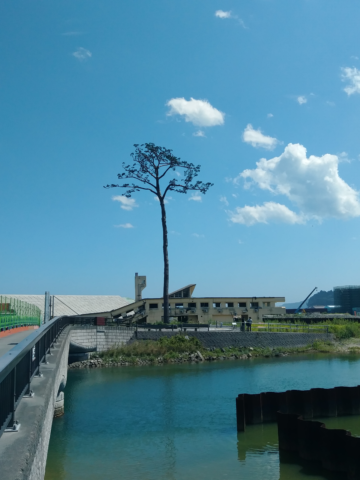
This talk will explore the political stakes of modes of seeing and remembering through the lenses of proximity and transparency, while proposing a possible reevaluation of these concepts in the light of the Fukushima Daiichi nuclear disaster. Radiation upsets spatial hierarchies and visual regimes by posing its own questions on positionality and representation. A tentative answer to such queries might come from a careful consideration of recent directions in scholarship in new materialism and ecocriticism, and in the form of a kind of ‘radioactive aesthetic’. Thanks to its poetics of avisuality and distance, radioactive aesthetic often attracts into its orbit literary works apparently removed from the catastrophe, thus proposing a corrective to the criteria of authority and proximity implicit in the process of canonization of works of ‘post-Fukushima literature’ and of disaster literature in general. Details and registration here
Speaker:
Chiara Pavone, University of California, Los Angeles
DIJ Study Group ‘Visions and Expectations of Autonomous Driving’
 There are many innovation efforts in the field of mobility such as autonomous driving or ‘mobility as a service’ in Japan today. Expectations and visions play a significant role for the direction of innovations: future-oriented narratives and imaginaries mobilize interests and financial resources, stimulate agenda setting, and facilitate actor coordination. In the process of being shared by different actors, expectations can transform into binding requirements, or into self-evident assumptions providing orientation for future actions. This presentation explores the substance of governmental visions and expectations of autonomous driving in Japan by examining government policy documents and archival records. These visions include the performance of envisioned technologies that have yet to be realized and wider socio-technical transitions. However, such visions also entail the risk of policy makers becoming locked in a single pattern while overlooking alternative solutions. Details and registration here
Speaker:
Yukari Yamasaki, Karlsruhe Institute of Technology
Online conference ‘Climate Change, Energy, and Sustainability in the Pacific Region’
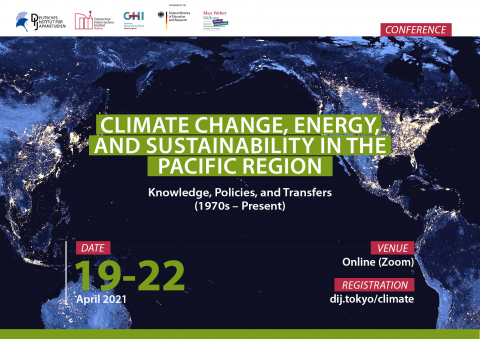
Please note: Panel 5 was moved to Friday, April 23, 11:30 a.m. JST / Warsaw 4:30 a.m. / Eugene, OR 7:30 p.m. (Thursday, April 22)
The DIJ will host the four-day online conference ‘Climate Change, Energy, and Sustainability in the Pacific Region Knowledge, Policies, and Transfers (1970s – Present)’ from April 19 to 23. It seeks to explore the historical development of attitudes towards climate change and environmental degradation within various Pacific Rim countries like China, the United States, the Soviet Union/Russia, Japan, South Korea, Australia, Canada, and Mexico. It will also address interactions between their climate, energy, and environmental policies and ask which national economic goals, geopolitical rivalries, social structures, and cultural preferences pose obstacles to the implementation of countermeasures to climate change and environmental degradation. The conference is part of the Max Weber Foundation’s collaborative research project “Knowledge Unbound” in the module “Interaction and Knowledge in the Pacific Region: Entanglements and Disentanglements”, funded by the Federal Ministry of Education and Research (Germany). Details and registration here
Book exhibition ’10 Years after 3.11′ in March and April

Ten years have passed since the massive Great East Japan Earthquake hit Japan on March 11, 2011. To mark the anniversary, the International House of Japan Library, the library of the German Institute for Japanese Studies, and the Bibliothèque de la Maison franco-japonaise present publications related to the earthquake and its aftermath in English, German, and French. The joint book exhibition is open to the public from March 1 to March 31. The exhibition at the DIJ will be open until April 30. For further information please see the poster and contact the respective library. A list of available books and articles at the DIJ library is available here for download (PDF).
DIJ researchers at virtual AAS 2021 Annual Conference
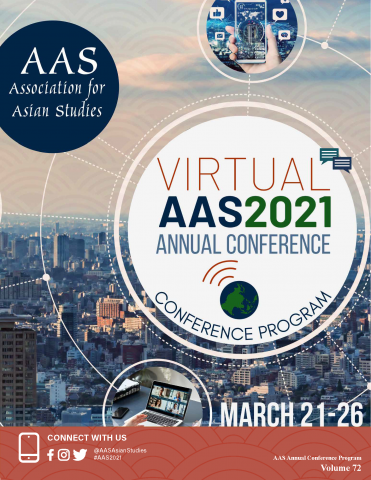
DIJ social scientists Sonja Ganseforth and Nora Kottmann have presented papers on their current research projects at this year’s virtual AAS annual conference. Sonja’s paper “The Political Ecology of Japanese Coastal Fisheries Reform” draws on her research project Fishing communities between growth and demise and studies challenges faced by Japanese coastal fisheries after recent legal reforms. Nora gave her paper “Negotiating Belonging: German Expatriates in Southern Tokyo” in the panel ‘Managing Migration in Japan: Short-term Labour, Tourists, and International Students’. Her paper is based on ongoing fieldwork and analyzes different conceptions of belonging among privileged, highly mobile short-term migrants. DIJ alumna Gabriele Vogt served as discussant in this panel. The AAS presentations are available as on-demand videos. More information here.
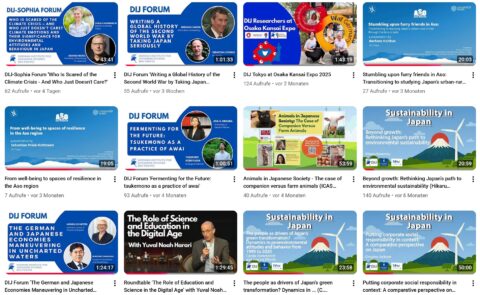
Sustainability-Blog

Lesen Sie die neuesten Artikel unseres DIJ-Blogs Sustainability in Japan and Beyond

 Follow us on Bluesky
Institutsbroschüre
Einblicke in unser Institut und seine Aktivitäten bietet unsere aktuelle DIJ Broschüre (Stand 4/2025)
Call for Submissions

Contemporary Japan
Aktuelle Ausgabe Vol. 38, Nr. 2
Contemporary Japan akzeptiert Einsendungen ganzjährig ohne Abgabefrist. Zur Veröffentlichung angenommene Artikel werden umgehend online publiziert. Weitere Details finden Sie hier.
DIJ Monographienreihe
Unsere Monographien sind nach einem einjährigen Embargo  Open Access und können hier heruntergeladen werden:
→ DIJ Monographien
Wegbeschreibung
DIJ Tokyo
Jochi Kioizaka Bldg. 2F
7-1 Kioicho Chiyoda-ku, Tokyo
102-0094 Japan
Wegbeschreibung
+81 (0)3 3222-5077
+81 (0)3 3222-5420
dijtokyo@dijtokyo.org

DIJ-ARI Asian Infrastructures Research Partnership