Veranstaltungen und Aktivitäten
DIJ Newsletter 58 erschienen
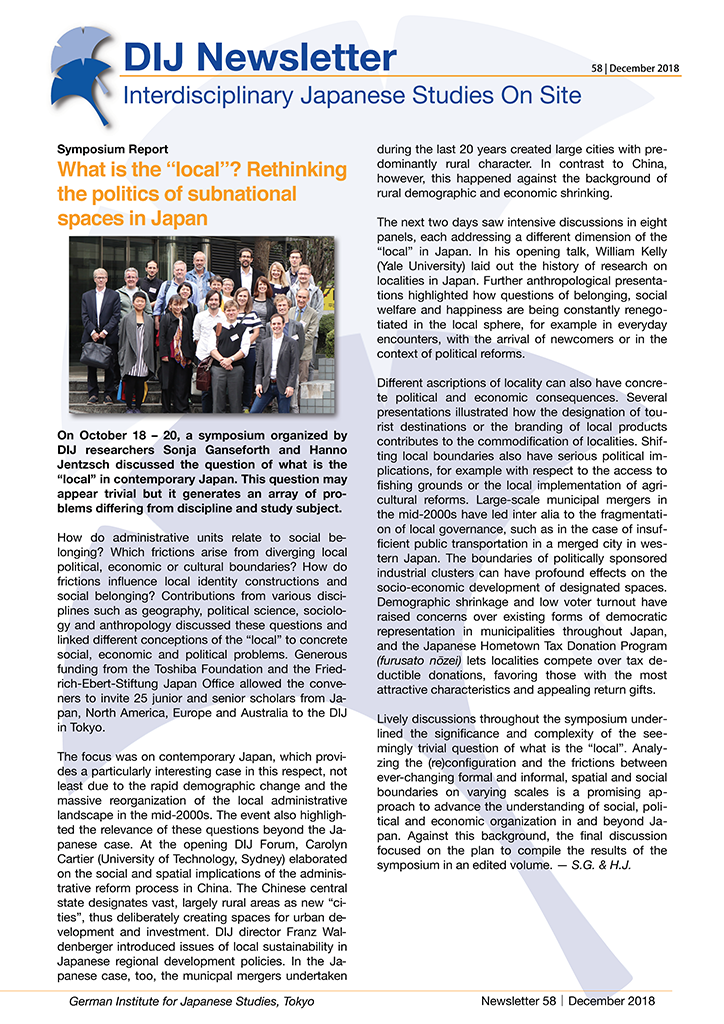 Symposiumsbericht: Was ist “lokal”? Neue Ansätze zur Erforschung sub-nationaler Räume in Japan
Vom 18. bis zum 20. Oktober diskutierte am DIJ ein internationales Symposium die Frage: Was ist das „Lokale“ im gegenwärtigen Japan? Diese Frage mag trivial klingen – tatsächlich bringt sie jedoch je nach Disziplin und Forschungsgegenstand ganz unterschiedliche Problemstellungen hervor.
DIJ’s Flagship Journal: Contemporary Japan
In Contemporary Japan, der am DIJ herausgegeben internationalen Fachzeitschrift, erscheinen in zwei jährlichen Ausgaben doppelt begutachtete originäre wissenschaftliche Aufsätze auf dem Gebiet der sozial- und geisteswissenschaftlichen Japanforschung sowie Buchbesprechungen zu Neuerscheinungen in dem Bereich.
DIJ NIRA Workshop: Big Data – Wie gut ist Japan auf die digitale Transformation vorbereitet?
Big Data ist ein Kernbestandteil der digitalen Transformation. In einer digitalisierten und vernetzten Welt fallen Daten im Überfluss an. Sich rapide entwickelnde Anwendungen ermöglichen die Verarbeitung, Integration und Analyse voluminöser multimedialer Daten auf immer schnellere und intelligentere Weise. Sie eröffnen unermessliche Potenziale für Forschung, Wirtschaft und Politik.
Festakt im Hotel New Otani: 30 Jahre DIJ
Gemeinsam mit 170 geladenen Gästen, darunter hochrangigen Vertretern aus Wissenschaft, Wirtschaft und Politik, feierte das DIJ am 31. Oktober sein dreißigjähriges Bestehen.
Aktuelle Statistik: Weniger Überstunden: Ein Erfolg von Abes „Arbeitsstilreform“?
Die Entwicklung der Überstunden reagiert traditionell stark auf die wirtschaftliche Entwicklung. Doch seit 2016 fällt die Zahl der Überstunden fast durchgehend trotz Wachstum.
DIJ monograph 62 released:
Parental well-being. Satisfaction with work, family life, and family policy in Germany and Japan
 “Pursuing happiness is not only idealistic, it is the world’s best and perhaps only hope to avoid global catastrophe” (Global Happiness Policy Report 2018). With that, the report argues for happiness as overarching policy goal. This volume argues that parental well-being is well qualified to assume a central role for governments of industrially advanced nations that are in need of coping with the challenges of low fertility and societal aging.
More than 4000 mothers and fathers of young children in Germany and Japan have been surveyed in regard to their well-being and satisfaction with many aspects related to their work and family lives. The volume brings together 13 scholars to analyze this unique dataset. The chapters fall into three main parts: (1) parenting and childcare, (2) self, social relatedness, and social structures, and (3) family policy well-being. A particular focus lies on the well-being of mothers in contrast to fathers. The volume uses a multidimensional concept of parental well-being, with each chapter highlighting one dimension, ranging from health, education, employment, and family policy satisfaction to partnership, social network, and childcare satisfaction. National differences are in several aspects superseded by gender, class, and personality types.
Bouncing Back After Failure: Perceived and Actual Similarity as a Coping Resource in Multinational Work Teams
Multinational work environments challenge the coping capabilities of employees with additional culture-related stressors above and beyond those usually found at the workplace. This paper examines the differential effects of perceived team leader / member similarity, their actual national similarity, and the mutual overlap in personal values on the coping potential of team members in a multinational work team setting, with a special focus on the Japanese context. An analysis of the data provided by 365 dyads of multinational team leaders and members in mixed Japanese/non-Japanese work teams revealed that the coping abilities of team members who shared the leader’s country of origin (surface level national similarity) were not significantly higher than those of team members who came from a different country. Conversely, the actual overlap in personal values endorsed by a team’s leader and each individual team member emerged as a robust predictor for that team member’s coping potential, both directly and indirectly through generalized similarity perceptions. This highlights that in order to understand why some multinational work teams work out in the long run and others do not, an overly strong focus on surface characteristics of their composition (e.g., national or ethnic diversity) may not be an optimal approach. In many cases, the actual determinants may be the perceived and experienced match or mismatch between the deep-level psychological characteristics (e.g., shared personal values) of team members and their leaders.
The Politics of Balancing Flexibility and Equality: A Comparison of Recent Equal Pay Reforms in Germany and Japan
In Germany and Japan, like in most OECD countries, the equal pay for equal work principle and other regulations related to equal treatment have been strengthened recently through reforms. These have been justified and promoted as measures to address gender wage gaps as well as discriminatory practices regarding non-standard workers. Yet, observers remain sceptical as to whether these reforms will be effective. Previous research has argued that Germany and Japan as “socially conservative welfare states” (Gottfried and O’Reilly 2002) face particular institutional and value-related obstacles for achieving equal treatment in practice. This paper argues that, while these factors remain important, gaps between policy output and persisting inequalities are increasingly the result of a strategically motivated politics of balancing. Policymakers in both countries use existing institutions such as collective bargaining and labour-management consultations to balance conflicting policy goals, i.e. improving equal treatment and maintaining employment flexibility, which crucially relies on differentiated treatment of workers by, for example, distinguishing between standard and non-standard workers. By resorting to strategies of balancing policymakers hope to console both objectives while mitigating the political risks of controversial structural reform.
DIJ Newsletter 57 ist erschienen!
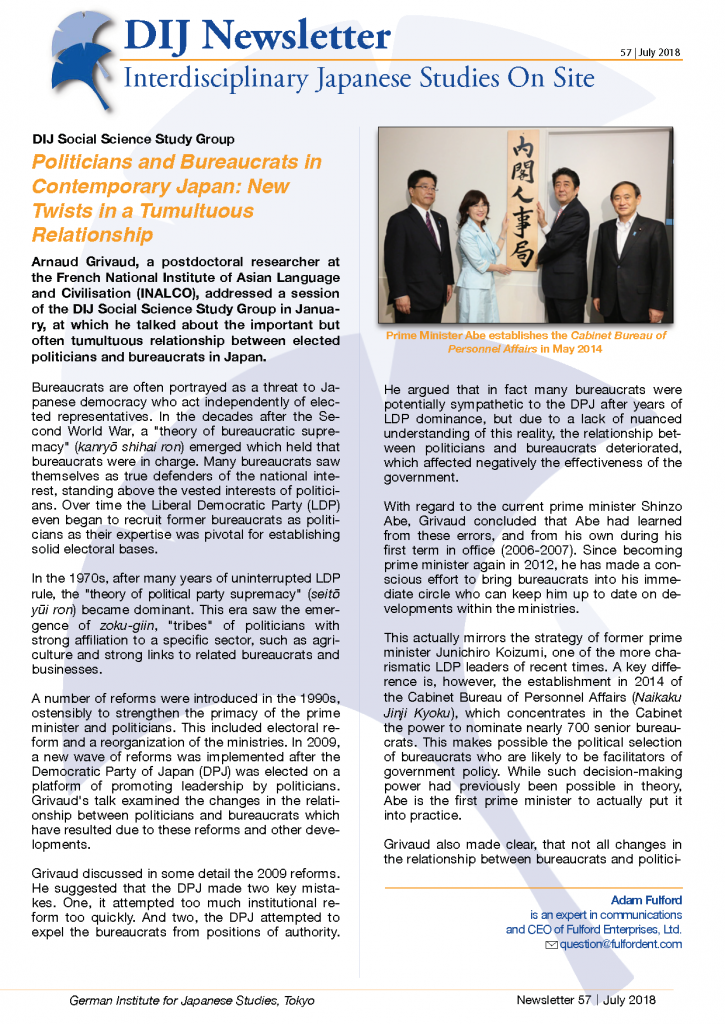 Unser Newsletter Nummer 57 ist erschienen. In dieser Ausgabe finden Sie folgende Themen:
DIJ Social Science Study Group: Politik und Ministerialbürokratie in Japan: Wendungen in einer turbulenten Beziehung
Arnaud Grivaud, Wissenschaftler am French National Institute of Asian Language and Civilisation (INALCO), sprach im Rahmen einer DIJ Social Science Study Group im Januar über das bedeutende, aber oft auch turbulente Verhältnis zwischen Politikern und Bürokraten in Japan.
China, Japan und der Kampf um ‚Asien‘
Chinas jüngste Wiederentdeckung der Seidenstraße erneuert den Anspruch des sogenannten Reichs der Mitte wieder als solches anerkannt zu werden. Kern dieses letztlich globalen Anspruches ist Chinas Position in Asien.
Der Umzug des Tsukiji-Großmarktes
Der Tsukiji-Großmarkt liegt mitten in Tokyo und ist mit einem Umsatz von 428 Milliarden Yen im Jahr 2017 der größte Markt für Meeresfrüchte weltweit. Seine Thunfischauktionen geben den Weltmarktpreis vor, es werden aber auch Gemüse, Obst, Eier, Hühnerfleisch und verarbeitete Lebensmittel gehandelt. Der Markt existiert seit der Edo-Zeit und befindet sich seit 1935 auf dem heutigen Gelände. Nach jahrzehntelangem politischen Ringen soll er nun endgültig in einen modernen Neubau nach Toyosu verlagert werden.
Inbound Tourismus – Japans neuer Wachstumsmarkt
Japan erlebt seit 2012 einen regelrechten Touristenboom. Mehr als 28 Millionen Touristen besuchten das Land in 2017, viermal so viele wie 2011.
DIJ-Monographie 61 erschienen!
“Networks and Mobilization Processes: The Case of the Japanese Anti-Nuclear Movement after Fukushima”
Environmental disasters or other large-scale disruptive events often trigger the emergence of social movements demanding social and/or political change. This study investigates mobilization processes at the meso level of the Japanese anti-nuclear movement after the nuclear disaster at the Fukushima Daiichi nuclear power plant caused by the Great East Japan Earthquake and subsequent tsunami waves on March 11, 2011. To capture such meso level movement dynamics – which so far have played only a minor role in research on social movement mobilization – the study presents an analytical model based on premises from political process theory, network theory, and relational sociology. This model is then applied to the case of the Japanese anti-nuclear movement after Fukushima by looking at the relational dynamics of two coalitional movement networks engaged in advocacy-related activities in Tōkyō.
DIJ Newsletter 56 ist erschienen!
Die aktuelle Ausgabe befasst sich mit diesen Themen:
Internationale Konferenz am DIJ: Diversität in der Arbeitswelt
Vom 30. November bis 1. Dezember 2017 veranstaltete das DIJ mit Förderung der Konrad-Adenauer-Stiftung die Konferenz „From Flexible Rigidities to Embracing Diversity? – Work-Related Diversity and its Implications in Japan and Beyond“.
Lokale Anti-Atom-Bewegungen in Japan
Die Errichtung von Atomkraftwerken ist stets eine äußerst kontroverse Angelegenheit, insbesondere in den betroffenen Kommunen selbst.
Japans ländlicher Raum – Herausforderungen und Bewältigungsstrategien
Japans demographische Entwicklung stellt sich in den Regionen außerhalb der Ballungszentren teilweise sehr dramatisch dar.
Untergraben Ungleichheiten auf dem Arbeitsmarkt den Rückhalt für Demokratie?
Ein Workshop im Oktober 2017 untersuchte, inwiefern sich Ungleichheiten auf dem Arbeitsmarkt auf die Politik auswirken.
Ausländische Beschäftigte in Japan
Seit der globalen Finanzkrise nimmt die Zahl der ausländischen Beschäftigten in Japan wieder zu.
Der DIJ Newsletter ist auf Deutsch und Englisch verfügbar. Er wird als Download-Variante sowie in Print angeboten.
“Rural Japan Revisited” – Contemporary Japan Virtual Special Issue

This virtual special issue is dedicated to contemporary studies exploring a Japan beyond the country’s metropolitan areas. Over the past decades, rural Japan nearly vanished from the Western research agenda, as urban Japan had come to dominate the attention of most social scientists studying contemporary Japan. Particularly the cityscape of Tokyo, the epitome of the Asian mega-city, has shaped the popular cultural imagination of Japan from abroad to an extent that the countryside, if seen at all, acquires all qualities of a museum or cultural repository of the past. Yet it should not be forgotten that millions of Japanese continue to live in quite different social spaces, such as hamlets, villages, or rural towns in mountainous and coastal areas. Even though urbanization, consumption and media usage have left their imprint on everyday life, social values and behavior rules in even the most remote part of the country, there is ample reason to take the urban-rural divide as a meaningful line of distinction between the two structurally different and inherently distinct spheres of city and countryside.
This virtual special issue has been compiled as a reminder of the significance that life and living in regional Japan is having for an adequate understanding of contemporary Japan, the changing faces of the “rural imaginary” (Schnell 2005) and the plurality of lifeways in late-modern society.

Sustainability-Blog

Lesen Sie die neuesten Artikel unseres DIJ-Blogs Sustainability in Japan and Beyond

 Follow us on Bluesky
Institutsbroschüre
Einblicke in unser Institut und seine Aktivitäten bietet unsere aktuelle DIJ Broschüre (Stand 4/2025)
Call for Submissions

Contemporary Japan
Aktuelle Ausgabe Vol. 38, Nr. 2
Contemporary Japan akzeptiert Einsendungen ganzjährig ohne Abgabefrist. Zur Veröffentlichung angenommene Artikel werden umgehend online publiziert. Weitere Details finden Sie hier.
DIJ Monographienreihe
Unsere Monographien sind nach einem einjährigen Embargo  Open Access und können hier heruntergeladen werden:
→ DIJ Monographien
Wegbeschreibung
DIJ Tokyo
Jochi Kioizaka Bldg. 2F
7-1 Kioicho Chiyoda-ku, Tokyo
102-0094 Japan
Wegbeschreibung
+81 (0)3 3222-5077
+81 (0)3 3222-5420
dijtokyo@dijtokyo.org

DIJ-ARI Asian Infrastructures Research Partnership