イベント&アクティビティ
DIJ researchers at virtual AAS 2021 Annual Conference
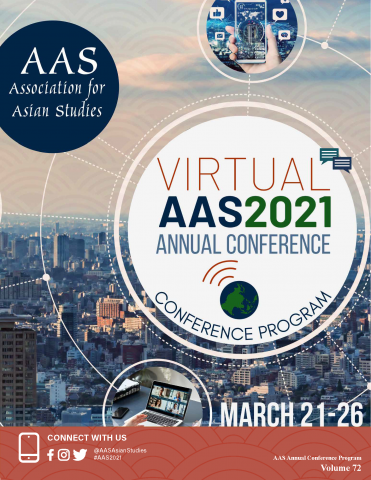
DIJ social scientists Sonja Ganseforth and Nora Kottmann have presented papers on their current research projects at this year’s virtual AAS annual conference. Sonja’s paper “The Political Ecology of Japanese Coastal Fisheries Reform” draws on her research project Fishing communities between growth and demise and studies challenges faced by Japanese coastal fisheries after recent legal reforms. Nora gave her paper “Negotiating Belonging: German Expatriates in Southern Tokyo” in the panel ‘Managing Migration in Japan: Short-term Labour, Tourists, and International Students’. Her paper is based on ongoing fieldwork and analyzes different conceptions of belonging among privileged, highly mobile short-term migrants. DIJ alumna Gabriele Vogt served as discussant in this panel. The AAS presentations are available as on-demand videos. More information here.
VSJF Annual Conference ‘Continuity and Change 10 years after 3.11’
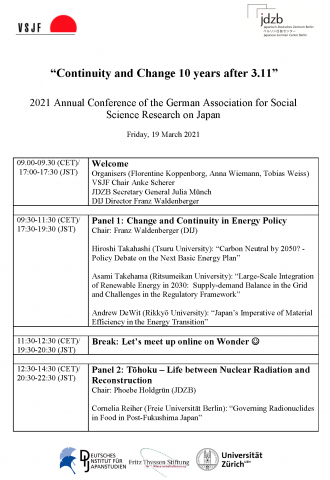 The DIJ is cooperation partner of the 2021 Annual Conference of the German Association for Social Science Research on Japan (VSJF), organized by DIJ alumni Anna Wiemann and Tobias Weiss together with Florentine Koppenborg. The one-day online conference ‘Continuity and Change 10 years after 3.11’ takes place on Friday, 19 March 17-25h (JST)/9-17h (CET). It features panels on ‘Change and Continuity in Energy Policy’, ‘Tōhoku – Life between Nuclear Radiation and Reconstruction’, and ‘Civil Society and the State since 3.11’. Participants include the DIJ’s director Franz Waldenberger, principal researcher Isaac Gagné, and DIJ alumna Phoebe Holdgrün. Isaac will present the paper “Haunting Memories of 3.11 and the Heaviness of Trauma in Post-Disaster Miyagi” which is part of his ongoing research project Listening to the Community: Grassroots Mental Healthcare in Local Communities. The conference is organized by the Japanese-German Center Berlin (JDZB) and the VSJF, in cooperation with the DIJ and supported by the Fritz Thyssen Stiftung and the Universität Zürich. Details, programme, and registration link here.
Virtual lecture on ‘Love in the Time of COVID-19’

DIJ researcher Nora Kottmann and DIJ alumna Elisabeth Scherer (Heinrich Heine University Düsseldorf) will be the next speakers in the virtual lecture series at the University of Vienna’s Japanese Studies programme. Their presentation “Love in the Time of COVID-19. The ‘New Normal’ in the TV Series #rimorabu (‘Remote Love’)” focuses on the television series #rimorabu. Futsū no koi wa jadō which aired from October to December 2020 on NTV. The series is situated in the context of the ongoing pandemic and discusses how calls for self-restraint and the avoidance of ‘the 3Cs’ – closed spaces, crowds and close contact situations – affect the dating- and love-life of unmarried individuals. The presentation will address challenges on the production side and critically discuss depictions of a ‘new normal’ in the context of current single- and gender-discourses in Japan. More information on this talk and link to register here.
DIJ research presentation at ISA Forum of Sociology
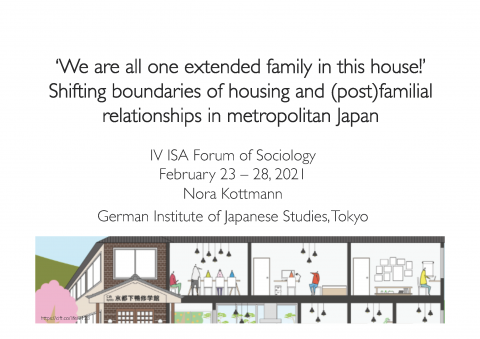
DIJ senior research fellow Nora Kottmann presented her paper “‘We Are All One Extended Family in This House!’ Shifting Boundaries of Housing and ‘(Post)Familial’ Relationships in Japan” at the virtual IV ISA Forum of Sociology on February 26, 2021. Her presentation was part of the panel “From the Changing Idea of ‘the Family’ to a Shifting Notion of Home?” which examined practices of doing family and home with foci on the temporal, spatial, material, and affective aspects of everyday life. Based on qualitative data from an ongoing field study in Tokyo, Nora’s paper addressed the interrelation of housing and ‘(post)familial’ relationships and the perception of dwelling spaces with regard to understandings of ‘family’. Her findings reveal that housing is highly interrelated with various ‘(post)familial’ relationships and that ‘new’ spaces are actively created and done by people living ‘new’ or rather unconventional relationships. Nora’s presentation was part of her ongoing research project on Spatial Perspectives on Personal Relationships in Contemporary Japan.
DIJ research presentations at “Sporting Japan” conference
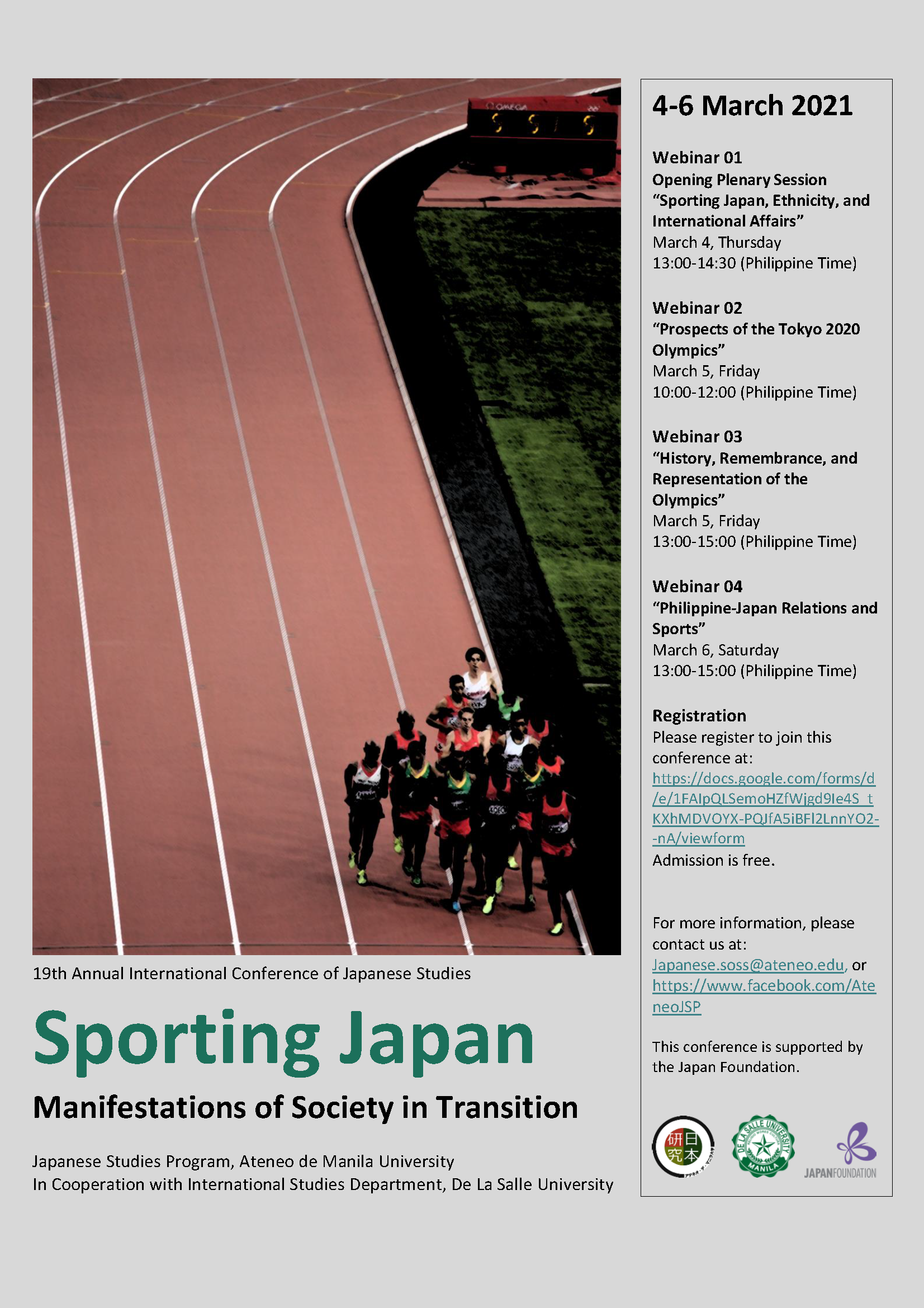 DIJ principal researchers Sonja Ganseforth and Torsten Weber have been invited by the Japanese Studies Program at Ateneo de Manila University to give research presentations at the 19th Annual International Conference of Japanese Studies. This year’s theme is “Sporting Japan: Manifestations of Society in Transition” and both will present papers related to their research on the Tokyo Olympics. Sonja’s paper “Spectacle and disaster – Opposition against the Tokyo 2020+1 ‘Recovery Games’” is part of the panel “Prospects of the Tokyo 2020 Olympics” (March 5, Friday, 11-13 JST). Torsten will give his paper “1940, 1964, 2020: Tokyo’s Olympic Pasts as Selective Memory, Nostalgia, and Denial” in the panel “History, Remembrance, and Representation of the Olympics” (March 5, Friday, 14-16 JST). Both papers draw on research Sonja and Torsten undertook for the DIJ’s special project on the Tokyo Olympics and the open access book publication Japan Through the Lens of the Tokyo Olympics. You can register for this online conference here.
DIJ Study Group on PTAs and economic regionalism in Japan and China
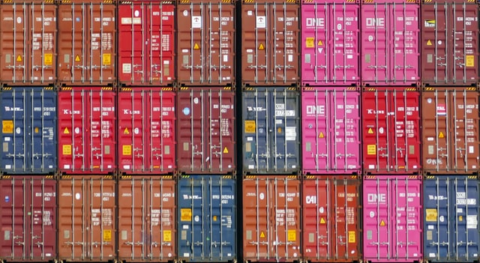
In this online session of the DIJ Business & Economics Study Group, our former PhD fellow Aya Adachi will present her research project which explores through a Comparative Political Economy perspective why Preferential Trade Agreements (PTAs) patterns differ in form and scope. The cases of China and Japan demonstrate the value of analyzing the role of the state and its interrelations with sub-national and market actors and spheres in PTA policy-making within two vastly different political systems. The main findings of this project show that the scope and depth of Japan’s PTAs are more consistent pronounced, while the scope of China’s PTAs are limited, with a main focus on liberalization of trade in goods. These differences have also regional and global economic governance implications: while China is promoting a supplementary and informal approach, Japan is supporting a more regulatory-based governance. Details
Speaker:
Aya Adachi, Ruhr University Bochum & University of Duisburg-Essen
DIJ researchers give talks at Euraxess European Research Day

Deputy director Barbara Holthus and Senior Research Fellow Nora Kottmann will present their latest and upcoming book publications at the European Research Day & Night “Publish and Prosper” on December 9th. The event is organized by Euraxess Japan, the EU-sponsored initiative to support and connect researchers in Japan. Barbara will present the recent DIJ publication project “Japan Through the Lens of the Tokyo Olympics: an Open Access Book”. Nora’s talk “Doing Research on/in Japan: Methods and Methodologies” will introduce her forthcoming co-edited volume Studying Japan. Handbook of Research Designs, Fieldwork and Methods. Registration and programme of this online event here
From New Normal to New Work? Insights from Japan and Germany
 DIJ Web-Forum
Due to the corona pandemic, work organization has been subject to dramatic change, and teleworking from home offices had to be suddenly implemented to keep businesses running. Mobile working, software-based collaboration, web-based meetings and new means of performance control were installed at a large scale. Have we suddenly reached the long-discussed digital future of work? Or is this only a temporary phase, and work life will return to what it was before the pandemic? Our speakers will outline the major changes in the organization of work caused by the pandemic in Japan and Germany. They will also discuss to what extent national regulations have been obstructing, shaping or supporting respective adjustments and assess to what extent the newly introduced workstyles can be expected to last. Details
Speakers:
Andrea Hammermann, German Economic Institute
Nobuko Nagase, Ochanomizu University
Michael Johannes Pils, Taylor Wessing
Chisako Takaya, Mori Hamada & Matsumoto
moderated by Franz Waldenberger, DIJ



 Follow us on Bluesky
Call for Submissions

Contemporary Japan
current issue Vol. 38, No.2
Contemporary Japan is open year-round for rolling submissions, with accepted publications published immediately online. Please see the instructions for submission here.
DIJ Monograph Series
Our monograph series is  Open Access after a one-year embargo period. Downloads are available on our
→ monographs pages.
道案内
ドイツ-日本研究所
〒102-0094 東京都千代田区
紀尾井町7-1 上智紀尾井坂ビル 2F
道案内
+81 (0)3 3222-5077
+81 (0)3 3222-5420
dijtokyo@dijtokyo.org