Events and Activities
New article by Sonja Ganseforth analyses Japanese fishery reform
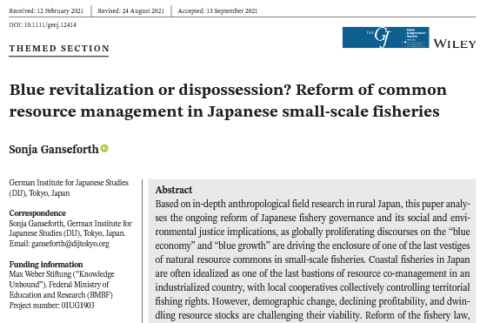
A new, open-access article by DIJ principal researcher Sonja Ganseforth investigating the ongoing reform of Japanese fishery governance and its social and environmental implications has just been published in The Geographical Journal (online first). “Blue revitalization or dispossession? Reform of common resource management in Japanese small-scale fisheries” analyses the growth-oriented reform which challenges successful resource co-management in small-scale fisheries by opening up coastal fishery resources to corporate investors and strengthening top-down regulation. Its analysis offers deeper insights into the transformative as well as dispossessive potential of the global paradigmatic shift towards an intensified industrial exploitation of the oceans against the background of globally proliferating discourses on “blue growth” and the “blue economy”. The article is based on in-depth anthropological field research in rural Japan and an outcome of Sonja’s research project Fishing communities between growth and demise.
New DIJ Monograph compares wartime photography in Germany and Japan
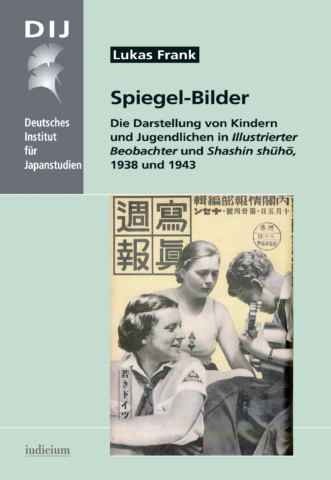
Spiegel-Bilder. Die Darstellung von Kindern und Jugendlichen in Illustrierter Beobachter und Shashin shūhō, 1938 und 1943 by Lukas Frank is the latest addition to our DIJ Monograph Series. Frank’s book compares patterns of pictorial representations of children and youth in German and Japanese press photography of the late 1930s and early 1940s on the basis of two important illustrated magazines of the time: the Illustrierter Beobachter and Shashin shūhō (写真週報, Photographic Weekly). The study shows similarities and differences of pictorial propaganda in both countries, explains general trends in the design of propaganda, and analyses the organisation and function of propaganda in radical nationalist states. Connections between German and Japanese photography and their influences on the pictorial propaganda of the magazines are also addressed, as are representations of Germany on the Japanese side and of Japan on the German side. Details
Autumn issue of DIJ Newsletter published
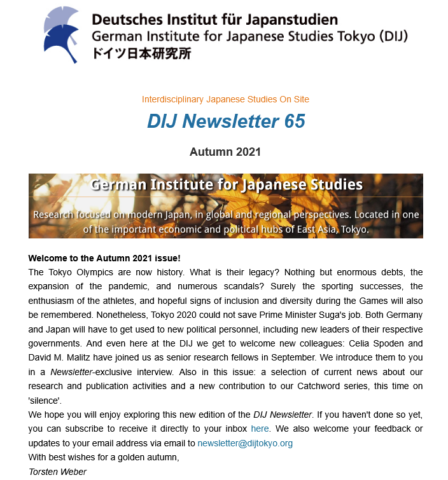
We have just published the autumn issue of our DIJ Newsletter featuring updates on our research, publications, and events, including three upcoming Web Forum sessions on Digital Transformation; two CfP for a workshop on health infrastructures and a conference on sustainable societies; new book publications by our researchers Barbara Geilhorn, Sonja Ganseforth and our alumnus Hanno Jentzsch; an interview with our new senior research fellows Celia Spoden and David M. Malitz; a new contribution to our Catchword series; and much more. We hope you will enjoy exploring this new edition of the DIJ Newsletter. If you haven’t done so yet, you can subscribe to receive it directly to your inbox. The full issue and subscription form are available here.
New edited volume explores work of theatre maker Okada Toshiki

Playwright, novelist and theatre director Okada Toshiki is one of the most prominent voices of the current generation of Japanese contemporary theatre makers. His plays, which have been staged at theatre festivals all over the world, address issues such as social inequity, life in Japan after the 3.11 triple disaster, and post-human society. Okada Toshiki & Japanese Theatre (Performance Research Books, 2021), co-edited by DIJ researcher Barbara Geilhorn, Peter Eckersall, Andreas Regelsberger, and Cody Poulton, explores Okada’s work and its importance to the development of contemporary performance in Japan and around the world. For the first time in English it gathers a comprehensive selection of essays, interviews, and translations of three of Okada’s plays. In addressing the work of Okada Toshiki from an interdisciplinary perspective, the book provides an in-depth analysis of an outstanding Japanese artist and contributes to a better understanding of art and society in contemporary Japan. More information here
New issue 33(2) of Contemporary Japan published
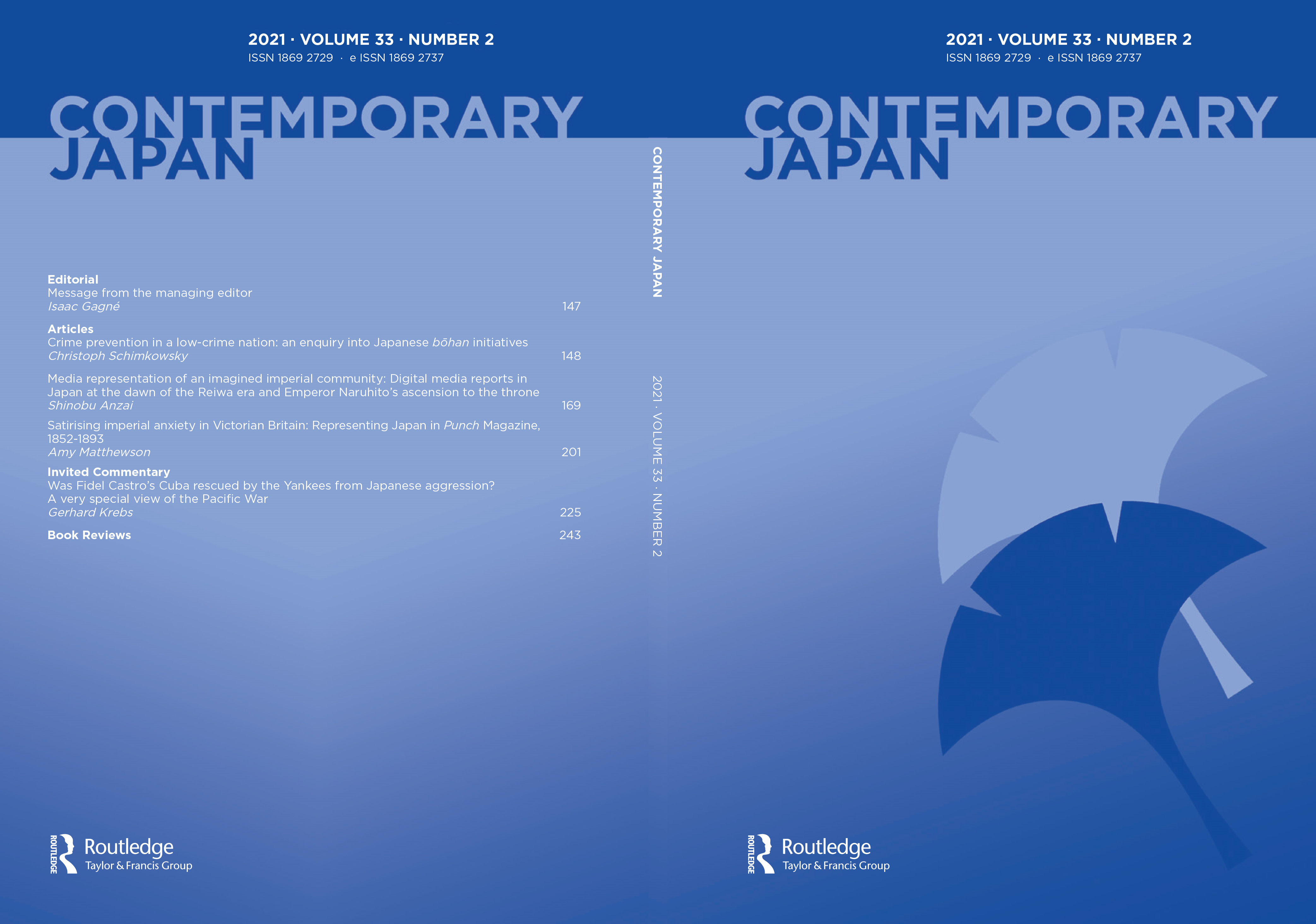
The latest issue of Contemporary Japan is now available online and in print. It features original research articles exploring: 1) how crime prevention (bōhan) became a widespread concept in low-crime Japan (Schimkowsky); 2) changing media representations of the imperial family from the Meiji era to the dawn of the Reiwa era (Anzai); 3) and a critical discussion of the role of satirical depictions of Japan in Victorian British cartoons (Matthewson). In addition, we continue our Invited Commentary section with the historian Gerhard Krebs’ critical analysis of the argument regarding Imperial Japan’s expansionist ambitions by Gerhard L. Weinberg, whose works have suggested that Japanese imperial ambitions extended as far as the Caribbean. Lastly, our book review section includes a broad range of important publications in the fields of philosophy, history, anthropology, gender studies, food studies, and religious studies. Please see the full issue here
Journal article explores living arrangements of unmarried adults
Staying unmarried and not starting a nuclear family is increasingly common around the globe. At the same time, living arrangements are diversifying. A new journal article by DIJ social scientist Nora Kottmann investigates the relationship worlds of unmarried adults through and in relation to their living arrangements. Based on a qualitative study of unmarried individuals in Tokyo and Kyoto, “Living (alone) together in metropolitan Japan: shifting boundaries of dwelling, relating, and belonging” offers insights into how the emergence of a so-called ‘Hyper-Solo-Society’ in Japan is interwoven with the diversification of living arrangements. By identifying changing perceptions of home and belonging, Nora’s article contributes a new perspective to current global debates on ‘singles’ and their practices of relating and belonging at the intersection of gender, mobility, and space. The article was published online first in Gender, Place & Culture. A Journal of Feminist Geography and can be viewed here
Journal article reviews studies on new venture entrepreneurship
DIJ director Franz Waldenberger and DIJ alumnus Martin Hemmert (Korea University) are authors of a new open access article that systemically reviews studies on new venture entrepreneurship in East Asia. “New venture entrepreneurship and context in East Asia: a systematic literature review” (Asian Business & Management, online first), jointly researched and written with Adam R. Cross, Ying Cheng, Jae‑Jin Kim, Masahiro Kotosaka, and Leven J. Zheng, examines articles published in Social Science Citation Index (SSCI)-listed journals between 2000 and 2020. It finds that the research body is highly unbalanced: most articles are single-country studies focused on China, apply a quantitative methodology, and concentrate on topics such as entrepreneurial strategies and new venture entrepreneurs’ personal attributes and networks. More contextualized research on countries such as Japan and South Korea and on less studied themes such as culture, entrepreneurial financing and teams, new venture internationalization and entrepreneurial intention is desirable. The article is an outcome of the DIJ research project Start-ups in Asia – the role of agglomerations and international linkages.
New edited volume on Locality in Japan
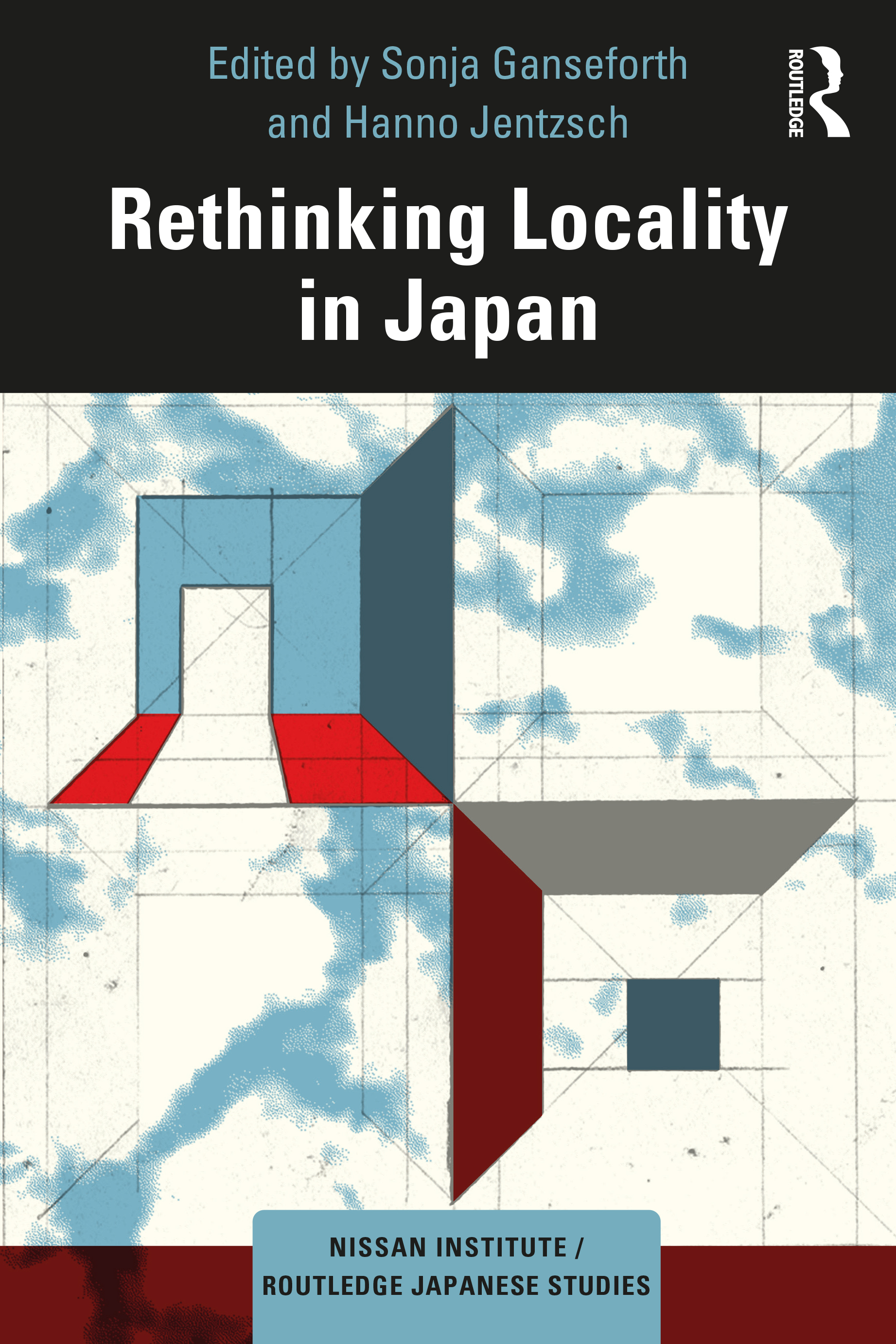
What does it mean when we say “local” and what does “local” mean in the Japanese context? Rethinking Locality in Japan, edited by DIJ researcher Sonja Ganseforth and DIJ alumnus Hanno Jentzsch (Vienna), examines broader political and socio-economic shifts in Japan through the window of locality. It covers demographic change, electoral and administrative reform, rural decline and revitalization, welfare reform, and the growing rift in energy and food production. Chapters discuss the different ways in which locality in Japan has been reconstituted, from historical and contemporary instances of administrative restructuring to more subtle social processes of making and unmaking local places. Contributors include the co-editors Sonja Ganseforth (“Territorialized yet Fluid Locality: Reform, Consolidation, and the More-than-Human in Japanese Fishery Cooperatives”) and Hanno Jentzsch (“San’ya – The Making and Unmaking of a Welfare Quarter”) as well as DIJ researchers Barbara Holthus (“The Meaning of Place for Selfhood and Well-being in Rural Japan”, with Wolfram Manzenreiter) and Isaac Gagné (“Mapping the Local Economy of Care: Social Welfare and Volunteerism in Local Communities”). The volume is an outcome of the DIJ’s research focus The Future of Local Communities in Japan.



 Follow us on Bluesky
Call for Submissions

Contemporary Japan
current issue Vol. 38, No. 1
Contemporary Japan is open year-round for rolling submissions, with accepted publications published immediately online. Please see the instructions for submission here.
DIJ Monograph Series
Our monograph series is  Open Access after a one-year embargo period. Downloads are available on our
→ monographs pages.
Access
DIJ Tokyo
Jochi Kioizaka Bldg. 2F
7-1 Kioicho Chiyoda-ku, Tokyo
102-0094 Japan
Where to find us
+81 (0)3 3222-5077
+81 (0)3 3222-5420
dijtokyo@dijtokyo.org

DIJ-ARI Asian Infrastructures Research Partnership