Veranstaltungen und Aktivitäten
New issue 33(1) of Contemporary Japan published
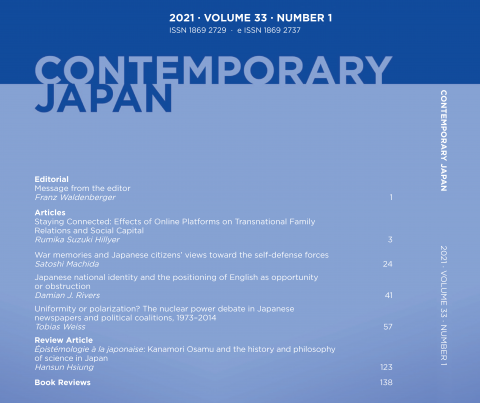
The latest issue of Contemporary Japan is now available online and in print. Articles in CJ 33(1) cover Nikkei Brazilian migrants in Japan and their use of online platforms to stay connected (by Rumika Suzuki Hillyer), war memories and Japanese citizens’ views toward the self-defense forces (by Satoshi Machida), English language education and national identity (by Damian J. Rivers), and the nuclear power debate in Japanese newspapers, 1973–2014 (by Tobias Weiss). This issue also features a Review Article of Kanamori Osamu (金森修) and the history and philosophy of science in Japan by Hansun Hsiung. Plus: three reviews of recently published books on the Soka Gakkai, the anime boom in the United States, and professional baseball in modern Japan. Please see the full issue here
New DIJ Miscellanea Double Debt Disaster
 Double Debt Disaster by Julius Weitzdörfer and S.J. Beard is latest volume published in our DIJ Miscellanea series. It offers a detailed examination of obstacles to recovery from catastrophes caused by the concurrence of pre-disaster obligations with post-disaster capital needs and the destruction of collateral assets. The convergence of growing risk from natural hazards, coupled with ever-higher levels of public and private indebtedness will soon propel the quest for micro-and macro-economic policy solutions to global attention. No case is more instructive for understanding these problems than the Great East Japan Earthquake. In its wake came a second disaster, as former home-owners and businesspeople found themselves in need of loans to rebuild and invest, while being unable to pay off pre-disaster debts. Treating issues of property-, insurance-, debtor-creditor-, social welfare-, charity-, financial-, and insolvency law, this volume examines Japan’s double debt disaster from the perspective of social justice and disaster recovery. It proposes that policymakers take sustainable steps to avoid socioeconomic disasters. More details and link to download the PDF here.
New book chapter by Barbara Geilhorn on post-3.11 plays
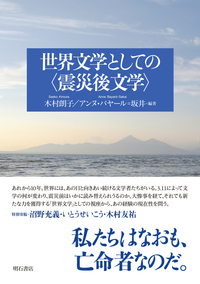
DIJ research fellow Barbara Geilhorn has contributed the chapter “Genjitsu wo henyō saseru fikushon. Okada Toshiki no engeki kara kore kara no nihon shakai wo yomitoku” (Fiction that transforms reality: understanding the future of Japanese society through the plays of Toshiki Okada) to a new book publication on post-3.11 literature. Barbara’s chapter in Sekai bungaku toshite no ‘shinsaigo bungaku’ (‘Post-disaster literature’ as world literature) discloses the political potentialities of theatrical space through an in-depth evaluation of two post-‘Fukushima’ plays by Okada Toshiki, who gained reputation for his socially engaged theatre. While Unable to See (2012) is a harsh satire, written for a foreign audience, Current Location (Genzaichi, 2012) addresses the fear of nuclear threat from the perspective of Tokyo inhabitants as science fiction. The chapter scrutinizes the significance of Okada’s recent concept of fiction as ‘recessive reality’ and argues for a major turning point in his work as triggered by the catastrophe. Barbara’s chapter is a result of her ongoing research project Local Issues Take Stage – Culture and Community Revitalization.
New DIJ Working Paper on social movements in post-3.11 Japan
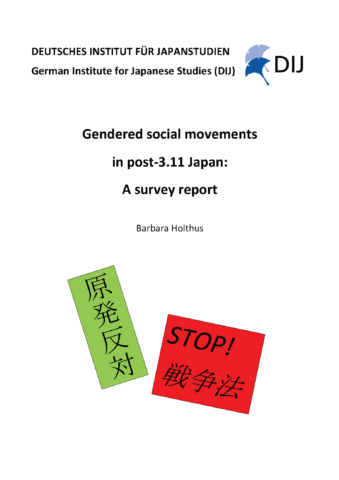 In the post-3.11 decade, Japan has seen at least two peaks in social movements: anti-nuclear protests in the year following the triple disaster of 2011 and a second one in 2015 in response to the Diet passing the National Security Act legislation. Together they mark the largest protest wave Japan has seen since the 1970s. In her latest DIJ Working Paper, deputy director Barbara Holthus introduces the findings of a large-scale survey undertaken in 2017 with close to 80,000 participants in the larger Tokyo metropolitan area. Questions focus on understanding who was sympathetic to the 3.11 movement, who was mobilized, and who participated in the protests. The goal was to understand what distinguishes the participants from the non-participants and to understand the role values and political views play in this. Gendered social movements in post-3.11 Japan: A survey report is the first English-language publication to present an overview of the data that was originally published in Japanese in 3.11go no shakai undō: 8mannin no dēta kara wakatta koto (eds. Naoto Higuchi & Mitsuru Matsutani) in 2020. This publication is part of Barbara’s ongoing research project Social movements and gender in post-3.11 Japan.
New book chapter on Japanese occupation of China

DIJ historian Torsten Weber has contributed a chapter on Chinese Asia discourse to the sourcebook Translating the Occupation. The Japanese Invasion of China, 1931–45, published by the University of British Columbia Press in February 2021 and edited by Jonathan Henshaw, Craig A. Smith, and Norman Smith. It is the first English-language volume to provide a diverse selection of important primary sources on Japan’s occupation of China translated from Chinese, Japanese, and Korean. Torsten’s chapter “Finding China’s ‘Asia’ in Japanese Asianism” studies how Chinese elites in the pro-Japanese Reorganized National Government (1940-45) tried to find a balance between cooperation and resistance to Japan by appropriating Japanese Asianist rhetoric of a ‘New Order in East Asia’ and an ‘East Asian League’. This chapter draws on his earlier research on Japanese and Chinese Asianism and his monograph Embracing ‘Asia’ in China and Japan. Asianism Discourse and the Contest for Hegemony (Palgrave 2018).
Blog posts introduce survey on unmarried adults in Japan
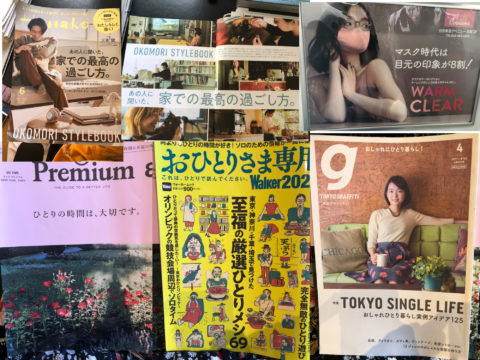
Being single is an increasingly common experience for Japanese adults. Not only has the average age at first marriage risen continuously over the last decades, so too has the rate of permanent singlehood. Research on the unmarried is therefore critical to an understanding of contemporary Japanese society. DIJ social scientist Nora Kottmann and Laura Dales (University of Western Australia) are currently conducting a survey that aims to better understand how the lives and relationship worlds of unmarried adults (‘singles’) have been affected by the ongoing COVID-19 Coronavirus pandemic and how this might affect future practices and perceptions of the increasing numbers of ‘singles’ in Japan (and beyond). Both researchers introduce this survey in their recent co-authored blog posts ‘Solo-camping and solo-hotpots: Rethinking practices and perceptions of singlehood in Japan in COVID-time’ and ‘Looking to capture practices of intimacy in times of social distancing: Mixed-methods research on singles in Japan’. Updates will be published on the project’s webpage.
Free access to highlight article from Asian Business & Management
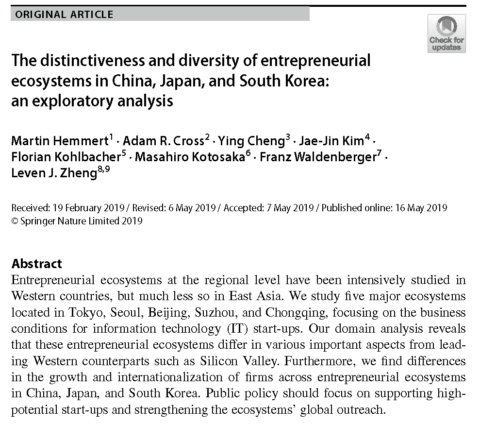
An article co-authored by DIJ director Franz Waldenberger was selected by Palgrave Macmillan and the editorial team of the Asian Business & Management journal as best content and can now be accessed for free. The original article “The distinctiveness and diversity of entrepreneurial ecosystems in China, Japan, and South Korea: an exploratory analysis” by DIJ alumni Martin Hemmert and Florian Kohlbacher, Adam R. Cross, Ying Cheng, Jae‑Jin Kim, Masahiro Kotosaka, Franz Waldenberger, and Leven J. Zheng studies five major ecosystems located in Tokyo, Seoul, Beijing, Suzhou, and Chongqing. It focuses on the business conditions for information technology (IT) start-ups and reveals that these entrepreneurial ecosystems differ in various important aspects from leading Western counterparts, including in the growth and internationalization. It concludes that public policy should focus on supporting high-potential start-ups and strengthening the ecosystems’ global outreach. The article is an outcome of the DIJ research project Start-ups in Asia – the role of agglomerations and international linkages and can be accessed here.
New working paper on ‘Unconventional Monetary Policy’
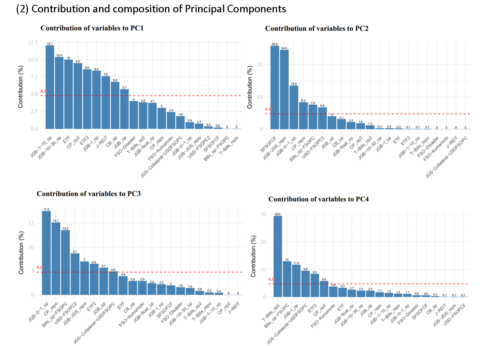
A new working paper, co-authored by Senior Research Fellow Markus Heckel and Kiyohiko G. Nishimura (Graduate Institute for Policy Studies GRIPS/Center for Advanced Research in Finance CARF, University of Tokyo) examines the unconventional monetary policies of the Bank of Japan from 2002 to 2019 with a focus on open market operations. The CARF working paper Unconventional Monetary Policy through Open Market Operations: A Principal Component Analysis applies a principal component analysis to investigate the complexity of the operations. The authors find that four principal components (PCs) explain most of the variance of the Bank of Japan’s operations of various facilities and measures. They also observe that open market operations of the Shirakawa era (2008-2013) were the most complex, resulting in an increased number of PCs. In contrast, the corresponding number in the other eras has been at most two (Fukui, 2003-2008) and four (Kuroda, 2013-present). This paper is a result of Markus’ research project Economic Discourses of Monetary Policy – The Case of the Bank of Japan.
Sustainability-Blog

Lesen Sie die neuesten Artikel unseres DIJ-Blogs Sustainability in Japan and Beyond

 Follow us on Bluesky
Institutsbroschüre
Einblicke in unser Institut und seine Aktivitäten bietet unsere aktuelle DIJ Broschüre (Stand 4/2025)
Call for Submissions

Contemporary Japan
Aktuelle Ausgabe Vol. 38, Nr. 2
Contemporary Japan akzeptiert Einsendungen ganzjährig ohne Abgabefrist. Zur Veröffentlichung angenommene Artikel werden umgehend online publiziert. Weitere Details finden Sie hier.
DIJ Monographienreihe
Unsere Monographien sind nach einem einjährigen Embargo  Open Access und können hier heruntergeladen werden:
→ DIJ Monographien
Wegbeschreibung
DIJ Tokyo
Jochi Kioizaka Bldg. 2F
7-1 Kioicho Chiyoda-ku, Tokyo
102-0094 Japan
Wegbeschreibung
+81 (0)3 3222-5077
+81 (0)3 3222-5420
dijtokyo@dijtokyo.org

DIJ-ARI Asian Infrastructures Research Partnership