Veranstaltungen und Aktivitäten
New book publications analyse digital transformation of financial system
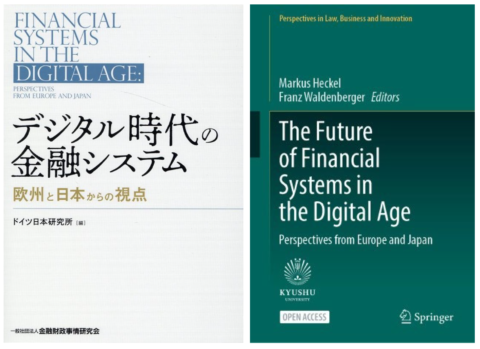
The increasing capacity of digital networks and computing power, together with the resulting connectivity and availability of “big data”, are impacting financial systems worldwide. They transform the structure and performance of financial markets and the business models of banks and other financial service providers. The new open access book The Future of Financial Systems in the Digital Age: Perspectives from Europe and Japan, edited by DIJ director Franz Waldenberger and principal researcher Markus Heckel, brings together leading scholars, policymakers, and regulators from Japan and Europe to analyse the digital transformation of the financial system. The authors study the impact of digitalization on the financial system, including transaction costs, digital and blockchain-based currency systems, algorithmic trading, the use of cashless payments, the challenges of regulatory oversight, and the transformation of banking business models. The book and its individual chapters can be downloaded for free here. A Japanese version of the book has been published as デジタル時代の金融システム―欧州と日本からの視点 by the Kinzai Institute for Financial Affairs.
Article co-authored by Markus Heckel investigates the complexity of monetary policy
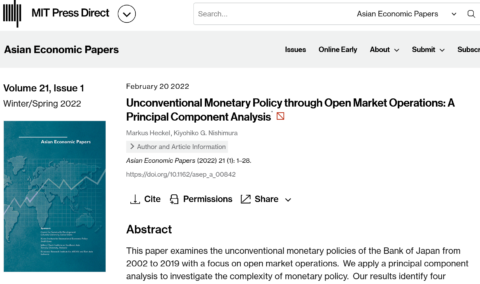
A new article co-authored by DIJ economist Markus Heckel and Kiyohiko G. Nishimura (GRIPS) examines the unconventional monetary policies of the Bank of Japan from 2002 to 2019 with a focus on open market operations. “Unconventional Monetary Policy through Open Market Operations: A Principal Component Analysis” (Asian Economic Papers, 21 (1), pp. 1–28) identifies four principal components that explain the variance of measures taken by the Bank of Japan and its operations of various facilities: asset purchase measures including Japanese Government Bonds (JGBs), Exchange-Traded Funds (ETFs), Japanese Real Estate Investment Trusts (J-REITs), and three different liquidity supply measures. Complexity differs substantially among different governorships of Fukui, Shirakawa (most complex), and Kuroda. The article is an outcome of Markus’ research project Economic Discourses of Monetary Policy – The Case of the Bank of Japan.
Open access article by Harald Kümmerle studies data practices in Japan
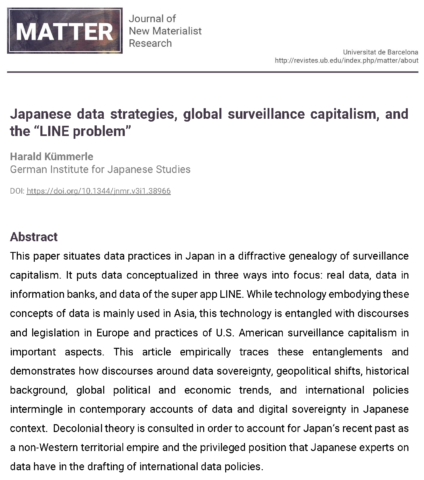 A new, open access article by DIJ senior research fellow Harald Kümmerle studies how data practices in Japan are linked to global surveillance capitalism. “Japanese data strategies, global surveillance capitalism, and the ‘LINE problem'”, published in the special issue on prospects for a new materialist informatics of Matter. Journal of New Materialist Research (Vol. 3, No.1, pp. 134-160), focuses on data conceptualized in three ways: real data, data in information banks, and data of the super app LINE. While technology embodying these concepts of data is mainly used in Asia, this technology is entangled with discourses and legislation in Europe and practices of U.S. American surveillance capitalism. The article demonstrates how discourses around data sovereignty, geopolitical shifts, historical background, global political and economic trends, and international policies intermingle in contemporary accounts of data and digital sovereignty in Japan. It is an outcome of Harald’s research project The discourse on the digital transformation in Japan: an analysis based on the concept of data.
Environmental Humanities talk on ‘Cultural Specificity and Planetary Thinking’
 Ishimure Michiko is best known for her writing on mercury poisoning of the Shiranui Sea in and around Minamata in Southern Japan. Yet, in her later years she became increasingly invested in the concept of the planetary. In this talk, we will examine this shift in her writing and the complicated role that cultural forms play in writing that is especially invested in planetary health. Marran will introduce the concept of the “biotrope” as a tool for analyzing Ishimure’s attention to cultural and material elements in the discussion of Ishimure’s final work “Hana no okudo e” (2014). We will conclude our discussion by addressing the ways that area studies may or may not be compatible with particular forms of ecocriticism. This talk is part of the DIJ Environmental Humanities in East Asia lecture series and takes place online on May 25. Details and registration here
Speaker:
Christine L. Marran, University of Minnesota
DIJ Method Talk on Critical Discourse Analysis and the politics of reproduction

With ongoing attempts since the early 1990s to elevate the low birth rate in Japan, the politics of reproduction are a highly contested realm in Japanese society. While policy makers’ attempts to influence reproductive behavior on an individual level have been scrutinized in diverse analyses, the role of the biomedical business and mass media has been mostly overlooked. Isabel Fassbender addresses this lacuna in her recent publication Active Pursuit of Pregnancy: Neoliberalism, Postfeminism and the Politics of Reproduction in Contemporary Japan (Brill, 2021) by using Critical Discourse Analysis on the “active pursuit of pregnancy” (ninkatsu). In her talk, Isabel will not only focus on Critical Discourse Analysis as a research method in theory but also try to show a possible practical implementation by presenting concrete examples from her work. Details and registration here
Speaker:
Isabel Fassbender, Doshisha Women’s College, Kyoto
Online panel discussion of East and Southeast Asian responses to the Russian War on Ukraine
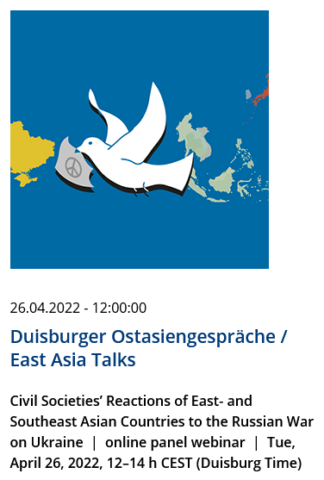
The Russian invasion of Ukraine and the US- and EU-led response to it are watershed events in global affairs with far-reaching political and economic implications for East and Southeast Asian stability. Governments in these regions have largely sided with the USA and the EU in the General Assembly of the United Nations; however, due to historically rooted and strategic reasons, most Southeast Asian governments did not join their efforts in sanctioning Russia. This online panel discussion will provide a critical assessment of the responses of countries across East and Southeast Asia. It features panelists Hee Kyoung Chang (Korea), Kasira Cheeppensook (ASEAN), Manuel R. Enverga III (Philippines), DIJ researcher David M. Malitz (Japan), Surachanee Sriyai (Thailand), Patrick Ziegenhain (Indonesia) as well as Claudia Derichs (moderation) and welcome remarks by DIJ director Franz Waldenberger and Nele Noesselt (director, IN-EAST). The panel is jointly organised by the Institute of East Asian Studies at the University of Duisburg-Essen (IN-EAST), the DIJ, the Chair of Transregional Southeast Asian Studies at Humboldt University Berlin, and the Faculty of Political Science, Chulalongkorn University, Bangkok. It takes place on Tuesday, April 26, 19-21h JST. Details and registration here
Joint DIJ-NUS Workshop explores Health Infrastructure in Asia
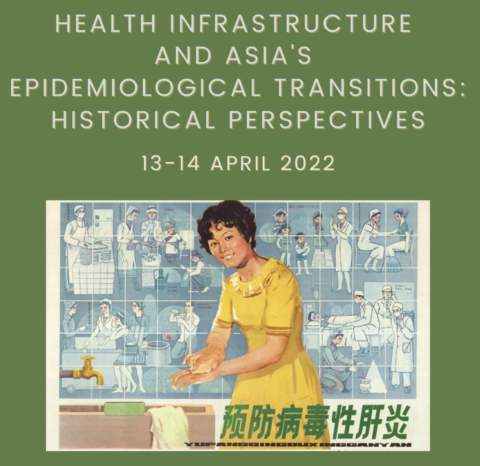
Jointly organised by the Asia Research Institute (National University of Singapore) and the DIJ, the workshop “Health Infrastructure and Asia’s Epidemiological Transitions: Historical Perspectives” will investigate Asian experiences in crafting health infrastructure over the long twentieth century. Asia has long been stigmatized as a source of global contagion, yet there has been relatively little historical examination of the everyday health challenges there, such as epidemiological transitions, climate change, and extensive internal and international migration. The workshop brings together scholars with different geographic foci within Asia to engage in a comparative and connective dialogue. It seeks to produce new ways of understanding the dynamics of health and disease under the processes of decolonization and development, but also with an eye to drawing lessons from the past that could lead to formulating better health policies in the present. The workshop takes place online on April 13-14 and is co-convened by DIJ’s David M. Malitz. Details and registration information here
Celia Spoden gives talk on cybernetic avatars and inclusive society at AI conference

DIJ social scientist Celia Spoden will present her latest research on “Cybernetic avatars and the vision of an inclusive society” at the Japanese-German conference Artificial Intelligence and the Human: Cross-Cultural Perspectives on Science and Fiction (May 11-13). In her presentation, Celia focuses on the avatar technology OriHime which aims to counteract people’s loneliness and create new forms of social participation. Celia analyses how technologies such as the OriHime can make physical limitations less significant in cyber-physical spaces. In her paper she examines the cultural backgrounds as well as the social and ethical implications of this new technology. The conference takes place in Berlin and is jointly organised by the Alexander von Humboldt Institute for Internet and Society, the Japanese-German Center Berlin, and Waseda University.

Sustainability-Blog

Lesen Sie die neuesten Artikel unseres DIJ-Blogs Sustainability in Japan and Beyond

 Follow us on Bluesky
Institutsbroschüre
Einblicke in unser Institut und seine Aktivitäten bietet unsere aktuelle DIJ Broschüre (Stand 4/2025)
Call for Submissions

Contemporary Japan
Aktuelle Ausgabe Vol. 38, Nr. 2
Contemporary Japan akzeptiert Einsendungen ganzjährig ohne Abgabefrist. Zur Veröffentlichung angenommene Artikel werden umgehend online publiziert. Weitere Details finden Sie hier.
DIJ Monographienreihe
Unsere Monographien sind nach einem einjährigen Embargo  Open Access und können hier heruntergeladen werden:
→ DIJ Monographien
Wegbeschreibung
DIJ Tokyo
Jochi Kioizaka Bldg. 2F
7-1 Kioicho Chiyoda-ku, Tokyo
102-0094 Japan
Wegbeschreibung
+81 (0)3 3222-5077
+81 (0)3 3222-5420
dijtokyo@dijtokyo.org

DIJ-ARI Asian Infrastructures Research Partnership